flowchart LR
    U["University /<br/>public laboratory"]
    F["Incumbent firm<br/>in the industry"]
    C["Use context<br/>(unmet need)"]
    S["Scientific knowledge<br/>codified, novel, patentable"]
    K["Commercial knowledge<br/>customers, channels, regulators"]
    N["Need knowledge<br/>problem definition"]
    V["Venture knowledge profile"]
    H["Inherited practices<br/>and culture"]
    U --> S
    F --> K
    C --> N
    S --> V
    K --> V
    N --> V
    F -.-> H
    H -.-> V
29 Entrepreneurship and New Ventures
The preceding chapter treated entry as something firms do: an established organization decides when to bring a product into a category and how to defend the position it takes. But a large share of entry is performed by organizations that did not exist before the entry decision was made. The founding of a firm is simultaneously an entry decision, a resource-assembly decision, and a positioning decision, and it is made by people whose knowledge was accumulated somewhere else—in a university laboratory, in an incumbent’s product division, or in the course of using a product and finding it inadequate.
This chapter develops the resulting research program. Its organizing claim is that the origin of a founder’s knowledge is a strategically consequential variable, and that it predicts not merely how well a venture performs but what kind of economic value the venture is able to capture at all. A venture founded on scientific knowledge and a venture founded on industry knowledge are not two draws from the same distribution with different means; they are firms solving different problems, transacting in different markets, and failing in different ways. Treating founder origin as a control variable in a performance regression discards exactly the variation that matters.
We proceed in four movements. Section 29.1 establishes the knowledge-origins taxonomy and the evidence that founders carry more than human capital out of their prior organization. Section 29.2 defines modes of value capture and develops the chapter’s central result: the correspondence between where knowledge came from and which market a venture monetizes in. Section 29.3 formalizes that correspondence and shows why the interesting founders are the ones who fit neither category. Section 29.4 and Section 29.5 then turn to founding-team composition and to the evaluation problem ventures face when they seek resources from investors, regulators, and employees. Section 29.7 closes with what marketing has to contribute to a literature that has so far been written almost entirely without customers in it.
A methodological thread runs underneath. Much of the best work here is descriptive: it maps a pattern rather than estimating a treatment effect. That is a deliberate design choice with its own standards of rigor, and it is treated as a craft problem in Section 75.3.
29.1 Where Ventures Come From: The Knowledge-Origins View
The foundational move in this literature is to stop treating “entrepreneur” as a homogeneous category. Agarwal and Shah (2014) organize firm formation around three distinct knowledge sources, each associated with a different pre-founding context.
Academic entrepreneurs commercialize knowledge generated in scientific research, typically at universities or public laboratories. Their knowledge is codified, novel, and often protected by patents assigned to or licensed from the parent institution. It is deep on the technical dimension and thin on everything downstream: who the customer is, what the distribution channel looks like, how a regulator will react.
Employee entrepreneurs (also called spinouts) leave an incumbent firm in the same or an adjacent industry. Their knowledge is the mirror image: rich in customer requirements, supplier relationships, pricing norms, and the tacit operating detail of an industry, but bounded by the technological trajectory the parent was already on.
User entrepreneurs found firms on knowledge generated by using a product and encountering an unmet need. Their knowledge is neither scientific nor producer-side; it is need knowledge, and it explains why user-founded firms cluster in categories where the need is legible to those who experience it and invisible to those who do not.
The taxonomy matters because it predicts different founding rates, different entry timing relative to industry emergence, and different survival profiles. The evidence that founders carry organizational content, and not merely skill, out of the parent is by now substantial.
Zucker, Darby, and Armstrong (2002) supply the original demonstration on the academic side. Studying biotechnology, they show that firm performance is tied to the capture of university science by identifiable star scientists working with the firm, not to proximity to universities in the abstract. Knowledge moved with people, and the firms that got the people got the performance.
Feldman, Ozcan, and Reichstein (2019) extend the claim from knowledge to practice. Using survey and registrar data on spawns and their parents, they find that organizational practices transfer from parent to spinout: the overlap in practices between a spawn and its parent is roughly ten percent greater than between the spawn and other established firms, and about seventy percent of comparisons show start-ups to be less similar to unrelated organizations than parents are to their spawns. Crucially, transfer is selective. The practices that travel are the ones that fit a start-up’s requirements and are clearly defined and causally unambiguous. Heritage is not wholesale replication; it is a filtered inheritance.
Ahn and Greve (2025) push the same logic into culture. Linking Crunchbase start-ups to natural-language measures of culture derived from Glassdoor reviews, they show that founders transmit cultural elements from the parent organization, and that transmission is stronger when the founder’s tenure at the parent was longer, when the parent’s culture was internally coherent, and when it was atypical relative to other organizations. The contingencies are the contribution: an incoherent parent culture supplies no transmissible toolkit, and a generic one supplies nothing distinguishable.
Finally, the pathway into founding is itself structured by employment. Law et al. (2025) follow more than eight thousand individuals through the Venture For America program and find that working as a start-up employee raises the likelihood of later founding—and that this joiner-to-founder effect is markedly stronger for Black women than for other demographic groups. Their qualitative evidence points to self-reflection prompted by the start-up employment experience as a mechanism. The result is a reminder that the supply of founders is not exogenous to the organizations that employ them.
Figure 29.1 summarizes the pathway from prior context to venture.
29.1.1 What makes founding salient
Origin explains what a founder brings. It does not explain when the decision to found gets made, and the trigger turns out to be partly a marketing artifact. Huang et al. (2026) study entry onto a large Chinese e-commerce marketplace and find that individuals are more likely to open an online store after observing the salient success of a nearby one. The source of variation is the platform’s own store rating system: when a local store’s rating is upgraded, new store entries in the vicinity rise significantly. The effect decays with physical distance and strengthens with the salience of the upgrade—the two gradients a salience account predicts, and the reason the result is not simply local demand information diffusing.
The second half of the paper is what makes it worth teaching. The entries induced by a local upgrade event are worse: they underperform in sales and are more likely to exit, and the excess exit concentrates in downturns in overall market conditions. That asymmetry is the discriminating test. If a neighbor’s rating upgrade revealed genuine unexploited local demand, entrants responding to it should do at least as well as other entrants; that they systematically do worse is consistent instead with salience-based decision making, in which highly visible local information is overweighted relative to its actual diagnosticity (Bordalo, Gennaioli, and Shleifer 2013)—the same primitive that a salience nudge perturbs (Section 19.1).
Two implications follow for marketing. First, on the supply side of entry: the entry-order literature in Chapter 28 takes the set of entrants as given and asks who moves when, but the composition of that set is being set in part by which local successes happen to be visible, and visibility is manufactured by a rating system. Second, on platform design: a ratings mechanism built to solve a buyer-side information problem also functions as an entry-inducement device on the seller side, and it induces the marginal entrant least equipped to survive a downturn. That is an externality of the design, not of the market, and it belongs with the other realized externalities of platform structure in Section 69.7.1.
29.2 Modes of Economic Value Capture
The knowledge-origins taxonomy becomes strategically interesting only when it is connected to an outcome that is categorical rather than scalar. That outcome is the mode of value capture.
Definition: modes of economic value capture
A venture founded on a technological opportunity may realize economic value in one of two markets. In the market for technology it monetizes the technology itself—licensing, selling patents, being acquired for its intellectual property, or entering a research collaboration in which a partner commercializes the output. In the market for product it monetizes an artifact sold to end users, which requires assembling the complementary assets that production, distribution, regulatory clearance, and after-sales service demand.
A third possibility, no value capture, is not a residual category but a substantive outcome: many ventures founded on genuine technological opportunities never transact in either market. Any study that conditions on having captured value selects on the dependent variable.
The distinction descends from a long line of work on the appropriability of innovation, but its use as a dependent variable in its own right is more recent. Moeen and Agarwal (2017) study the incubation stage of an industry—the interval between a technological breakthrough and the first commercialization of it—in agricultural biotechnology, and deliberately report what they call stylized findings rather than tests of hypotheses. Among them: knowledge evolution precedes product evolution in an industry’s life cycle; the firms investing during incubation are heterogeneous in type; and different types converge on different modes of value capture. Incumbents of the obsolescing industry tend to become acquisition targets, science-based start-ups tend toward alliances and acquisitions, and diversifying firms tend toward product commercialization. Their managerial takeaway is the methodological one restated: success and failure must be measured against multiple yardsticks, not against product commercialization alone.
Moeen, Agarwal, and Shah (2020) extend the incubation program by asking how firms reduce uncertainty across industry milestones, and Agarwal et al. (2025) synthesize the resulting body of work into an account of industry creation as the joint product of heterogeneous actors. Together these establish the setting in which the chapter’s centerpiece operates.
29.2.1 Founder knowledge and the mode of capture
Moeen (2026) asks the question the incubation literature had set up but not answered at the level of the individual venture: given that value can be captured in either market, which founders end up in which?
The design separates founders by prior employment context—academic scientists versus former employees of within-industry firms—and observes the mode of value capture in a population of U.S. medical device start-ups. The setting is chosen well. Medical devices leave an institutional paper trail on both sides of the distinction: intellectual-property transactions on the technology side, and FDA clearance and marketing authorization on the product side. The dependent variable is therefore classified by regulators and registries rather than by the researcher.
Three findings follow, and their structure repays study.
- Academic start-ups tend to capture value in markets for technology. The scientific knowledge that founded them is precisely the asset a technology market prices, and it is not sufficient for the complementary-asset assembly that product markets demand.
- Within-industry employee start-ups tend to capture value in markets for product. Their commercial knowledge is what product commercialization requires, and it is not the novel scientific content a technology market pays for.
- Founders whose history bridges the two dimensions shift toward pioneering products. Academics with industry experience, and employees with scientific training, do not simply split the difference between the two modes. They move to a third outcome that neither pure profile reaches.
The third finding is what converts the study from a stereotype into a mechanism claim, and the next section explains why.
29.3 A Formal Sketch: Why Bridging Founders Pioneer
The three findings above have a compact formal representation that makes the role of the bridging case transparent. Let a founding team be summarized by a knowledge profile \[ \mathbf{k} \;=\; (\sigma, \kappa), \qquad \sigma \ge 0,\ \kappa \ge 0, \] where \(\sigma\) is depth of scientific knowledge and \(\kappa\) is depth of commercial knowledge about the focal industry. Origin enters only through the distribution from which \(\mathbf{k}\) is drawn: academic founders draw high \(\sigma\) and low \(\kappa\), within-industry employee founders the reverse.
Suppose the venture chooses among three modes. Licensing into the market for technology yields a payoff increasing in scientific depth alone; selling a conventional product into an established category yields a payoff increasing in commercial depth alone; and pioneering a product—one that is both technically novel and successfully commercialized—requires the two knowledge types as complements:
\[ \begin{aligned} V_T(\mathbf{k}) &= \alpha\,\sigma - f_T + \varepsilon_T, \\ V_P(\mathbf{k}) &= \beta\,\kappa - f_P + \varepsilon_P, \\ V_N(\mathbf{k}) &= \lambda\,\sigma\kappa - f_N + \varepsilon_N, \end{aligned} \tag{29.1}\]
with \(f_T < f_P < f_N\) the fixed costs of operating in each mode and \(\varepsilon_m\) an idiosyncratic venture-specific shock capturing everything the knowledge profile does not determine. The mode is chosen as \[ m^{*}(\mathbf{k}) \;=\; \arg\max_{m \in \{T,\,P,\,N,\,\varnothing\}}\ V_m(\mathbf{k}), \tag{29.2}\] where \(\varnothing\) denotes no value capture and yields zero. Because the shocks are non-degenerate, the model predicts tendencies rather than deterministic sorting—which is the form the empirical claim takes as well.
The structural content of Equation 29.1 is the contrast between additive and multiplicative aggregation in the systematic part of the payoff. \(V_T\) and \(V_P\) are each linear in one coordinate and flat in the other, so each is maximized along an axis of the knowledge plane. \(V_N\) is multiplicative, so it vanishes whenever either coordinate is near zero and can only dominate in the interior. Three consequences follow immediately, and they are the paper’s three findings.
- A profile with high \(\sigma\) and \(\kappa \approx 0\) has \(V_N \approx 0\), so the technology market wins. Academic founding maps to markets for technology.
- A profile with high \(\kappa\) and \(\sigma \approx 0\) likewise has \(V_N \approx 0\), so the product market wins. Employee founding maps to markets for product.
- A profile bounded away from both axes can have \(\lambda\sigma\kappa\) exceed both linear terms even when neither coordinate is individually extreme. Bridging founders pioneer.
The pioneering region is therefore not a blend of the other two; it is a region of the knowledge plane that neither pure profile can reach, because reaching it requires a product of coordinates rather than a sum. This is the formal sense in which the bridging cell identifies the mechanism: if mode of capture were driven by credential—university versus firm—the bridgers would follow their institution. Because they instead follow their knowledge profile into a third mode, the operative variable is the profile.
The following simulation makes the partition concrete. It draws founders from two origin distributions, applies Equation 29.2, and cross-tabulates origin against realized mode.
Code
suppressPackageStartupMessages({library(dplyr); library(ggplot2)})
set.seed(20260811)

# Payoff parameters: complementarity lambda, mode-specific fixed costs,
# and the scale of the idiosyncratic shock.
alpha <- 1.00; beta <- 1.00; lambda <- 1.20
f_T   <- 0.25; f_P  <- 0.45; f_N    <- 0.70
s_eps <- 0.50

n <- 3000
draw <- function(origin, n) {
  if (origin == "Academic") {
    # deep science, thin commercial knowledge (right tail = industry stints)
    sigma <- rgamma(n, shape = 6.0, rate = 3.0)
    kappa <- rgamma(n, shape = 1.6, rate = 3.0)
  } else {
    # deep commercial knowledge, thin science (right tail = scientific training)
    sigma <- rgamma(n, shape = 1.6, rate = 3.0)
    kappa <- rgamma(n, shape = 6.0, rate = 3.0)
  }
  data.frame(origin = origin, sigma = sigma, kappa = kappa)
}

founders <- rbind(draw("Academic", n), draw("Employee", n)) |>
  mutate(
    V_T  = alpha  * sigma         - f_T + rnorm(dplyr::n(), 0, s_eps),
    V_P  = beta   * kappa         - f_P + rnorm(dplyr::n(), 0, s_eps),
    V_N  = lambda * sigma * kappa - f_N + rnorm(dplyr::n(), 0, s_eps),
    # argmax over the three modes and the outside option (no capture)
    mode = c("None", "Technology", "Product", "Pioneer")[
      max.col(cbind(0, V_T, V_P, V_N), ties.method = "first")
    ],
    # "bridging" = neither coordinate near zero, i.e. the interior of the plane
    bridging = sigma > 1 & kappa > 1
  )

# Mode shares by founder origin
round(prop.table(table(founders$origin, founders$mode), margin = 1), 3)
#>
#>             None Pioneer Product Technology
#>   Academic 0.007   0.141   0.043      0.809
#>   Employee 0.013   0.163   0.733      0.091
The cross-tabulation reproduces the first two findings: academic founders concentrate in the technology mode and employee founders in the product mode. The third finding is a statement about the interior, and is best seen by conditioning on it.
Code
# Among bridging founders only, the pioneering mode becomes the modal outcome
round(prop.table(table(founders$origin[founders$bridging],
                       founders$mode[founders$bridging]), margin = 1), 3)
#>
#>            Pioneer Product Technology
#>   Academic   0.734   0.040      0.226
#>   Employee   0.745   0.142      0.112

cat(sprintf("\nPioneering share, non-bridging founders: %.3f\n",
            mean(founders$mode[!founders$bridging] == "Pioneer")))
#>
#> Pioneering share, non-bridging founders: 0.072
cat(sprintf("Pioneering share, bridging founders    : %.3f\n",
            mean(founders$mode[founders$bridging]  == "Pioneer")))
#> Pioneering share, bridging founders    : 0.739
Conditioning on the interior flips the modal outcome for both origins: among bridging founders, pioneering becomes the majority mode regardless of whether the founder came from a university or a firm. That is the point. The shift toward pioneering is a property of the knowledge profile, not of the founder’s institutional label, and the label is what a credential-based explanation would have to run on. Figure 29.2 plots the resulting partition of the knowledge plane, with the pioneering region visible as a wedge that touches neither axis.
Code
grid <- expand.grid(sigma = seq(0, 3.5, length.out = 260),
                    kappa = seq(0, 3.5, length.out = 260))
grid$mode <- c("None", "Technology", "Product", "Pioneer")[
  max.col(cbind(0,
                alpha  * grid$sigma,
                beta   * grid$kappa,
                lambda * grid$sigma * grid$kappa) -
          cbind(0, f_T, f_P, f_N)[rep(1, nrow(grid)), ],
          ties.method = "first")
]

ggplot() +
  geom_raster(data = grid, aes(sigma, kappa, fill = mode), alpha = 0.55) +
  geom_point(data = dplyr::slice_sample(founders, n = 700),
             aes(sigma, kappa, shape = origin), size = 0.9, alpha = 0.7) +
  scale_fill_manual(values = c(None       = "grey88",
                               Technology = "#9ecae1",
                               Product    = "#a1d99b",
                               Pioneer    = "#fdae6b")) +
  coord_cartesian(xlim = c(0, 3.5), ylim = c(0, 3.5), expand = FALSE) +
  labs(x = expression(paste("Scientific knowledge  ", sigma)),
       y = expression(paste("Commercial knowledge  ", kappa)),
       fill = "Optimal mode", shape = "Founder origin") +
  theme_minimal(base_size = 11)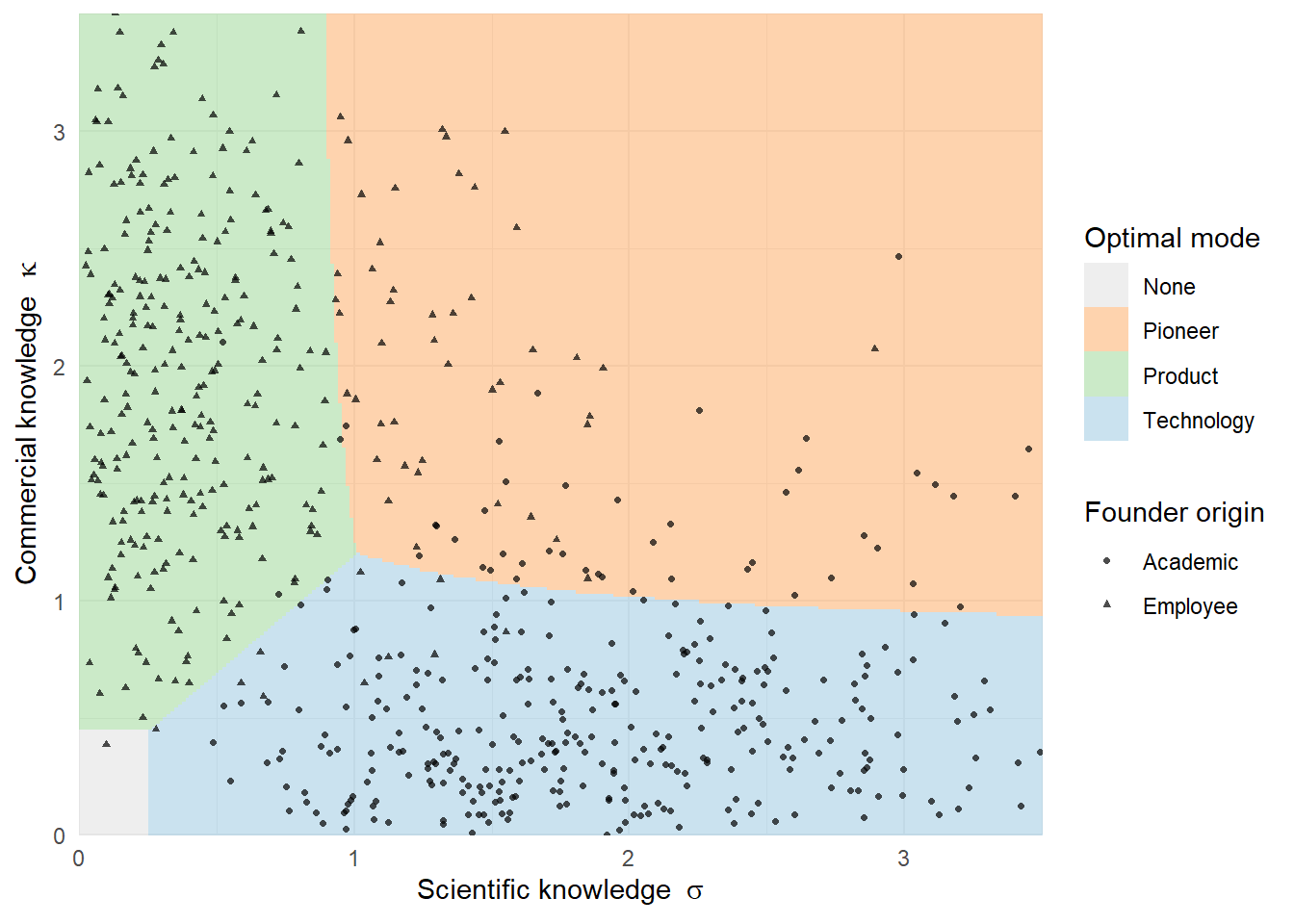
Two cautions about what this exercise does and does not establish. It is a consistency demonstration: it shows that a complementarity in the value-capture technology is sufficient to generate the observed correspondence, not that it is the only mechanism that could. And the empirical claim in Moeen (2026) is a correspondence between origin and mode in observational data, not a treatment effect of origin on mode; founders select into universities and firms for reasons that may independently predict which market they can transact in. The contribution is the map, and the map is what disciplines the causal designs that should follow.
29.3.1 Positioning as a regulatory act
The product-market pathway carries an obstacle the technology-market pathway does not: in regulated categories, clearance precedes revenue. Pahnke, Zuzul, and Howard (2026) study 239 new medical device firms’ 510(k) clearances between 2001 and 2019 and show that how a venture positions its device relative to already-cleared products materially changes time to clearance. For a firm’s first product, clearance is accelerated by citing fewer reference products while positioning against same-category products and category exemplars; for the second product, by referencing the firm’s own cleared device.
This is a positioning problem in the strict marketing sense—choosing a reference set and a claimed similarity—with a regulator rather than a consumer as the audience, and with the optimal strategy changing as the firm accumulates its own precedent. It connects the venture literature directly to the categorization and positioning material developed in Section 10.4, and it supplies a concrete reason why the product mode is costlier than the technology mode in Equation 29.1.
Positioning is not the only lever on clearance time, and the other prominent one is nonmarket. Grandy et al. (2026) build a reputation-based account of how regulators read lobbying under uncertainty. Because an agency is criticized both for approving too fast and for approving too slowly, it uses its discretion over decision time to manage its own reputational exposure, and a firm’s sustained engagement raises or lowers the agency’s confidence that foreseeable risks have been identified and addressed. In FDA medical device approvals from 2002 to 2021, lobbying is associated with faster approval on average. The effect can reverse after a product recall, when the regulator treats the firm’s engagement as misplaced confidence and adds scrutiny, and it strengthens when the firm carries an innovation reputation that makes a prompt approval defensible to outside audiences. For a venture the lesson pairs with the positioning result: the reference set it chooses and the reputation it has accumulated both change how quickly the regulator lets it reach revenue.
29.4 Founding Teams and the Distribution of Outcomes
Founder knowledge is carried by people, and most ventures are founded by more than one. Four recent studies sharpen how team composition maps to outcomes, and the first of them changes what “outcome” should mean.
Agarwal et al. (2026) examine how pre-entry knowledge and post-entry learning shape start-up performance, and report the result as a statement about the distribution rather than the mean. Pre-entry knowledge does not simply shift average performance; it reshapes the whole distribution, with effects on the upper and lower tails that differ from each other and from the effect on the mean. A literature that reports only average returns to founder experience therefore understates what founder knowledge does.
This is a general point about resource assembly, and it recurs wherever performance depends on combining resources whose fit is uncertain: the interesting action is in the second moment, because good fit and bad fit are both amplified by the act of combination. The same logic governs acquisition performance, where it is developed at length in Section 10.8.
The following simulation isolates why a mean-only summary is misleading when a covariate shifts both location and spread.
Code
set.seed(915)
N <- 20000
know <- runif(N)                              # pre-entry knowledge, standardized to [0,1]

# Knowledge raises the mean modestly, but raises the SPREAD sharply:
# it amplifies both good and bad realizations of fit.
mu <- 0.30 * know
sd <- 0.40 + 1.30 * know
perf <- rnorm(N, mean = mu, sd = sd)

grp <- cut(know, breaks = quantile(know, seq(0, 1, 0.2)),
           include.lowest = TRUE, labels = paste0("Q", 1:5))

tab <- t(sapply(split(perf, grp), function(x)
  c(mean = mean(x), p10 = quantile(x, .10), p50 = quantile(x, .50),
    p90 = quantile(x, .90))))
round(tab, 3)
#>     mean p10.10% p50.50% p90.90%
#> Q1 0.028  -0.659   0.040   0.688
#> Q2 0.105  -0.947   0.131   1.116
#> Q3 0.158  -1.178   0.139   1.521
#> Q4 0.240  -1.469   0.234   1.980
#> Q5 0.284  -1.652   0.324   2.219

# The mean effect understates the tail effects in OPPOSITE directions.
cat(sprintf("\nMean   Q5 - Q1: %+.3f\n",
            mean(perf[grp == "Q5"]) - mean(perf[grp == "Q1"])))
#>
#> Mean   Q5 - Q1: +0.256
cat(sprintf("p90    Q5 - Q1: %+.3f  <- upside widens\n",
            quantile(perf[grp == "Q5"], .90) - quantile(perf[grp == "Q1"], .90)))
#> p90    Q5 - Q1: +1.530  <- upside widens
cat(sprintf("p10    Q5 - Q1: %+.3f  <- downside deepens\n",
            quantile(perf[grp == "Q5"], .10) - quantile(perf[grp == "Q1"], .10)))
#> p10    Q5 - Q1: -0.993  <- downside deepens
The mean difference is positive and modest. The ninetieth-percentile difference is much larger and the tenth-percentile difference is negative: high-knowledge founders both fly higher and crash harder. Reporting only the mean would license the conclusion that knowledge is mildly good, when the accurate statement is that knowledge raises variance far more than it raises location.
D’Acunto, Tate, and Yang (2026) change the unit of measurement in a way that matters. Rather than reading skills off founders’ credentials, they take the career histories of a start-up’s initial employees—for the full cohort of U.S. start-ups, linked through Census employer–employee records—and treat each person’s prior industry as a proxy for the skillset carried in. A team’s skill profile is then the distribution of those prior industries, and the variable of interest is its diversity.
Start-ups whose teams span more prior industries grow faster than same-industry local peers: a one-standard-deviation increase in diversity is associated with roughly 16% higher five-year employment growth and 10% higher sales growth, net of demographic diversity, pre-start-up wages, and the usual observables. The association concentrates in innovative industries and in teams whose coordination costs are low—the two conditions under which combining distinct skillsets is worth the friction of combining them.
The identification problem is the familiar one: teams choose their own composition, and whatever makes a venture promising may also let it recruit across industries. The authors’ answer is to use a shock to composition rather than a choice about it—episodes in which a team abruptly loses a member whose skills no teammate duplicates. The contrast between losing an unduplicated member and losing a redundant one is what isolates the role of the diversity.
The phrase the paper settles on is worth keeping: teams do well by combining individual specialization with team-level diversification, so that they are “jacks of all trades and masters of each.” That is a different claim from the classic jack-of-all-trades argument, which locates breadth inside a single founder. Here breadth is a property of the team and depth a property of the person, and the two have to travel together—breadth without individual depth buys nothing.
Code
set.seed(2026)
K <- 6      # prior industries
M <- 4      # members per founding team
N <- 6000   # start-ups
B <- 8      # human capital per member -- held FIXED, only its allocation varies
tau <- 1    # an industry pays off only once team capability clears this floor

# `focus` is the share of a member's budget in their own prior industry:
# 1/K is a pure generalist, 1 a pure specialist. Home industries are drawn
# independently of focus, so team diversity is not mechanically tied to it.
draw_team <- function(focus) {
  home <- sample.int(K, M, replace = TRUE)
  d <- matrix(B * (1 - focus) / (K - 1), nrow = M, ncol = K)
  d[cbind(seq_len(M), home)] <- B * focus
  list(depth = d, home = home)
}

# "Masters of each": the team's capability in an industry is its DEEPEST member
# there, and shallow coverage below tau contributes nothing at all.
growth <- function(tm) sum(sqrt(pmax(0, apply(tm$depth, 2, max) - tau)))

focus <- runif(N, 1 / K, 1)
teams <- lapply(focus, draw_team)
div   <- vapply(teams, function(tm) length(unique(tm$home)), integer(1))
g     <- vapply(teams, growth, numeric(1))

# (1) The headline association, with total human capital constant by construction.
#     The magnitude is not calibrated to theirs; only the sign and mechanism are.
b <- coef(lm(g ~ div + focus))["div"]
cat(sprintf("+1 SD diversity: %+.1f%% growth from the mean\n",
            100 * b * sd(div) / mean(g)))
#> +1 SD diversity: +19.1% growth from the mean

# (2) ...but only where members are individually deep. Split on specialization.
spec <- ifelse(focus > 0.75, "specialists", "generalists")
round(tapply(g, list(spec, div), mean), 2)
#>                1    2    3    4
#> generalists 2.22 3.71 5.14 6.53
#> specialists 2.49 4.91 7.33 9.79
Code
# (3) The identification strategy: a team abruptly loses one member. Removing an
# UNDUPLICATED member and removing a redundant one delete identical human
# capital, so any gap between them is what the diversity was contributing.
uniq <- dup <- numeric(0)
for (tm in teams[focus > 0.75]) {
  for (i in seq_len(M)) {
    d <- growth(list(depth = tm$depth[-i, , drop = FALSE])) - growth(tm)
    if (sum(tm$home == tm$home[i]) == 1) uniq <- c(uniq, d) else dup <- c(dup, d)
  }
}
cat(sprintf("Lose an unduplicated member: %+.2f\n", mean(uniq)))
#> Lose an unduplicated member: -2.45
cat(sprintf("Lose a duplicated member   : %+.2f\n", mean(dup)))
#> Lose a duplicated member   : +0.00
The split table makes the interaction visible. In the generalist rows every member already spans every industry at shallow depth, so adding another prior industry to the team changes almost nothing; it is only when members are deep in one thing each that spanning more things gives the team anything to combine. The loss shock then reproduces the asymmetry the empirical design leans on: departures that remove identical amounts of human capital have very different consequences depending on whether the leaver’s industry was covered by anyone else. The redundant departure costs exactly nothing here only because the stylization is extreme—team capability is its single deepest member—but the asymmetry it exaggerates is the one the design exploits.
Because the measure is built from employees rather than founders, this paper is already most of the way to the argument of Section 29.4.1 below—that the venture’s relevant human capital does not stop at the founding team.
Two studies then address who founds together. Howell and Hall (2026) take up the assumption that founding teams dominate solo founders—more human capital, more diverse networks—and note that solo founding nonetheless persists at high rates. Examining its viability, they find the lone-genius-versus-lonely-fool dichotomy too coarse: solo founding is viable under identifiable conditions rather than uniformly inferior.
Kovács and Sels (2026) examine team assembly on a dimension previously unexamined. Using Crunchbase and voter-file data on 1,125 U.S. start-ups, they document strong political homophily in founding-team formation—politically similar teams form more often than diverse ones, net of gender, age, location, and industry—and find that politically heterogeneous founding teams are more likely to shut down. The authors are careful about the evidentiary status of the secondary outcomes: associations with funding, headcount, and platform rankings are directionally consistent but vary in robustness, and they say so. That calibration is itself a model for how to report a descriptive result whose components differ in strength.
The choice of voter-file registration rather than donation records to measure ideology is more consequential than it looks. Barber IV and Blake (2026) show that executive donations mix expressive and strategic giving in proportions that vary with the donor’s role, firm, and exposure to political risk, so an ideology score built from donations carries a resource-dependence component that registration does not.
29.4.1 Beyond the founders: the entrepreneurial content of the payroll
The three studies above stop at the founding team. Braunerhjelm and Lappi (2026) push the same variable one layer down, into the people the venture hires. Working with Swedish longitudinal register data from 1997 to 2016—which lets them identify every new venture founded over two decades and link it to the full prior careers of its employees—they define a venture’s entrepreneurial human capital (EHC) as the share of its employees who have previously started and managed a firm of their own. After controlling for an extensive set of confounders, a higher EHC share is associated with a higher probability of venture survival.
The paper’s contribution is less the sign of that association than the three mechanisms it separates. First, an enlarged resource base, magnified by learning: the association strengthens with the length of an employee’s prior spell in entrepreneurship, which is what a learning account predicts and a pure selection-on-type account does not. Second, an organizational fit: the hiring venture must be structured to absorb and use what these employees carry. Third, a human capital fit, in which the competencies acquired in running a firm match the competence requirements of an early-stage venture rather than being generically valuable. The three are stated as conditions under which the association holds rather than as a single flat effect, which is why the headline number understates what happens in the ventures where the fit is good.
The paper describes its theoretical framing as eclectic, and the word is a term of art in this literature rather than an apology. The eclectic theory of entrepreneurship was set out by Verheul et al. (2002) as a deliberate multi-lens framework: the rate of entrepreneurship in an economy is the outcome of a demand side (the opportunities that technology, market structure, and economic development create), a supply side (the population’s abilities, resources, and preferences, shaped by culture and institutions), and the individual occupational choice that weighs the risks and rewards of the two, with government policy entering through each channel and an equilibrium rate distinguished from the actual one. Its successors applied the framework to cross-country data, drawing determinants from several disciplines at once. Wennekers et al. (2005) find a U-shaped relation between nascent entrepreneurship and the level of economic development across 36 countries. Freytag and Thurik (2007) test institutional and cultural variables against both the preference for self-employment and actual self-employment across the EU-25 and the United States, and find that country-specific cultural variables explain the preference but not the activity. Grilo and Thurik (2008) fit a multinomial logit to more than 20,000 Flash Eurobarometer respondents across the engagement ladder from “never thought about it” through “taking steps” to running an older business, and find that perceived administrative complexity and risk tolerance discriminate between rungs while the perceived lack of financial support does not. Braunerhjelm and Lappi carry the same habit of mind to the firm: rather than commit to human capital theory, the knowledge-based view, or organizational learning alone, they let each supply a mechanism (resource base, organizational fit, competence fit) and test the three as conditions. Their companion paper, Braunerhjelm and Lappi (2023), applies the same construct to a different outcome, showing on the same Swedish registers that employees’ entrepreneurial human capital raises firm productivity, and the conference version of the survival paper (Braunerhjelm and Lappi 2022) read the mechanism through two shocks, the 2001 to 2003 IT crisis and the 2008 to 2009 recession, finding that former entrepreneurs on the payroll lowered exit probability most for new ventures and differently across the two crises, which is where the “resilience” in the published title comes from. For a marketing reader the eclectic stance is a useful model for constructs that no single theory owns. The discipline it imposes is that every borrowed mechanism must yield a distinct testable condition, which is what keeps eclecticism from collapsing into a list.
Two cautions belong with the result. The estimand is associational, as the authors state; register data buy an unusually rich confounder set but do not shut down sorting, and the most obvious alternative story—that ventures with better prospects both attract former founders and survive longer—is exactly the one the mechanism tests are working to constrain. And survival is a coarse outcome: it is institutionally observable and comparable across the whole population, which is why it is the right dependent variable at this scale, but it is silent about the distributional questions Agarwal et al. (2026) raises for founder knowledge.
Read alongside Law et al. (2025), the two papers close a loop. Law and coauthors trace the joiner-to-founder channel, in which start-up employment raises the likelihood of later founding; Braunerhjelm and Lappi (2026) trace the same channel in reverse, with former founders returning to wage employment and carrying their entrepreneurial capital onto someone else’s payroll. Neither the supply of founders nor the supply of employees is exogenous to the population of ventures.
The payroll variable can be pushed one level up as well, to the senior hire. Zhang et al. (2026) study startup complementors in the Hadoop ecosystem and ask what an externally hired senior technology executive does to the startup’s product innovation, distinguishing two kinds tied to the platform’s layered modular architecture: layer-expansion innovation, which extends a product into technical layers it had not used, and within-layer innovation, which deepens use of layers already embedded in it. External senior technology hires are associated with more of the first and less of the second, a reallocation rather than a uniform increase, and the mechanism evidence points to the tacit technical and product knowledge the executive carries from prior employers. The effects are stronger when the position is newly created, when the executive’s prior expertise extends beyond the startup’s existing layers, at growth-stage startups, and at startups without a senior technical founder. Read with the Swedish register results, the two papers make the same point at different levels of the hierarchy: what a venture’s people did before joining it shapes what the venture can do next, and the effect depends on the fit between that history and the venture’s current position. For marketing this matters because most of a young venture’s customer-facing capability—pricing, positioning, channel, the first sales hires—sits with employees rather than founders, and this literature’s usual practice of treating the founder as the venture’s entire stock of human capital measures the wrong person.
29.5 Getting Resources: Evaluation, Signaling, and Persuasion
A venture must persuade before it can transact. Its earliest audiences are not customers but investors, regulators, and prospective employees, and the persuasion problem it faces with them is structurally the same one marketing studies with consumers: an audience forms an evaluation under uncertainty from signals the venture partly controls.
Gius (2025) reports a result that inverts the usual reading of evaluator consensus. Across 67 venture competitions, the more judges disagree about a start-up’s quality, the more likely it is to succeed—particularly when its proposition is unique. The argument is that common opinion cannot itself be a source of competitive advantage, so value accrues disproportionately to founders with unconventional ideas, which are exactly the ideas that provoke disagreement. The paper also examines which evaluators disagree more (former entrepreneurs) and which aspects of a venture are most polarizing (the business model). For anyone who aggregates expert ratings into a quality score, the implication is direct: the variance of the ratings carries signal that the mean discards.
Conti, Peukert, and Roche (2025) study signaling through observable activity rather than pitch. Linking 160,065 U.S. start-ups in Crunchbase to their GitHub activity, they find in a matched difference-in-differences design that engaging with open source communities raises the likelihood of subsequent funding, while using GitHub for internal development only does so much more weakly. The effect is stronger for firms developing novel technologies and weaker in highly competitive environments—a visible trade-off between community engagement and appropriability. Machine-learning classification of technology use cases and data on product launches support access to external knowledge as an important channel.
Sanchez-Ruiz et al. (2025) take the founder’s self-presentation as the signal. Separating narcissistic admiration from narcissistic rivalry, and using Shark Tank pitch data, they find the two associate with opposite funding patterns through opposite movements in investor sentiment: admiration raises sentiment and funding, rivalry lowers both. The methodological lesson generalizes past this setting—a construct that behaves inconsistently across studies may be two constructs that have been summed.
Kanze (2026) inverts the direction of evaluation. Venture funding is a two-sided matching process, yet the literature has attended almost exclusively to investors evaluating founders. Across an archival study of 677 entrepreneurs evaluating 408 investors and a preregistered experiment on 481 entrepreneurs, investors with prior entrepreneurial experience are perceived as more empathetic, and perceived empathy mediates the relationship between shared experience and how favorably founders rate them. Linguistic analysis separates cognitive from affective perspective-taking as components. The paper also documents that women are less likely to move from entrepreneurship into investing, which constrains their access to these relational returns.
Wu (2026) pushes evaluator similarity below the level at which it is usually measured. Investor homophily is well documented in coarse categories, with investors backing founders who share their gender, ethnicity, or school, but those categories may be proxies for something investors register faster and less consciously: whether the founder looks like them. Wu runs professional headshots of founders and investors through a facial-recognition model and defines face distance as the distance between the two embeddings, a continuous measure of visual similarity that no demographic label captures. Pairing the founders in twelve Y Combinator batches from 2014 to 2019 with the investors recorded at each Demo Day yields more than 93,000 potential deals, and facial similarity predicts which of them close: in early-stage deals a visually similar pair is roughly 10% more likely to fund, conditional on shared geography, gender, ethnicity, and startup industry and after filtering photo artifacts such as glasses, an open mouth, or apparent age. The effect is concentrated exactly where hard information is scarcest, strong among early-stage startups with no traction to show and weak and imprecise among growth-stage ones, and it is costly: each 10-percentage-point increase in the share of a startup’s investors who closely resemble the founder is associated with a 14% drop in the odds of a successful exit. An online experiment with roughly 400 Prolific participants cast as investors reproduces the pattern with fictional entrepreneurs, more strongly under a vague “soft” pitch than a concrete “hard” one, and participants rated look-alike founders as warmer and more attractive but not as more competent. (The figures here come from UCLA Anderson’s research brief on the paper, Fried (2026); the article itself was paywalled at the time of writing, and the abstract is the only part we could verify directly.) The paper is a method as much as a finding. It shows the image-embedding machinery of Chapter 48 being used to measure similarity between two people rather than to infer attributes of one, which sidesteps most of the validity objections to face analysis while raising a new one about how investor decisions should be audited.
Prospective employees are the third audience in the figure below and the least studied, and the evidence that exists runs against the venture rather than for it. Snellman and Younkin (2026) randomize real job seekers into three conditions that vary the founders’ race and gender and find that candidates are less likely to apply once they learn the founders are Black, that those who do apply ask for 10% more in salary, and that the more qualified the candidate the less likely the application, so Black founders face an applicant pool that is smaller, weaker, and more expensive than their White peers face. White female founders carry no comparable penalty. Two follow-up survey experiments locate the effect among White applicants evaluating Black founders and trace it to doubts about fitting in at the firm and about the firm’s long-run success, not to a general homophily in which every group favors its own or to a general statistical discrimination against atypical entrepreneurs. Set beside the face-distance result, the two papers show that the resource side of a venture is filtered by evaluator demographics twice, once by who funds it and once by who will work for it, and that the second filter operates on the founders’ identity before the pitch is read.
The employee side also has a price that runs the other way. Kim and Lee (2026) use microdata from a structured recruitment process in which startups hired recent graduates into full-time roles and find that employers with a social responsibility orientation attract more initial interest, especially from female candidates, and are more likely to have their offers accepted, and that among candidates holding multiple offers the implied willingness to forgo salary for a mission-driven employer is 13% to 18.5% of annual pay. The advantage stops at the door: employees hired by these employers show neither higher retention nor higher job satisfaction. Mission therefore behaves like the costly signals elsewhere in this section, valuable at the point of evaluation and silent afterward, which is the boundary a venture should know before it prices its purpose into its compensation.
The pitch itself is a moving target. Zuzul and Mohliver (2026) show, in a multi-year qualitative study of one promising venture in a nascent industry, that the founder’s future-oriented narrative did not stay a narrative: as employees translated the vision into targets and as pressure for tangible progress mounted, statements slid from “we will” to “we have” and hardened into codified present-tense claims about capabilities that did not exist. The drift was sustained by belief in the founder’s foresight, the interpretive flexibility of a new technology, and a sense that the mission justified it, and it was visible only in retrospect. The evaluators above are therefore reading a signal whose truth value can change after the reading, which is the entrepreneurial version of the unfulfilled-preannouncement problem treated in Chapter 28.
Figure 29.3 places these audiences in one frame.
flowchart LR
    V["New venture"]
    P["Pitch and<br/>self-presentation"]
    A["Observable<br/>activity"]
    R["Positioning against<br/>a reference set"]
    I["Investors"]
    G["Regulator"]
    E["Prospective<br/>employees"]
    O["Resources:<br/>capital, clearance, talent"]
    V --> P
    V --> A
    V --> R
    P --> I
    A --> I
    R --> G
    P --> E
    I --> O
    G --> O
    E --> O
    I -.->|"founders evaluate investors"| V
29.5.1 After the term sheet: who holds the board
The audiences in Figure 29.3 decide whether a venture is funded. The contract that delivers the capital also decides who governs the venture afterward, and the instrument is the board of directors, which hires and replaces top executives, approves major budget items and new share issues, and initiates the sale of the firm. Ewens and Malenko (2026) supply the first large-scale map of how that authority moves. Merging the director lists in SEC Form D filings with VentureSource, and classifying every remaining director by hand as an executive, an investor, or an independent, they follow the boards of 7,780 U.S. VC-backed startups first financed between 2002 and 2017 from the first VC round to exit. The data construction is a contribution in itself. Commercial databases miss executive directors and the dates on which directors join and leave; in almost half of observations the authors find more executive directors than VentureSource records, which changes the classification of board control in 49% of firm-years.
The pattern they document is a transfer of control that runs through a third party. At the first financing the median board has two founders or executives and one VC director, and entrepreneurs control 48% of boards against 20% for VCs, with the remaining 32% shared. At the second financing the typical firm adds a VC director and, at the same time, an independent director, so the median board becomes two founders, two VCs, and one independent who casts the deciding vote whenever the two sides disagree. VC control then becomes the norm, reaching more than 60% of boards by the fourth round. The movement runs almost entirely in one direction: among boards whose control changes from one year to the next, 71% of those leaving entrepreneur control move to shared control and 85% of those leaving shared control move to VC control, while VC-controlled boards remain so 89% of the time (Figure 29.4).
flowchart LR
    subgraph S1["First financing"]
        direction TB
        C1["Entrepreneur control<br/>48% of boards<br/>median: 2 founders, 1 VC"]
    end
    subgraph S2["Second financing"]
        direction TB
        C2["Shared control<br/>median: 2 founders, 2 VCs,<br/>1 independent tie-breaker"]
        M2["Independent as mediator<br/>often a former founder,<br/>unconnected to either side"]
    end
    subgraph S3["Fourth round onward"]
        direction TB
        C3["VC control<br/>more than 60% of boards"]
        M3["Independent as adviser<br/>C-level and public-board<br/>experience"]
    end
    C1 -->|"71% of changes"| C2
    C2 -->|"85% of changes"| C3
    M2 -.-> M3
Two of the paper’s results show that this is more than dilution. The founder’s shrinking equity stake predicts the loss of control but does not exhaust it: the drift toward VC control across rounds survives a control for ownership. And control follows bargaining power. When Amazon Web Services cut the capital needed to start an internet business in 2006, startups in the most affected industry segments became 19% more likely to have an entrepreneur-controlled board at the Series A, and 25% less likely to have a VC-controlled one, than unaffected startups. Across cohorts, the share of boards under VC control after the second round fell from 60% for startups first financed in 2003 to about 25% for the 2013 cohort, while entrepreneur control nearly doubled.
The independent director is not a monitor in the public-company sense. Independents sit on the board in 49% of firm-financing years although no law requires them. At the first round they are 19% more likely to be present, and to hold the tie-breaking seat, when one of the investors has a record of replacing the CEOs of its portfolio companies, and less likely to hold that seat when an investor has backed the same founder or CEO before. The authors read this as mediation between two parties who expect to disagree, over exit timing, the sale of the firm, or whether to replace the founder. The kind of director changes as the firm matures. Independents who join early, while control is still shared or held by the entrepreneur, are more often former founders and less often connected to either side; those who join later bring C-level and public-board experience; and firms headed for an IPO add an independent as exit approaches far more often than firms that end up acquired (35% against 15%). Mediation gives way to advising.
For marketing research the result changes what “founder-led” means. The paper does not observe product, pricing, or go-to-market decisions, but it does establish who holds the vote over the decisions through which those choices are carried out: replacing the founder-CEO and other top executives, approving the budget, and choosing the exit. A study that compares founder-driven positioning or pricing in a Series A firm with the same choices in a Series D firm is therefore comparing organizations with different decision rights, and financing round or board control belongs in the model as a moderator rather than being absorbed into firm age. The cohort trend adds a second confound, since a startup first financed in 2013 was more likely to be founder-controlled at a given stage than one financed in 2003, so pooled panels mix life-cycle and era effects. The measurement result is a warning for anyone who builds a governance variable from Crunchbase, PitchBook, or VentureSource, each of which the authors find incomplete on directors or their dates; the board panel itself is public (github.com/michaelewens/vc_backed_boards). The paper also extends the two-sided evaluation in Kanze (2026): an investor chosen at the pitch stage arrives with a governance reputation that the board is then negotiated around. And it is a clean example of the descriptive design discussed in Section 29.8, in which most of the contribution is a carefully measured pattern and causal identification is reserved for a single channel.
(Figures and table-based numbers in this section are from the authors’ accepted manuscript (Ewens and Malenko 2025); the typeset article was not reachable when this section was written, although its published abstract matches the manuscript’s word for word.)
29.6 Where Ventures Operate: The Legal Environment
The sections above treat the venture’s environment as a set of audiences to be persuaded. There is a second environment, less visible and rarely modeled, that sets the expected cost of operating at all: the courts that will hear the venture’s disputes.
Canayaz and Gustafson (2026) supply the first systematic evidence that small businesses respond to it. Their finding is that shifts toward more liberal—that is, less probusiness—federal courts predict reductions in local small business activity. A one-standard-deviation increase in liberal ideology predicts a 1% reduction in firm count relative to the county it borders in a different federal circuit, and the effect has more than doubled since 2000. The reduction is concentrated in circuit-years with elevated small-business-related federal cases or heightened public attention to the legal environment, which is what one expects if the channel is the salience of expected litigation costs rather than a mechanical legal constraint.
Two features of the result matter more than the headline magnitude. First, the adjustment runs through exit of young firms rather than relocation. Firms do not pick up and move across the circuit line; marginal young firms fail to survive on the less favorable side. This is an important discipline on how the finding should be read: judicial ideology is not shifting the map of where existing businesses sit, it is shifting the survival threshold for businesses that have not yet established themselves. Second, the decline coincides with a compositional shift away from litigation-sensitive industries. The local economy does not merely shrink; its industry mix tilts toward activities with less legal exposure. A count of firms conceals both mechanisms, and reporting only the count would have made the result look like a simple level effect.
29.6.1 The Design: A Boundary, Not a Cutoff Score
The identification strategy is worth isolating, because it is the version of regression discontinuity that geographic marketing data most often admits. Federal appellate jurisdictions partition the United States into circuits, and those circuit boundaries run through otherwise continuous economic geography. Counties on either side of such a boundary share labor markets, weather, input prices, and regional demand shocks, but fall under courts whose ideological composition moves independently. Comparing a county to the county it physically borders, when the two sit in different circuits, differences out the local economic conditions that would otherwise confound any cross-sectional comparison of business activity and legal climate.
This is a boundary discontinuity design, developed at greater length in Section 43.6.1. The running variable is not a score a firm can accumulate but a location, and the identifying assumption correspondingly changes: what must hold is not that firms cannot manipulate a test score but that nothing else discrete changes at the same line. That assumption is substantive rather than statistical, and here it bites hard, because federal circuits are built from whole states—so every circuit boundary is also a state boundary, carrying tax codes, licensing regimes, minimum wages, and incorporation law, each of which independently affects small business formation.
What rescues the design is that the treatment has a time dimension. Circuit ideology turns over as judges are appointed and replaced, for reasons having nothing to do with any particular county’s economy, so identification can come from changes within a fixed pair of bordering counties rather than from the permanent difference between them. The permanent state-policy gap is then absorbed rather than assumed away, and what remains to be ruled out is the much narrower possibility that state policy shifts in step with judicial turnover. The general lesson travels: a boundary design whose treatment is static is usually estimating the effect of a bundle, while one whose treatment moves along a fixed boundary over time is estimating something closer to what it claims.
29.6.2 Why This Belongs in a Marketing Reader
The paper is a finance paper, and it is not obvious on its face why a marketing doctoral student should read it. Three reasons.
It supplies a cost shifter that entry models routinely omit. The formal sketch in Section 29.3 treats the fixed cost of the product mode, \(f_P\), as a parameter. Expected litigation cost is part of that parameter, it varies across locations for reasons unrelated to demand, and it is therefore a candidate instrument as well as a candidate covariate—an exclusion restriction that market conditions cannot supply. The entry-timing questions of Chapter 28 inherit the same opportunity.
It makes the exit margin measurable. Marketing’s customer-side models are overwhelmingly models of acquisition and retention on the demand side; the supply side of small business survival is usually left to industrial organization. Here is a design in which the firms that disappear are identified and located, which is exactly the variation needed to ask whether the ventures that fail under legal pressure are the ones with weaker customer franchises.
It is a public-policy result about a policy no one legislated. The welfare apparatus of Chapter 72 presumes a policy instrument with a lever attached. Judicial ideology has no lever; it drifts with appointments made for unrelated reasons, and its consequences for small business fall on communities that never voted on it. That combination—a real distributional effect, no policy-maker who chose it—is a specific and underexploited genre for the policy-and-welfare paper described in Chapter 74.
The caution to carry with it is the one the paper itself observes. The verb throughout is predict, and the mechanism—expected litigation costs—is inferred from the pattern of heterogeneity rather than measured directly. Nobody observes a founder’s estimate of what a lawsuit would cost. The heterogeneity results (salience, litigation-sensitive industries) are what make the interpretation credible, and they are doing more work than the point estimate is.
29.6.3 When Distress Arrives: Bankruptcy Design and Survival
Courts set the expected cost of operating. Bankruptcy law sets the cost of failing, and in particular whether a small business that cannot pay its debts leaves the courthouse as a going concern or as a list of assets. For small U.S. firms the answer has usually been the second. Hotchkiss, Iverson, and Zheng (2026) report that 70% of small businesses entering bankruptcy between 2010 and 2019 filed directly for Chapter 7 liquidation, and that only about one-third of those that tried Chapter 11 reorganized; the rest were liquidated or dismissed. Their account of why should interest a marketing reader. Fixed legal costs loom large against a small balance sheet, but the subtler friction is ownership. A reorganization that follows absolute priority wipes out the prebankruptcy owner and hands the firm to its creditors. Yet in a small business the owner’s knowledge and contacts with suppliers and customers may be what makes the going concern worth more than its parts, while the typical creditors, trade suppliers and regional banks, often neither want nor are permitted to run what they would inherit.
The Small Business Reorganization Act of 2019 created Subchapter V of Chapter 11 (SubV) to remove those frictions. Open from February 2020 to debtors with noncontingent liabilities of at most $7.5 million (a ceiling originally set below $3 million and unexpectedly raised by the CARES Act a month after launch), it changes three things. The owner can keep the equity under a plan confirmed over creditors’ objections, in exchange for paying projected disposable income to creditors for three to five years. The creditors’ committee and the disclosure statement are dropped, and early deadlines force the case along. And a trustee is appointed to mediate between debtor and creditors rather than to replace management. More than three-quarters of small businesses entering Chapter 11 now elect it. Figure 29.5 places the reform among the routes out of distress.
flowchart LR
  D["Distressed<br/>small business"]
  subgraph CH["Chapter 11 route"]
    direction TB
    SV["Subchapter V:<br/>owner keeps equity,<br/>trustee mediates"]
    TR["Traditional Chapter 11:<br/>absolute priority,<br/>committee, disclosure"]
  end
  subgraph EX["Exit without Chapter 11"]
    direction TB
    C7["Files Chapter 7:<br/>liquidation"]
    OC["Closes outside<br/>bankruptcy"]
  end
  PC["Reorganization<br/>plan confirmed"]
  LD["Converted, liquidated,<br/>or dismissed"]
  GC["Going concern survives:<br/>owner, customer and<br/>supplier ties kept"]
  GN["Business usually ends:<br/>relationships lapse,<br/>assets hard to redeploy"]
  D --> SV
  D --> TR
  D --> C7
  D --> OC
  SV ==>|"more often"| PC
  SV --> LD
  TR --> PC
  TR --> LD
  PC --> GC
  LD --> GN
  C7 --> GN
  OC --> GN
Because firms choose SubV, a raw comparison of SubV and traditional cases is not informative. The authors instead identify the effect from the eligibility ceiling, using a fuzzy regression discontinuity on 999 Chapter 11 cases filed between March 2020 and June 2024 with noncontingent liabilities between $4 million and $11 million (the design is unpacked in Section 43.6). Among the non-SubV cases in that sample, only 17.3% confirm a reorganization plan. SubV raises the probability by 32.0 percentage points across the full band and by 49.5 points within $6 to $9 million, more than doubling it, and the cases that do confirm get there about 35% faster. The obvious worry is that the gain comes out of creditors’ pockets, since the reform shifts bargaining power to owners. On the authors’ estimates it does not: expected recoveries for general unsecured creditors rise by 11.9 percentage points (13.9 points, not significant, in the narrow band). Nor are the extra reorganizations zombies. Measured by active status in state business registries in December 2024, SubV raises survival by 20.7 percentage points; the narrow-band estimate is also positive but not significant.
Which provision does the work cannot be isolated, but the descriptive evidence points at ownership. In confirmed cases the original owner keeps at least some equity 91% of the time under SubV, against 65% in traditional Chapter 11, and confirmed firms whose owner keeps equity are 18.7 percentage points more likely to survive. Once retention enters the regression, the SubV coefficient itself loses significance. The authors present these as correlations, and they are, but they are what one would expect if liquidation destroys owner-specific relationship capital of the kind Chapter 5 treats as an asset.
Three lessons carry over to marketing research.
Firm survival is partly a legal outcome. Customer-base models (Chapter 15) implicitly treat the firm as permanent and ask when the customer “dies.” For a small business the firm’s own death is a live possibility, and its probability turns on a procedural choice made in court. A reform that moves reorganization by tens of percentage points plausibly also moves whether customer accounts, service commitments, and supplier relationships outlive the crisis. The paper measures none of these, and that is the opening. Whether reorganized firms keep their customers, and whether buyers and suppliers read a SubV filing as a signal of continuity or of distress, are demand-side questions the finance literature has not asked.
Comparisons among the firms that made it mislead. Taken at face value, the raw numbers say SubV hurts creditors: confirmed SubV plans promise unsecured creditors 32.8% on average, against 60.8% for confirmed traditional plans. That comparison conditions on the outcome. When reorganizing without SubV is hard, only the strongest traditional debtors confirm a plan at all, so the traditional-plan average describes a favorably selected few. Counting every filer, with liquidations included and recoveries for dismissed cases imputed from the reason for dismissal, and comparing filers on either side of the ceiling turns the estimated effect positive. This is the survivorship problem of Chapter 28 in a new setting, and it applies to any marketing evaluation run only on surviving stores, retained customers, or launched products.
Selection should be bounded, not only tested. A threshold rule can change who enters the sample. If SubV drew healthier firms into bankruptcy that would otherwise have restructured privately, the estimates would be inflated. The authors find no bunching below the ceiling, smooth covariates across it, and SubV filers that are, if anything, more leveraged than traditional filers, which would bias the estimates down. They then bound what the tests cannot rule out. At most 2.9% of the sample could be excess entrants; removing that many successful SubV firms at random trims the reorganization effect from 32.0 to 29.1 percentage points, and about 120 such removals would be needed to erase it.
Two cautions travel with the result. Registry status overstates true survival, because dissolutions are reported with a lag; the authors argue the error should not differ across the threshold, which is an assumption rather than a measurement. And survival is not efficiency. Liquidated entrepreneurs might found better firms and liquidated assets might find better uses, neither of which the paper can track, and the authors expect borrowers and lenders to adjust their debt and credit terms as the procedure becomes familiar, effects they leave for future work. With at least eleven countries having adopted simplified small-business insolvency procedures in the past decade, the design questions reach well beyond the United States. Read against Canayaz and Gustafson (2026), the paper completes a pair: there, an institution nobody chose shifts the survival margin of young firms; here, a legislated rule does, and its published cutoff is what makes the effect measurable.
29.7 What Marketing Brings, and What Is Missing
Read as a body, this literature has a conspicuous absence: the customer. Value capture is measured in licences, clearances, funding rounds, and survival. Positioning is studied with a regulator as the audience. Signaling is studied with investors as the audience. The demand side enters, when it enters at all, as an unmodeled residual.
Four openings follow directly, and each is a place where marketing has constructs and data that the strategy literature does not.
Mode of value capture has a demand-side determinant that is never measured. Equation 29.1 treats \(f_P\), the fixed cost of the product mode, as a parameter. In reality much of it is the cost of building the customer-facing assets—brand, channel access, salesforce—whose measurement is the subject of Chapter 11 and Chapter 14. A venture with a technically weak but commercially legible proposition may enter the product market precisely because its founders can build those assets cheaply, and nothing in the current literature measures that.
Pioneering products are studied without pioneer advantage. The bridging founders in Moeen (2026) arrive at pioneering products, which is the exact object of Chapter 28: whether being first confers durable share, and through which mechanism. The two literatures describe the same firms and do not cite each other. Whether founder knowledge profile predicts the durability of a pioneer’s advantage, rather than merely the act of pioneering, is an open and answerable question.
Founder heritage should have a brand signature. If practices (Feldman, Ozcan, and Reichstein 2019) and culture (Ahn and Greve 2025) transfer from parent to spawn, positioning and brand-identity elements plausibly do too, and these are directly measurable from the venture’s own communications. A spawn whose positioning is inherited from its parent is competing in a category the parent defined, which has implications for differentiation that neither literature has drawn.
Evaluator disagreement is a measurement problem marketing already solves. The result in Gius (2025)—that rating variance predicts success—is a claim about the information content of dispersion in a panel of judges. Marketing has an extensive apparatus for exactly this in concept testing and expert panels (Chapter 40), including models that separate genuine disagreement from scale-use heterogeneity. Applying it would establish whether the disagreement result survives the correction.
The exception that shows what the gap costs is Delecourt, Doering, and Ng (2026), a venture study in which the customer is the mechanism. In two face-to-face markets in India, confederate sellers ran identical newly created microenterprises under a fixed engagement protocol, and female sellers drew 41% more customers and earned significantly more, because buyers approached them expecting a warmer exchange and then lingered to chat and bargain. The gender earnings gap among microentrepreneurs, usually attributed to structural constraints on the supply side, here has a demand-side component that only a design with customers in it could detect. The result is developed with the rest of the selling evidence in Section 14.2.
29.8 Reading This Literature: The Descriptive Design
A reader arriving from empirical marketing will notice that several of the studies above make no causal claim. Moeen and Agarwal (2017) reports “stylized findings.” Moeen (2026) reports a correspondence between founder origin and mode of capture. Kovács and Sels (2026) reports associations and grades them by robustness. None of these is a design failure; each is a deliberate choice to map a phenomenon whose shape was unknown, on the reasoning that a causal estimate of the wrong quantity is worse than an honest description of the right one.
The genre has explicit methodological warrant. Helfat (2007) argues that stylized facts are a legitimate and necessary input to theory development in management, and Hambrick (2007) argues that the field’s insistence on theory in every paper suppresses exactly the descriptive work that theory needs to feed on. Choudhury, Moeen, and Wormald (2026) give the positive account: abduction, the mode of inference that formulates explanations for unexplained phenomena, is a distinct and teachable research design rather than a deduction that failed.
How to write such a paper—what makes a descriptive contribution defensible, where the design typically fails, and what the norms are in marketing as opposed to management—is treated as a craft problem in Section 75.3. When the paper goes one step further and argues for a particular explanation of the pattern it documents, the reporting structure for that argument is the PEEBI scheme of Pillai et al. (2026), developed in Section 75.4.
29.9 Key Takeaways
- Founder origin is a knowledge variable, not a demographic control. Academic, employee, and user founders carry systematically different knowledge profiles out of systematically different prior contexts (Agarwal and Shah 2014), and what transfers includes practices (Feldman, Ozcan, and Reichstein 2019) and culture (Ahn and Greve 2025), not only individual skill.
- The timing of founding is partly a marketing artifact. Entry onto an e-commerce platform rises when a nearby store’s rating is upgraded, decaying with distance and rising with the salience of the upgrade; the entrants so induced underperform and exit more, especially in downturns (Huang et al. 2026). A rating system built for buyers doubles as an entry-inducement device for sellers (Section 29.1.1).
- The right dependent variable is often a category, not a magnitude. Modes of value capture—technology market, product market, no capture—are institutionally observable and carry the strategic content that a performance scalar averages away (Moeen and Agarwal 2017; Moeen 2026).
- Origin predicts mode, and the exception identifies the mechanism. Academic founding maps to markets for technology and employee founding to markets for product; founders bridging both dimensions shift to pioneering products (Moeen 2026). Formally, the pioneering mode is multiplicative in the two knowledge types and so is reachable only from the interior of the knowledge plane (Equation 29.1, Figure 29.2).
- Report distributions, not means. Pre-entry knowledge widens the performance distribution far more than it shifts its location (Agarwal et al. 2026); a mean-only summary reverses the sign of the tail effects.
- Entrepreneurial human capital is not only the founder’s. The share of a venture’s employees who have previously run a firm is associated with survival, and the association operates through learning from longer prior spells, organizational absorptive fit, and competence fit rather than as a single flat effect (Braunerhjelm and Lappi 2026). The joiner-to-founder channel (Law et al. 2025) and the founder-to-joiner channel run in both directions through the same labor market (Section 29.4.1).
- The first audience is not the customer. Ventures are evaluated by investors, regulators, and employees, each reading a different signal (Gius 2025; Conti, Peukert, and Roche 2025; Sanchez-Ruiz et al. 2025; Pahnke, Zuzul, and Howard 2026), and investor matching runs in both directions (Kanze 2026). Similarity to the evaluator operates below demographics, at the level of the face: visually similar founder–investor pairs fund more often and exit less successfully (Wu 2026).
- Funding reallocates control, and it does so through a third party. On VC-backed startup boards, control passes from entrepreneurs at the first financing, through shared control in which an independent director breaks ties, to VC control in later rounds; the shift outruns founder dilution and tracks bargaining power, so founder control is a stage-contingent condition rather than a trait of the firm (Ewens and Malenko 2026) (Section 29.5.1).
- The operating environment is a cost shifter, not a control. Judicial ideology—an institution no founder chose and no legislature set—predicts local small business counts, and it does so through the exit of young firms rather than relocation, alongside a compositional shift away from litigation-sensitive industries (Canayaz and Gustafson 2026). The contiguous-county design that identifies it is the geographic form of regression discontinuity (Section 43.6.1).
- Bankruptcy design moves survival too. Subchapter V’s liability ceiling identifies a reform that more than doubles small firms’ reorganization rates near the threshold, raises expected recoveries for unsecured creditors rather than lowering them, and raises later survival (Hotchkiss, Iverson, and Zheng 2026). Owners keeping their equity looks like the channel, and the raw comparison of confirmed plans, which points the other way, is a lesson in conditioning on the outcome (Section 29.6.3).
- Descriptive is a design, not a deficiency—when the outcome categories are institutionally classified, the typology is declared in advance, and the paper states plainly what it is not claiming (Section 29.8, Section 75.3).
29.10 Further Reading
Begin with Agarwal and Shah (2014) for the knowledge-sources taxonomy that organizes the field, then Agarwal et al. (2025) for the synthesis of how heterogeneous actors create industries. The value-capture program is best read in sequence: Moeen and Agarwal (2017) for the stylized findings and the multiple-yardsticks argument, Moeen, Agarwal, and Shah (2020) for uncertainty reduction across industry milestones, and Moeen (2026) for the founder-level correspondence that is this chapter’s centerpiece. On heritage, Zucker, Darby, and Armstrong (2002) remains the cleanest demonstration that knowledge moves with people; Feldman, Ozcan, and Reichstein (2019) and Ahn and Greve (2025) extend it to practices and culture. For teams and outcomes, pair Agarwal et al. (2026) with Howell and Hall (2026) and Kovács and Sels (2026). On evaluation and resource acquisition, Gius (2025), Conti, Peukert, and Roche (2025), Sanchez-Ruiz et al. (2025), and Kanze (2026) cover pitch, activity, self-presentation, and two-sided matching respectively; Wu (2026) measures investor homophily from faces; Pahnke, Zuzul, and Howard (2026) covers the regulator. For what happens to control once the money arrives, Ewens and Malenko (2026) is the entry point, and its board panel is public. On the legal environment that sets the cost of operating, Canayaz and Gustafson (2026) is the entry point, and it doubles as a worked example of the boundary-discontinuity design treated in Section 43.6.1; Hotchkiss, Iverson, and Zheng (2026) is its companion on the cost of failing rather than operating, and a clean fuzzy discontinuity. Law et al. (2025) is the entry point on how employment structures the supply of founders, and Braunerhjelm and Lappi (2026) is its mirror image, tracing former founders back onto the payrolls of new ventures. The eclectic theory of entrepreneurship behind that paper’s framing begins with Verheul et al. (2002); Wennekers et al. (2005), Freytag and Thurik (2007), and Grilo and Thurik (2008) are its cross-country applications, and Braunerhjelm and Lappi (2023) is the firm-productivity companion to the survival paper. On what triggers the founding decision in the first place, Huang et al. (2026) is the entry point, and it reads well against the salience machinery in Section 19.1. On the descriptive genre itself, read Helfat (2007) and Hambrick (2007) alongside Sutton and Staw (1995), and then Choudhury, Moeen, and Wormald (2026) for the constructive account. The entry-order material this chapter presumes is in Chapter 28, and the resource-assembly logic it mirrors is in Section 10.8.
Agarwal, Rajshree, Benjamin Campbell, Seth Carnahan, and Joonkyu Choi. 2026. “Flying High or Crashing down: Pre-Entry Knowledge, Post-Entry Learning, and the Distribution of Startup Performance.” Strategic Management Journal. https://doi.org/10.1002/smj.70101.
Agarwal, Rajshree, Mara Guerra, Mahka Moeen, and Paolo Aversa. 2025. “Creating New Industries: The Generative Role of Heterogeneous Actors.” Academy of Management Annals 19 (2): 476–521. https://doi.org/10.5465/annals.2023.0244.
Agarwal, Rajshree, and Sonali K. Shah. 2014. “Knowledge Sources of Entrepreneurship: Firm Formation by Academic, User and Employee Innovators.” Research Policy 43 (7): 1109–33. https://doi.org/10.1016/j.respol.2014.04.012.
Ahn, Yeonsin, and Henrich R. Greve. 2025. “Cultural Spawning: Founders Bringing Organizational Cultures to Their Startup.” Organization Science 36 (1): 411–28. https://doi.org/10.1287/orsc.2023.17771.
Barber IV, Benjamin, and Daniel J. Blake. 2026. “Mixing Motives: Political Donations by Corporate Executives.” Organization Science. https://doi.org/10.1287/orsc.2024.19531.
Bordalo, Pedro, Nicola Gennaioli, and Andrei Shleifer. 2013. “Salience and Consumer Choice.” Journal of Political Economy 121 (5): 803–43. https://doi.org/10.1086/673885.
Braunerhjelm, Pontus, and Emma Lappi. 2022. “How Entrepreneurial Experience Foster Crises Resilience: Survival and Performance of New Ventures and Incumbents.” In DRUID22 Conference. Copenhagen Business School, Frederiksberg, Denmark. https://research.cbs.dk/en/publications/how-entrepreneurial-experience-foster-crises-resilience-survival-/.
———. 2023. “Employees’ Entrepreneurial Human Capital and Firm Performance.” Research Policy 52 (2): 104703. https://doi.org/10.1016/j.respol.2022.104703.
———. 2026. “Staying Alive! Entrepreneurial Human Capital and Resilience of New Ventures.” Organization Science. https://doi.org/10.1287/orsc.2023.17457.
Canayaz, Mehmet I., and Matthew T. Gustafson. 2026. “Small Business Judging Judges.” Management Science. https://doi.org/10.1287/mnsc.2024.08333.
Choudhury, Prithwiraj, Mahka Moeen, and Audra Wormald. 2026. “Cultivating and Embracing Plurality in Abductive Inquiries Within Strategy Research.” Strategic Management Journal. https://doi.org/10.1002/smj.70120.
Conti, Annamaria, Christian Peukert, and Maria Roche. 2025. “Beefing IT up for Your Investor? Engagement with Open Source Communities, Innovation, and Startup Funding: Evidence from GitHub.” Organization Science 36 (4): 1551–73. https://doi.org/10.1287/orsc.2023.18348.
D’Acunto, Francesco, Geoffrey Tate, and Liu Yang. 2026. “Entrepreneurial Teams: Prior Industry Experience and Early-Stage Growth.” Management Science. https://doi.org/10.1287/mnsc.2023.00773.
Delecourt, Solene, Laura Doering, and Odyssia Ng. 2026. “Women’s Approachability Premium in Sales: A Field Experiment Among Microentrepreneurs.” Organization Science. https://doi.org/10.1287/orsc.2024.18859.
Ewens, Michael, and Nadya Malenko. 2025. “Board Dynamics over the Startup Life Cycle.” SocArXiv preprint, version 2 (accepted manuscript); Center for Open Science. https://doi.org/10.31235/osf.io/t96yq_v2.
———. 2026. “Board Dynamics over the Startup Life Cycle.” The Journal of Finance 81 (5): 2543–94. https://doi.org/10.1111/jofi.70072.
Feldman, Maryann P., Serden Ozcan, and Toke Reichstein. 2019. “Falling Not Far from the Tree: Entrepreneurs and Organizational Heritage.” Organization Science 30 (2): 337–60. https://doi.org/10.1287/orsc.2018.1222.
Freytag, Andreas, and Roy Thurik. 2007. “Entrepreneurship and Its Determinants in a Cross-Country Setting.” Journal of Evolutionary Economics 17 (2): 117–31. https://doi.org/10.1007/s00191-006-0044-2.
Fried, Carla. 2026. “That Silicon Valley Founder Reminds Me of His VC!” UCLA Anderson Review, research brief on Wu (2026). https://anderson-review.ucla.edu/that-silicon-valley-founder-reminds-me-of-his-vc/.
Gius, Luca. 2025. “Disagreement Predicts Startup Success: Evidence from Venture Competitions.” Strategy Science 10 (2): 93–108. https://doi.org/10.1287/stsc.2024.0169.
Grandy, Jake, Joel L. Andrus, Zhe Xing, and Jieun Lee. 2026. “Regulatory Balancing Acts: Lobbying and Medical Device Approval.” Organization Science. https://doi.org/10.1287/orsc.2024.19802.
Grilo, Isabel, and Roy Thurik. 2008. “Determinants of Entrepreneurial Engagement Levels in Europe and the US.” Industrial and Corporate Change 17 (6): 1113–45. https://doi.org/10.1093/icc/dtn044.
Hambrick, Donald C. 2007. “The Field of Management’s Devotion to Theory: Too Much of a Good Thing?” Academy of Management Journal 50 (6): 1346–52. https://doi.org/10.5465/amj.2007.28166119.
Helfat, Constance E. 2007. “Stylized Facts, Empirical Research and Theory Development in Management.” Strategic Organization 5 (2): 185–92. https://doi.org/10.1177/1476127007077559.
Hotchkiss, Edith, Benjamin Iverson, and Xiang Zheng. 2026. “Can Small Businesses Survive Chapter 11?” The Journal of Finance 81 (5): 2493–2542. https://doi.org/10.1111/jofi.70076.
Howell, Travis, and Todd A. Hall. 2026. “Lone Genius or Lonely Fool? Exploring the Viability of Solo-Founding in Entrepreneurship.” Strategic Management Journal. https://doi.org/10.1002/smj.70103.
Huang, Yi, Chen Lin, Sibo Liu, and Gustavo Manso. 2026. “The Salience of Entrepreneurship: Evidence from Online Business.” Management Science. https://doi.org/10.1287/mnsc.2024.04409.
Kanze, Dana. 2026. “Seeing Both Sides: How Shared Experience Can Improve Entrepreneur Evaluations of Investors Through Perceived Empathy.” Organization Science 37 (2): 594–615. https://doi.org/10.1287/orsc.2023.18429.
Kim, J. Daniel, and Matthew Lee. 2026. “Putting a Price on Mission: Social Responsibility Orientation and Startup Employment.” Strategic Management Journal 47 (10): 2766–91. https://doi.org/10.1002/smj.70107.
Kovács, Balázs, and Tim Sels. 2026. “Political Alignment in Entrepreneurial Teams: Homophily in Venture Formation and Associations with Startup Success.” Strategic Management Journal 47 (4): 1161–1207. https://doi.org/10.1002/smj.70044.
Law, Christopher G., Travis Howell, Chris Bingham, and Y. Sekou Bermiss. 2025. “From Joiners to Founders: Startup Employment and Underrepresented Entrepreneurs.” Strategic Management Journal 46 (7): 1639–65. https://doi.org/10.1002/smj.3705.
Moeen, Mahka. 2026. “From Founders’ Knowledge to Economic Value Capture in Academic and Employee Start-Ups.” Organization Science. https://doi.org/10.1287/orsc.2023.18121.
Moeen, Mahka, and Rajshree Agarwal. 2017. “Incubation of an Industry: Heterogeneous Knowledge Bases and Modes of Value Capture.” Strategic Management Journal 38 (3): 566–87. https://doi.org/10.1002/smj.2511.
Moeen, Mahka, Rajshree Agarwal, and Sonali K. Shah. 2020. “Building Industries by Building Knowledge: Uncertainty Reduction over Industry Milestones.” Strategy Science 5 (3): 218–44. https://doi.org/10.1287/stsc.2020.0103.
Pahnke, Emily Cox, Tiona Zuzul, and Michael Howard. 2026. “Strategic Positioning and Accelerating Regulatory Clearance for New Ventures.” Strategic Management Journal 47 (6): 1730–63. https://doi.org/10.1002/smj.70072.
Pillai, Sandeep Devanatha, Brent Goldfarb, David A. Kirsch, Seojin Kim, and Evan Starr. 2026. “From Hypothesis Testing Toward Inference to the Best Explanation: A PEEBI Testimonial Structure for Abductive Studies in Strategy.” Strategic Management Journal. https://doi.org/10.1002/smj.70114.
Sanchez-Ruiz, Paul, Andrew Blake, Oleg Petrenko, Ileana Maldonado-Bautista, Veroniek Collewaert, and Kendall W. Artz. 2025. “Courting the Sharks: The Influence of CEO Narcissistic Admiration and Rivalry on New Venture Funding.” Organization Science 36 (6): 2304–23. https://doi.org/10.1287/orsc.2022.17024.
Snellman, Kaisa, and Peter Younkin. 2026. “Do Job Applicants Consider Founder Race and Gender? Evidence from a Field Experiment.” Management Science. https://doi.org/10.1287/mnsc.2021.00481.
Sutton, Robert I., and Barry M. Staw. 1995. “What Theory Is Not.” Administrative Science Quarterly 40 (3): 371–84. https://doi.org/10.2307/2393788.
Verheul, Ingrid, Sander Wennekers, David Audretsch, and Roy Thurik. 2002. “An Eclectic Theory of Entrepreneurship: Policies, Institutions and Culture.” In Entrepreneurship: Determinants and Policy in a European-US Comparison, edited by David B. Audretsch, A. Roy Thurik, Ingrid Verheul, and Sander Wennekers, 11–81. Boston, MA: Springer. https://doi.org/10.1007/0-306-47556-1_2.
Wennekers, Sander, André van Stel, Roy Thurik, and Paul Reynolds. 2005. “Nascent Entrepreneurship and the Level of Economic Development.” Small Business Economics 24 (3): 293–309. https://doi.org/10.1007/s11187-005-1994-8.
Wu, Jane. 2026. “A Familiar Face: Measuring Visual Similarity in Venture Capital.” Strategy Science. https://doi.org/10.1287/stsc.2025.0490.
Zhang, Chen, He Li, Jingyi Sun, and Denghui Zhang. 2026. “The Impacts of Externally Hired Senior Technology Executives on Startup Complementor Innovation in Software Platform Ecosystems.” Information Systems Research. https://doi.org/10.1287/isre.2023.0743.
Zucker, Lynne G., Michael R. Darby, and Jeff S. Armstrong. 2002. “Commercializing Knowledge: University Science, Knowledge Capture, and Firm Performance in Biotechnology.” Management Science 48 (1): 138–53. https://doi.org/10.1287/mnsc.48.1.138.14274.
Zuzul, Tiona, and Aharon Mohliver. 2026. “Dominant Deceptions: How Future-Oriented Narratives Transform into Deception.” Organization Science. https://doi.org/10.1287/orsc.2023.18038.