flowchart LR
  F[Pharma firm] -->|detailing, samples,<br/>journal ads| MD[Physician<br/>expert agent]
  F -->|DTC advertising| PT[Patient<br/>principal/consumer]
  PT -->|requests drug| MD
  MD -->|writes Rx| PH[Pharmacy]
  PH --> PT
  PAY[Payer / PBM] -.->|reimburses| PH
  REG[FDA / regulator] -.->|constrains claims| F
  classDef firm fill:#e8eef7,stroke:#33415c;
  classDef reg fill:#f7ece8,stroke:#5c3a33;
  class F firm
  class REG,PAY reg
22 Healthcare and Pharmaceutical Marketing
Healthcare is the largest sector of most advanced economies, and the marketing of its products differs from consumer goods in a way that organizes this entire chapter: the person who consumes a prescription drug is usually not the person who chooses it. A physician writes the prescription; a patient swallows the pill; a payer reimburses the cost; a regulator decides what may be claimed about the molecule at all. Marketing therefore acts on a chain of agents with divergent information and incentives, and the central empirical problems—who responds to detailing, whether direct-to-consumer advertising expands the category or merely reallocates it, how a new therapy diffuses through a professional network, what prescribers do when the evidence itself disagrees—are problems of separating persuasion from selection in exactly this multi-agent setting.
This chapter treats pharmaceutical and healthcare marketing as a set of measurement and identification problems rather than a catalog of tactics. We begin with the institutional structure that constrains every instrument (the prescribing agency relationship, regulation, and the data that researchers actually observe). We then take the four canonical levers in turn: physician detailing (personal selling to prescribers), direct-to-consumer advertising (DTCA), the diffusion of medical innovations through professional networks, and physician response to conflicting information. For each, we lead with the economic intuition, state a formal model with its estimator, and—critically—name what breaks identification, because the recurring threat in this literature is that firms target their effort exactly where response would have been high anyway. We close with the welfare and policy questions that make the sector distinctive, and with reproducible code for a detailing-response model and a Bass diffusion fit.
By the end the reader should be able to specify a prescription-response model that separates a detailing effect from targeting endogeneity, set up a DTCA design that distinguishes category expansion from business stealing, fit and interpret a diffusion model on adoption data, and reason about how a Bayesian prescriber should update beliefs when two trials contradict each other.
22.1 The Prescribing Agency Relationship
The defining feature of the prescription market is a double agency. The patient delegates the choice of therapy to a physician who is better informed, and the physician in turn prescribes against a budget that a third party (an insurer, a government program, or a pharmacy-benefit manager) ultimately pays. The physician is thus an expert agent who neither bears the full cost nor consumes the product. This structure has three consequences that recur throughout the chapter.
First, the buyer’s price sensitivity is muted and indirect. Because the prescriber does not pay and the patient pays only a copay, demand responds less to list price than in ordinary markets and more to clinical attributes, habit, and information—the very things marketing supplies. Pharmaceutical demand is, to a first approximation, an information problem.
Second, firms market to two audiences with different instruments. “Push” marketing—detailing (sales-representative visits), free samples, sponsored education, and journal advertising—targets the prescriber. “Pull” marketing—direct-to-consumer advertising—targets the patient, who then asks the prescriber for the drug. The two are complements as often as substitutes, and a recurring empirical question is how they interact (Narayanan and Manchanda 2009).
A prescription drug is a credence good chosen by an expert agent on behalf of a principal who consumes it, and paid for by a third party. Marketing in this market is the management of information flows to the agent and, where permitted, to the principal—under a regulatory ceiling on what may be claimed.
Third, the product is a credence good under heavy regulation. Patients cannot verify efficacy even after consumption (was it the drug or the disease course?), so claims are policed. In the United States the Food and Drug Administration (FDA) regulates promotional claims, requires “fair balance” between benefit and risk, and since its 1997 guidance has permitted broadcast DTCA with abbreviated risk disclosure—a regulatory regime that makes the U.S. and New Zealand the only major markets allowing product-claim DTCA. Most other jurisdictions ban it, which is why much of the credible DTCA evidence exploits this regulatory variation. Throughout, the reader should keep the regulatory boundary in view: it is both a constraint on firms and a source of identifying variation for researchers. Figure 22.1 sketches the agency chain and the two marketing routes, push and pull, that act on it.
22.1.1 What the Researcher Observes
The empirical literature is built largely on a small number of data structures, and the available data dictate the feasible identification strategy. Three are central. Physician-level panels (e.g., audits that record, for a sample of prescribers, their monthly new prescriptions and the detailing calls and samples they received) support individual-level response models and are the workhorse for detailing research (Manchanda, Ansari, and Gupta 1999; Manchanda, Rossi, and Chintagunta 2004). Market-level time series (national or regional sales against aggregate advertising and detailing spend) support category-versus-share questions and aggregate diffusion fits but cannot, on their own, separate persuasion from heterogeneity. Adoption records—the dates at which each physician first prescribes a new molecule, sometimes with the social ties among them—support diffusion and contagion models (Bulte and Lilien 2001; Iyengar, Ansari, and Gupta 2003). The selection problem differs by structure: in physician panels the threat is that calls are targeted; in market series it is that advertising is timed to demand; in adoption data it is that connected physicians are also similar.
22.2 Theoretical Foundations
The agency structure above explains the institutions of the prescription market; a parallel set of behavioral theories explains the individual decisions (of patients seeking care, of prescribers changing practice) that marketing tries to move. Five strands recur throughout the chapter.
The health belief model holds that protective health action follows from a person’s perceived susceptibility to a condition, the perceived severity of its consequences, the perceived benefits of acting, and the perceived barriers to doing so, often triggered by a cue to action. It frames the patient side of direct-to-consumer advertising (Chapter 22, “Direct-to-Consumer Advertising”): an advertisement that raises perceived susceptibility or lowers a perceived barrier is precisely a cue that converts latent need into a request to prescribe.
The theory of reasoned action and its extension, the theory of planned behavior, hold that behavior follows intention, which is in turn determined by attitudes, subjective norms, and, in the planned-behavior extension, perceived behavioral control (Ajzen 1991; Sheppard, Hartwick, and Warshaw 1988). This intention-to-behavior chain is the dominant account of health compliance and adoption, and it underwrites the survey-based predictive models that the prescription literature deploys.
Protection-motivation theory sharpens the fear-appeal logic by separating two appraisals: a threat appraisal (severity and vulnerability) and a coping appraisal (response efficacy and self-efficacy). Protection motivation rises only when both are favorable, which explains why risk-disclosure messaging that frightens without supplying an efficacious response can backfire, a caution directly relevant to the fair-balance regime constraining DTCA.
The transtheoretical (stages-of-change) model describes behavior change as movement through ordered stages (precontemplation, contemplation, preparation, action, and maintenance) rather than a single switch. It implies that interventions must be stage-matched: a message effective for someone contemplating treatment is wasted on someone not yet aware of the problem, a segmentation logic that mirrors the heterogeneous-response findings for detailing (Chapter 22, “Physician Detailing”) and conflicting information.
Behavioral-economics nudges in health complete the set. Because prescribers and patients are boundedly rational, choice architecture (defaults, framing, and salience of the easy option) shifts health behavior without changing the underlying clinical incentives. The same reference-dependence and present-bias mechanisms developed for nudges and pricing recur here: framing a screening as a loss avoided rather than a gain forgone, or defaulting a formulary toward the preferred therapy, moves behavior at the margin where the health belief model locates its barriers. Framing interacts with the regulatory-focus orientation of the recipient: Keller (2006) shows that a gain-framed message persuades promotion-focused readers while the loss-framed version of the same message persuades prevention-focused ones, so a single “optimal” frame is a category error.
Two further findings should temper any confidence that health marketing moves behavior in the intended direction. First, marketing a remedy can undercut the behavior the remedy is meant to complement: Bolton et al. (2008) find that exposure to drug and supplement advertising reduces intentions to pursue diet and exercise, an externality the fair-balance regime does not contemplate. Second, the food side of the health market is governed as much by perception as by nutrition. Consumers judge package size by a single salient dimension rather than by volume, so a change that supersizes in one dimension and downsizes in three reads as larger while delivering less (Chandon and Ordabayeva 2009), and when value and health conflict on the same package, value usually wins for the consumers whose health outcomes are worst (Haws and Winterich 2013).
22.3 Physician Detailing
Detailing is personal selling to physicians: a sales representative (“detail rep”) visits a prescriber, presents clinical information about a drug, leaves samples, and builds a relationship. It is the largest line in most pharmaceutical promotional budgets. The marketing-science question is deceptively simple—what is the incremental prescription return to a detailing call?—and the answer is hard for one reason: calls are not randomly assigned. Firms send representatives to high-volume, high-potential physicians, so a naive regression of prescriptions on detailing recovers the firm’s targeting rule compounded with any true response.
22.3.1 A Response Model and the Targeting Problem
Let \(y_{it}\) denote the number of new prescriptions physician \(i\) writes for the focal drug in period \(t\), and let \(d_{it}\) denote detailing calls received. A natural count model writes prescriptions as Poisson with a log-mean that responds to a stock of detailing goodwill,
\[ y_{it} \sim \text{Poisson}(\lambda_{it}), \qquad \log \lambda_{it} = \alpha_i + \beta\, g(D_{it}) + \mathbf{x}_{it}^{\top}\boldsymbol{\gamma}, \tag{22.1}\]
where \(\alpha_i\) is a physician-specific intercept (baseline prescribing propensity), \(\mathbf{x}_{it}\) collects controls, and \(g(D_{it})\) is a concave, saturating transform of the detailing stock
\[ D_{it} = (1-\delta)\,D_{i,t-1} + d_{it}, \tag{22.2}\]
with carryover \(1-\delta\). Concavity—e.g., \(g(D)=\log(1+D)\) or a power \(D^{\kappa}\) with \(\kappa<1\)—encodes the well-documented diminishing return to repeated calls and is what lets the model speak to the optimal call frequency rather than merely its sign (Manchanda, Ansari, and Gupta 1999). The object of interest is \(\beta>0\), the responsiveness of prescribing to accumulated detailing.
The identification threat is endogenous targeting: \(d_{it}\) is chosen by the firm as a function of expected prescribing, so \(\mathbb{E}[d_{it}\,\varepsilon_{it}] \neq 0\) even conditional on \(\mathbf{x}_{it}\), and ordinary estimation conflates response with selection. There are three lines of defense, in rough order of strength.
- Rich physician fixed effects. The intercept \(\alpha_i\) absorbs time-invariant potential, so \(\beta\) is identified from within-physician variation in calls. This removes the cross-sectional component of targeting (reps go to big prescribers) but not the dynamic component (reps go to physicians who are trending up).
- A joint model of the firm’s allocation. Manchanda, Ansari, and Gupta (1999) estimate the response model together with the firm’s detailing-allocation policy, treating calls as the outcome of an optimization that depends on the physician’s responsiveness. Modeling the selection mechanism explicitly is what purges the bias; a notable finding from this literature is that firms do not allocate calls optimally, leaving return on the table.
- Latent-trait segmentation. Manchanda, Rossi, and Chintagunta (2004) let responsiveness itself be heterogeneous and partly unobserved, recovering segments of physicians who differ in their detailing elasticity. The managerial payoff is a targeting rule keyed to responsiveness rather than to volume—two physicians with identical baseline prescribing can have very different marginal returns to a call.
A complementary mechanism operates through samples and learning. Free samples are simultaneously a price instrument (they lower the patient’s first-dose cost) and an information instrument (they let the physician observe the drug’s effect on her own patients). Dong, Manchanda, and Chintagunta (2009) model prescribing as Bayesian learning in which detailing supplies a signal and samples generate experience, so the two instruments have different decay and different long-run effects: persuasion fades while learned quality persists. Distinguishing an informative from a persuasive interpretation of detailing matters for welfare—informative detailing can be socially valuable even when it raises a single firm’s sales.
22.3.2 Heterogeneity, Saturation, and the Managerial Question
Two regularities are robust enough to plan around. First, response is concave and saturates: beyond a physician-specific threshold, additional calls add little, so the optimal policy spreads a fixed sales force across more physicians at lower frequency rather than pounding a few (Manchanda, Ansari, and Gupta 1999). Second, elasticities are heterogeneous, and the heterogeneity is not well predicted by prescribing volume alone (Manchanda, Rossi, and Chintagunta 2004). The practical implication is that the targeting problem and the response problem are the same problem: a firm cannot set an efficient call plan without an unbiased estimate of \(\beta\) for each segment, and it cannot obtain that estimate without modeling how it currently targets.
22.4 Direct-to-Consumer Advertising
Direct-to-consumer advertising (DTCA) addresses the patient rather than the prescriber. The patient, prompted by a television or print advertisement, raises the drug with a physician, who may or may not prescribe it. Because product-claim DTCA is legal in only a handful of countries, it is both economically large in the United States and a natural laboratory for studying advertising in a market where the buyer cannot transact directly.
The first-order policy question is the same one advertising raises everywhere (Chapter 13), sharpened by the agency structure: does DTCA expand the category (bring undiagnosed or untreated patients into therapy) or merely steal business (reallocate share among existing patients)? The welfare reading depends entirely on the answer. Category expansion that pulls undertreated patients into care can be health-improving; pure business stealing is a within-category transfer that consumes real resources. The empirical literature finds DTCA’s primary effect is typically on category/primary demand—the decision to seek treatment at all—rather than on brand choice, which detailing influences more (Narayanan and Manchanda 2009; Chintagunta, Gopinath, and Venkataraman 2010). DTCA and detailing are therefore not redundant: they act at different stages of the prescription funnel, and their returns interact.
22.4.1 Decomposing the Two Effects
A transparent way to separate the two effects is a nested-demand decomposition. Let category sales in market \(m\), period \(t\) be \(Q_{mt}\) and let brand \(j\)’s share be \(s_{jmt}\), so brand sales are \(q_{jmt}=s_{jmt}\,Q_{mt}\). In logs,
\[ \log q_{jmt} = \underbrace{\log Q_{mt}}_{\text{category (primary) demand}} + \underbrace{\log s_{jmt}}_{\text{brand (selective) demand}} . \tag{22.3}\]
Regressing \(\log Q_{mt}\) on the category’s total DTCA recovers the expansion effect; regressing \(\log s_{jmt}\) on brand \(j\)’s relative DTCA and detailing recovers the business-stealing effect. The empirical pattern is that DTCA loads on the first equation and detailing on the second (Narayanan and Manchanda 2009). Narayanan and Kalyanam (2015) push this further by recognizing that the marketing instruments are also informative: early in a drug’s life, advertising and detailing reduce consumer and physician uncertainty, so their measured effect changes over the life cycle—an informative role that dominates at launch and a persuasive/reminder role later. Treating marketing as carrying information, not just shifting tastes, is the through-line connecting the detailing, DTCA, and diffusion sections.
22.4.2 What Breaks Identification
Three threats recur, and a credible DTCA study must address each.
- Advertising endogeneity (timing). Firms raise DTCA when they expect demand to rise (a new indication, a seasonal peak), so \(\mathbb{E}[\text{adv}\cdot \varepsilon]\neq 0\) and OLS overstates the effect. Defenses include border/advertising discontinuities (television markets that spill across regions with different prescribing), instruments such as the cost of advertising or competitors’ spending, and within-market dynamic controls.
- Simultaneity of the two instruments. DTCA and detailing are set jointly and respond to the same demand shocks; estimating either in isolation attributes the common component to whichever is included. The fix is to model them jointly, as in Equation 22.3 with both instruments entering the share equation (Narayanan and Manchanda 2009).
- Aggregation. Market-level data cannot, by construction, distinguish “more patients each buying once” from “the same patients buying more,” which is precisely the expansion-versus-stealing question. Where physician- or patient-level panels exist, the decomposition is far more credible.
A useful comparison of the two push/pull instruments appears in Table 22.1.
| Dimension | Detailing (push) | DTCA (pull) |
|---|---|---|
| Target | Physician (expert agent) | Patient (principal) |
| Primary margin | Brand choice / selective demand | Category / primary demand |
| Mechanism | Information + persuasion + samples | Awareness + request to prescriber |
| Decay | Fast persuasion, slower if it teaches | Reminder-like, fast decay |
| Key identification threat | Endogenous targeting of calls | Endogenous timing of spend |
| Regulatory exposure | Moderate (fair balance, gifts) | High (broadcast risk disclosure) |
22.5 Diffusion of Medical Innovations
A new drug, device, or procedure does not reach all prescribers at once; it diffuses. The study of how innovations spread is one of marketing’s foundational contributions, and medicine is its archetypal setting—indeed the canonical early diffusion study tracked the adoption of the antibiotic tetracycline among physicians, seeding decades of work on social contagion in adoption. The tetracycline study of Coleman, Katz, and Menzel (1957) is the origin point: physicians who were socially integrated with colleagues adopted earlier than isolated ones, which is the first credible demonstration that adoption travels through ties rather than through advertising alone. The general diffusion machinery is developed in Section 34.15; here we specialize it to the professional adoption setting and emphasize what is distinctive about medicine: adopters are experts embedded in dense referral and collegial networks, so word-of-mouth among prescribers is unusually consequential.
22.5.1 The Bass Model
The Bass model (Bass 1969) is the standard parametric description of first-time adoption. Let \(F(t)\) be the cumulative fraction of the eventual market that has adopted by time \(t\) and \(f(t)=F'(t)\) the adoption rate. Bass posits that the hazard of adoption among those who have not yet adopted is linear in the fraction who already have,
\[ \frac{f(t)}{1-F(t)} = p + q\,F(t), \tag{22.4}\]
where \(p\) is the coefficient of innovation (the propensity to adopt independently of others—external influence such as advertising and detailing) and \(q\) is the coefficient of imitation (the propensity to adopt because peers have—internal, word-of-mouth influence). For a market of eventual size \(M\), instantaneous adoptions \(n(t)=M f(t)\) solve
\[ n(t) = M\left[ p + \frac{q}{M}\,N(t) \right]\bigl(M - N(t)\bigr), \tag{22.5}\]
with \(N(t)\) cumulative adoptions. Equation Equation 22.4 makes the medical interpretation transparent: \(p\) captures the firm’s push and pull marketing (the external channels of the previous two sections), while \(q\) captures contagion among prescribers. A high \(q/p\) ratio signals a market where collegial influence dominates marketing—exactly the regime in which seeding opinion leaders pays off.
Estimation and what breaks it. The discrete-time analogue of Equation 22.5 is the classic Bass (1969) regression of period adoptions on cumulative adoptions and its square,
\[ n_t = \beta_0 + \beta_1 N_{t-1} + \beta_2 N_{t-1}^2 + \varepsilon_t, \tag{22.6}\]
from which \((p,q,M)\) are recovered as nonlinear functions of \((\beta_0,\beta_1, \beta_2)\). OLS on Equation 22.6 is convenient but flawed: the regressors are generated from the dependent variable (so they correlate with \(\varepsilon_t\) by construction), the estimates of \(M\) are unstable until the peak is observed, and the additive error contradicts the multiplicative structure of Equation 22.5. Nonlinear least squares on Equation 22.5, or maximum likelihood, is preferred, and the parameters are poorly identified from data that do not yet span the inflection point (Bass 1969; Chandrasekaran and Tellis 2008). The broader empirical-generalizations literature documents systematic patterns in \(p\), \(q\), and the time-to-takeoff across categories and countries (Chandrasekaran and Tellis 2007; Sultan, Rohm, and Gao 2009), and warns that takeoff itself is a distinct, hard-to-predict event (Golder and Tellis 1998). Figure 22.2 separates the external, marketing-led inflow from the internal, contagion-led inflow that together generate the S-shaped curve.
flowchart LR M[Not-yet-adopted<br/>M - N(t)] -->|p : external<br/>marketing/detailing| A[Adopters N(t)] M -->|q/M · N(t) : internal<br/>peer contagion| A A -.->|word of mouth<br/>raises hazard| M
22.6 Conflicting Information
The agency relationship makes the prescriber a decision-maker under uncertainty, and that uncertainty is rarely resolved cleanly. A drug launches on the strength of its trials; later studies, meta-analyses, and post-marketing surveillance arrive with mixed or contradictory verdicts; marketing communications and news coverage selectively amplify favorable or unfavorable signals. How a prescriber updates beliefs when the evidence itself disagrees is the subject of this final section, and the running example is the diabetes drug rosiglitazone (Avandia), whose cardiovascular safety became the subject of openly conflicting reports (Kalra, Li, and Zhang 2011).
22.6.1 Bayesian Updating with Biased Signals
Cast the physician as a Bayesian learner about an unknown attribute \(\mu\)—say the true cardiovascular risk of a drug. Before new evidence she holds a Normal prior, \(\mu \sim \mathcal{N}(m_0, \sigma_0^2)\), with precision (inverse variance) \(\tau_0 = 1/\sigma_0^2\). A new study delivers a signal \(z\) with precision \(\tau_z = 1/\sigma_z^2\). The posterior mean is the precision-weighted average
\[ m_1 = \frac{\tau_0\,m_0 + \tau_z\,z}{\tau_0 + \tau_z}, \qquad \tau_1 = \tau_0 + \tau_z, \tag{22.8}\]
so the weight a physician places on the new study is \(\tau_z/(\tau_0+\tau_z)\). Three features of Equation 22.8 organize the empirical findings.
First, a more confident prior moves less. A physician with strong prior beliefs (large \(\tau_0\))—often the high-volume specialist who has prescribed the drug for years—down-weights a discordant new study, while a less committed prescriber updates more. Experience, expertise, and self-efficacy therefore predict resistance to new, conflicting information (Kalra, Li, and Zhang 2011).
Second, conflicting signals net out. When two studies of comparable precision point opposite ways, their weighted contribution to \(m_1\) partly cancels and the posterior is dragged toward the prior. Mixed evidence thus produces less belief revision than a single clear signal of the same total precision—which is exactly why contradictory reports can be more favorable to an incumbent drug than a single bad study would be.
Third, signals are not neutral: news releases and marketing communications are selected and may misrepresent precision, so a sophisticated learner should discount \(\tau_z\) for the source’s bias. Modeling this discount is what separates naive from rational updating in the data.
22.6.2 Heterogeneous Response, Sources, and Spillover
The Avandia episode yields three empirical regularities that map onto the model and that any analysis of conflicting information should anticipate (Kalra, Li, and Zhang 2011). Physician segments update differently: specialists versus primary-care physicians, and high- versus low-volume prescribers, revise their prescribing along distinct trajectories, consistent with heterogeneous priors \(\tau_0\) and heterogeneous trust in sources. Information sources differ by segment: groups rely on different channels (peer-reviewed studies, detailing, news), so the same event reaches them with different effective precision. And there is negative spillover across the category: safety concerns about Avandia depressed perceptions of its close competitor Actos as well—evidence that prescribers update about a class or category, not only a brand, and that bad news contaminates comparable products much as it does comparable brands in consumer markets (Chapter 11).
These dynamics connect back to the chapter’s spine. Conflicting information is a problem of signal precision under selection: detailing and DTCA are themselves biased signals whose informative content Narayanan and Kalyanam (2015) emphasize; diffusion through peers is partly the transmission of these signals along the network of Iyengar, Ansari, and Gupta (2003); and the welfare verdict on any marketing instrument turns on whether it raises or lowers the precision of the beliefs the prescribing agent acts on.
The same learner appears on the patient side of the market once treatment is delivered through software. Zhou et al. (2026) model a user’s engagement with eHealth behavioral interventions as a dynamic learning process, extending expectation-confirmation theory so that the user’s perception of an intervention’s effectiveness is updated from experience in a hierarchical Bayesian framework and the decision to keep participating follows from the updated belief. Estimated on users of an online weight-loss platform, the model shows that learning is weaker for interventions with ambiguous instructions or a short-term outcome focus, because those interventions return noisier feedback, and in the language of Equation 22.8 a noisy experience signal has low precision and moves the belief little, so the user cannot form an accurate view of what works and disengages. Behavioral interventions are credence goods in the sense used at the start of this chapter, since the user can rarely verify effectiveness directly, and the paper’s counterfactual simulations of denoising strategies, clearer instructions and feedback tied to outcomes the user can observe, are design levers that raise signal precision rather than persuasion. The disengagement problem that every subscription and app business faces (Chapter 8) is here given a structural interpretation: churn as the rational response of a learner whose signals are too noisy to reward continued effort.
22.7 Diagnostic Technology as an Upstream Marketing Variable
The chapter so far has treated the physician as an agent who receives persuasive information—detailing, advertising, peer signals—and converts it into a prescription. There is a prior input that the marketing literature rarely models: the measuring instrument whose reading the physician treats as fact. When that instrument is biased, and biased differentially across patient groups, every downstream decision inherits the error, and no amount of unbiased persuasion corrects it.
Pulse oximetry is the clean case. The device infers blood oxygen saturation from light absorption, and it systematically overestimates saturation in patients with darker skin pigmentation (Sjoding et al. 2020). Zhang and Jetley (2026) follow the consequences through the operational chain in an ICU cohort: under peripheral-oximetry monitoring, Black patients are 5.2 percentage points less likely than White patients to receive supplemental oxygen; oxygen delivery lowers the probability of unplanned ICU readmission by 4.8 percentage points, a 37% relative reduction; and readmissions carry a large downstream capacity penalty in remaining length of stay. When an accurate arterial reading is available, the therapy disparity attenuates to statistically indistinguishable from zero.
Three lessons transfer directly to marketing settings. First, a measurement defect upstream of a decision is a marketing problem, not only an engineering one, because it determines what the decision maker believes about the customer or patient in front of them—the same structure as a biased attribution model steering budget away from the channels it mismeasures. Second, disparities can be produced by instruments rather than by intentions, which changes the remedy from persuasion to process: confirmatory measurement, not retraining. Third, the design that establishes the pathway is worth studying on its own terms; it is read as a methods exemplar in Section 43.8.4, where the availability of the accurate reading functions as a moderator that switches the proposed mechanism off.
22.8 Information Latency as an Upstream Decision Variable
The previous section made measurement bias upstream of a decision a marketing problem. There is a second variable of the same kind, and it is even easier to overlook because it changes nothing about what the instrument says: latency—how long it takes the decision maker to see what the instrument already knows.
Espinosa, Kim, and Prada (2026) isolate it. Their setting is a hospital emergency department that introduced a technology which visually displayed when laboratory results became available. No new test, no new variable, no change in the content or the precision of any signal; only the delay between a result existing and a physician seeing it. The design covers 64,152 decisions by 387 physicians, which is enough to estimate heterogeneity rather than only an average. Faster access produced, at once, fewer and more targeted tests—a 25% reduction in charges—a 13% reduction in patient length of stay, roughly 75 minutes, lower hospitalization rates, and higher patient satisfaction. The gains were largest under high workload and in less common cases.
22.8.1 Why Speed Changes the Composition of Information, Not Only Its Timing
The interesting result is not that decisions got faster. It is that they got faster while using less information and producing better outcomes, which the naive reading of the value of information forbids. Equation 22.8 explains why, once one notices what it leaves out. That equation prices a signal by its precision \(\tau_z\) and is silent about when the signal arrives, because it treats the physician’s information set as chosen in one shot. Under high latency that is literally true: if results take hours to surface, the physician must commit to a batch of tests before any of them reports, and the optimal batch is deliberately redundant—it buys precision against several hypotheses at once because there will be no chance to condition on the first result before choosing the second.
Cut the latency and the same problem becomes sequential. The physician sees signal one, updates by Equation 22.8, and buys signal two only if the posterior is still too diffuse to act on. Sequential acquisition weakly dominates batch acquisition: it never buys a signal the earlier one made unnecessary. The observable consequence is exactly what the paper reports—fewer tests, better targeted, with an earlier resolution of uncertainty and no loss of decision quality. Data velocity is therefore not a scaled-up version of data volume; it changes the structure of the information acquisition problem.
The same lens explains the heterogeneity. In less common cases the prior is diffuse, \(\tau_0\) is small, and Equation 22.8 gives the early signal a large weight \(\tau_z/(\tau_0+\tau_z)\), so seeing it early has more to move. Under high workload attention is the binding constraint, and the value of releasing it early—closing one case to start another—rises with the queue.
22.8.2 What Transfers to Marketing
Three lessons carry over, and the third is a research-design lesson rather than a managerial one.
Latency is a decision variable, not an infrastructure constraint. The analytics default in marketing is to acquire more data: more touchpoints, more granularity, more history. This study prices the other margin. An investment that shortens time-to-insight without adding a single variable improved efficiency and quality simultaneously, which makes the latency of a dashboard, an attribution pipeline, or a brand-tracking study a first-class object of study rather than an IT detail (Chapter 31).
Speed and quality need not trade off. Frontline service models usually treat throughput and quality as points on a frontier (Section 21.5). A latency reduction does not move the firm along that frontier; it shifts the frontier, because it changes how much information a given unit of attention can condition on. That is a different managerial claim from “work faster,” and it has a different empirical signature.
The design is the contribution. Marketing’s analytics literature almost always confounds more data with faster data, because systems that deliver one usually deliver the other. The identifying move here is a pure timing intervention with the information content held fixed. Any evaluation of a real-time personalization engine, a live-bidding system, or an executive dashboard should be held to that standard: what varied, the information or only its arrival time? Absent that separation, an estimated “analytics effect” is a composite of the two, and the composite gives no guidance about which investment to make.
The caveats are the usual ones for a single-site operational study. The environment is protocolized, decisions are high-frequency, and the signal—a laboratory result—has an unusually well-defined arrival time. The marketing analogue is rarely so clean, and identifying what plays the role of “the test result” is the first question a transfer of this design must answer.
22.9 Peer Support Communities and Emotional Spillover
The chapter so far has treated the prescriber as the decision-maker and the firm as the sender. A large share of health information now moves through neither: online communities in which patients managing chronic illness, mental health conditions, and stigmatized diagnoses support one another. The marketing-relevant object there is not persuasion but participation, because a peer support community only supplies support while its members keep showing up.
Zhou and Sun (2026) study what sustains that. Analyzing 65,740 reply interactions in an online HIV community, they trace emotional exchange as a dynamic process rather than a property of individual messages. Users who receive more positive sentiment are more likely to remain active in writing replies and to express positive sentiment themselves later; receiving negative sentiment is associated with lower participation and less positive expression. The reverse direction holds too—a user’s own emotional expression shapes how others respond to them, with positive expressions drawing more replies and more positive ones, and negative expressions drawing fewer and less positive ones. The effects propagate across users, threads, topics, and local social clusters, and are strongest for feeling-oriented rather than information-oriented messages.
The structural point is that these two directions compose into a feedback loop, which is why the authors describe the dynamics as self-reinforcing and why the managerial recommendation is stated at the community level. A moderator watching individual conversations sees only messages; the quantity that determines whether the community survives is the loop gain, and a negative episode matters less for the offense it gives than for the withdrawal it triggers in the recipient, which removes their future positive replies from everyone else’s inbox.
Two limits are worth stating plainly. The design is observational, and the same-direction correlation between receiving and later expressing positive sentiment is consistent with homophily in sociability as well as with contagion; the cross-cluster propagation evidence constrains that story but does not close it. And a single-community study of a stigmatized condition is a hard case to generalize from—the stakes of participation there are unlike those in a product community, which is precisely why the effects are large enough to detect.
The complementary design exists, and it trades the mechanism for the causal claim. Black et al. (2026) study peer support not as a community that sustains itself but as a campaign a country runs: Australia’s “R U OK? Day,” a nationwide effort whose entire content is an instruction to ask someone else how they are. Using quasi-experimental methods on survey and administrative data, they find the campaign raises self-reported mental wellbeing by 4% of a standard deviation, with the effect concentrated among middle-aged men at 9% of a standard deviation—a group whose low rate of help-seeking is exactly what such campaigns are built to reach. But the effect stops at self-report. There are no detectable effects on mental health care utilization, and no statistically significant change in suicide-related deaths in the short run, though the authors are careful that mortality is rare here and the design is underpowered for it.
That pattern is the substantive lesson, and it is a general one for social marketing (Chapter 67). A campaign can move a psychological state and leave untouched every outcome that requires behavioural follow-through—booking the appointment, staying in treatment. The two findings are not in tension: feeling better after a day of national attention to asking the question is a real effect, and it is also not the same thing as entering care. Which of the two a campaign is evaluated on is therefore a choice with consequences, because an evaluation restricted to wellbeing scores would call this a success and one restricted to utilization would call it a failure. Set beside Zhou and Sun (2026), the pair brackets peer support at both ends of the design-credibility trade: a single community observed densely enough to see the feedback loop, and a whole country observed cleanly enough to price the intervention but too coarsely to see why it worked.
22.10 Welfare, Policy, and Identification Recap
The sector’s distinctive welfare question is whether marketing makes the agency relationship better or worse informed. Informative detailing and launch-phase DTCA can raise the precision of prescriber and patient beliefs and pull undertreated patients into care, a social good (Narayanan and Kalyanam 2015; Chintagunta, Gopinath, and Venkataraman 2010); persuasive, reminder-style promotion and selectively amplified evidence can degrade it. Because the same instrument can do either, the empirical decomposition is not an academic nicety—it is the policy lever. The recurring identification discipline of the chapter is the practical expression of this: estimate detailing response only while modeling targeting, estimate DTCA effects only while separating timing and aggregation, estimate contagion only while controlling marketing and homophily, and model belief revision only while discounting biased signals.
22.11 Worked Example: Detailing Response and Diffusion
The following reproducible examples implement two of the chapter’s core models on simulated data. The first fits the concave detailing-response model of Equation 22.1; the second fits the Bass diffusion model of Equation 22.5 by nonlinear least squares and plots the adoption curve. Both are seeded.
Code
set.seed(20240617)Code
# --- Simulate a physician panel with concave detailing response ----------------
n_md   <- 200L          # physicians
n_t    <- 24L           # months
delta  <- 0.30          # 1 - carryover
beta   <- 0.45          # true detailing-stock elasticity (on log(1 + D))
md     <- rep(1:n_md, each = n_t)
alpha  <- rnorm(n_md, mean = 0.2, sd = 0.6)[md]   # physician baseline propensity

# Detailing is TARGETED at high-baseline physicians -> endogeneity if ignored
call_rate <- exp(-0.5 + 0.8 * alpha)
d <- rpois(n_md * n_t, lambda = pmin(call_rate, 4))

# Build the detailing stock D_it within each physician
D <- numeric(length(d))
for (i in seq_along(d)) {
  D[i] <- if (i %% n_t == 1L) d[i] else (1 - delta) * D[i - 1L] + d[i]
}

lambda <- exp(alpha + beta * log1p(D))
y      <- rpois(length(lambda), lambda)
dat    <- data.frame(md = factor(md), y = y, logD = log1p(D), d = d)

# Naive Poisson (ignores targeting) vs. fixed-effects Poisson (absorbs baseline)
naive <- glm(y ~ logD, family = poisson, data = dat)
fe    <- glm(y ~ logD + md, family = poisson, data = dat)

cat("True beta:            ", beta, "\n")
#> True beta:             0.45
cat("Naive estimate:       ", round(coef(naive)["logD"], 3), "\n")
#> Naive estimate:        1.27
cat("Fixed-effects estimate:", round(coef(fe)["logD"], 3), "\n")
#> Fixed-effects estimate: 0.427
The naive estimate is biased because detailing is targeted at high-baseline physicians (the simulated call_rate rises with alpha); the physician fixed effects absorb that time-invariant targeting and recover an estimate much closer to the true \(\beta\). This is the within-physician identification of Equation 22.1 in miniature—and a reminder that it still does not address dynamic targeting, which would require the joint allocation model of Manchanda, Ansari, and Gupta (1999).
Code
# --- Simulate adoptions from a Bass process ------------------------------------
M_true <- 10000      # eventual adopters
p_true <- 0.015      # innovation (external: marketing/detailing)
q_true <- 0.42       # imitation  (internal: peer contagion)
Tmax   <- 36L

N <- numeric(Tmax); n <- numeric(Tmax); Nprev <- 0
for (t in 1:Tmax) {
  rate   <- (p_true + (q_true / M_true) * Nprev) * (M_true - Nprev)
  n[t]   <- max(rpois(1, lambda = rate), 0)
  Nprev  <- Nprev + n[t]
  N[t]   <- Nprev
}
period <- 1:Tmax
Ncum_lag <- c(0, head(N, -1))

# --- Fit the Bass model by nonlinear least squares -----------------------------
bass_fit <- nls(
  n ~ (p + (q / M) * Ncum_lag) * (M - Ncum_lag),
  start = list(p = 0.01, q = 0.3, M = 12000),
  control = nls.control(maxiter = 500, warnOnly = TRUE)
)
est <- coef(bass_fit)
cat(sprintf("Estimated p = %.4f (true %.3f)\n", est["p"], p_true))
#> Estimated p = 0.0137 (true 0.015)
cat(sprintf("Estimated q = %.4f (true %.3f)\n", est["q"], q_true))
#> Estimated q = 0.4256 (true 0.420)
cat(sprintf("Estimated M = %.0f (true %d)\n",   est["M"], M_true))
#> Estimated M = 10000 (true 10000)

plot(period, n, pch = 19, col = "grey40",
     xlab = "Month", ylab = "New adoptions",
     main = "Bass diffusion of a new drug")
lines(period, predict(bass_fit), col = "firebrick", lwd = 2)
legend("topright", legend = c("Observed", "Bass fit"),
       pch = c(19, NA), lty = c(NA, 1), col = c("grey40", "firebrick"), bty = "n")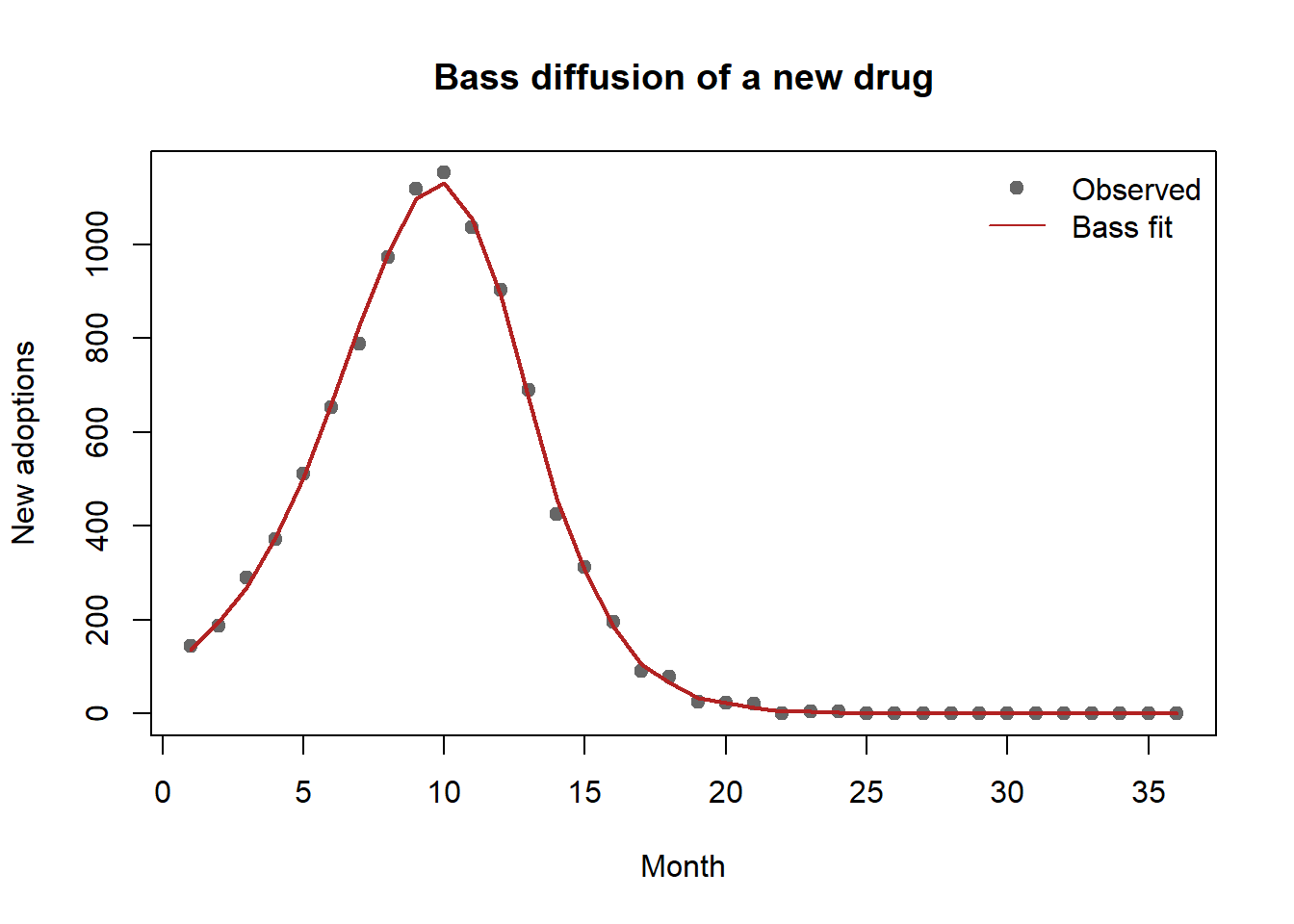
The recovered \(q/p\) ratio is large, the signature of a contagion-driven market in which seeding influential prescribers and supporting peer word-of-mouth—rather than brute-force detailing—offers the higher return. Whether that recovered \(q\) is real contagion or disguised homophily is, as Chapter 22 notes, the identification question that Equation 22.7 forces the analyst to confront before acting on it.
22.12 Key Takeaways
- Prescription marketing acts on a double-agency chain (patient–physician–payer) under a regulatory ceiling on claims; the buyer’s price sensitivity is muted, so marketing is fundamentally an information problem.
- Detailing response (Equation 22.1) is concave and heterogeneous, but estimates are confounded by endogenous targeting; credible estimates control rich physician effects or, better, model the firm’s allocation jointly (Manchanda, Ansari, and Gupta 1999; Manchanda, Rossi, and Chintagunta 2004).
- DTCA acts mainly on category (primary) demand while detailing acts on brand (selective) demand (Equation 22.3); separating expansion from business stealing is both the welfare question and the identification challenge (Narayanan and Manchanda 2009; Narayanan and Kalyanam 2015).
- The Bass model (Equation 22.4) decomposes adoption into external (marketing-led, \(p\)) and internal (contagion-led, \(q\)) channels; in medicine the central threat is contagion versus homophily, resolved only by controlling marketing effort and measured ties (Bulte and Lilien 2001; Iyengar, Ansari, and Gupta 2003).
- Physicians facing conflicting information update as Bayesian learners with biased signals (Equation 22.8): confident priors resist revision, mixed evidence nets out, and bad news spills across the therapeutic class (Kalra, Li, and Zhang 2011).
- A biased instrument upstream of a decision propagates through every downstream choice: differential pulse-oximetry error is associated with less supplemental oxygen for Black ICU patients, higher unplanned readmission, and a large length-of-stay penalty, and the therapy gap closes when an accurate arterial reading is available (Sjoding et al. 2020; Zhang and Jetley 2026). The remedy is confirmatory measurement, a process change, rather than persuasion (Section 22.7).
- Latency is the second upstream variable. Displaying when lab results became available—no new information, only faster access—cut test charges 25%, shortened length of stay 13% (about 75 minutes), lowered hospitalization, and raised patient satisfaction, with the largest gains under high workload and in uncommon cases (Espinosa, Kim, and Prada 2026). Speed changed the composition of information gathered, not just its timing: low latency converts a batch acquisition problem into a sequential one, so fewer and better-targeted signals suffice (Section 22.8).
22.13 Further Reading
The diffusion machinery specialized here is developed in full in Section 34.15; the general theory of advertising’s category-versus-share effects in Chapter 13; and the contamination of comparable products by negative information in Chapter 11. For the foundations of marketing as Bayesian learning under uncertainty, see the consumer-learning models of Tülin Erdem (1996) and Tulin Erdem (1998) and the quality-signaling logic of Kalra and Li (2008). On the speed rather than the volume of information, Espinosa, Kim, and Prada (2026) is the cleanest available design—a timing intervention with information content held fixed—and is worth reading alongside the service-operations material in Chapter 21 and the dashboard discussion in Chapter 31.
Ajzen, Icek. 1991. “The Theory of Planned Behavior.” Organizational Behavior and Human Decision Processes 50 (2): 179–211. https://doi.org/10.1016/0749-5978(91)90020-t.
Bass, Frank M. 1969. “A New Product Growth for Model Consumer Durables.” Management Science 15 (5): 215–27. https://doi.org/10.1287/mnsc.15.5.215.
Black, Nicole, Lachlan Deer, David W. Johnston, and Johannes S. Kunz. 2026. “Are You OK? Effects of a National Peer-Support Campaign on Mental Health.” Journal of Marketing. https://doi.org/10.1177/00222429261467752.
Bolton, Lisa E., Americus Reed, Kevin G. Volpp, and Katrina Armstrong. 2008. “How Does Drug and Supplement Marketing Affect a Healthy Lifestyle?” Journal of Consumer Research 34 (5): 713–26. https://doi.org/10.1086/521906.
Bulte, Christophe Van den, and Gary L. Lilien. 2001. “Medical Innovation Revisited: Social Contagion Versus Marketing Effort.” American Journal of Sociology 106 (5): 1409–35. https://doi.org/10.1086/320819.
Chandon, Pierre, and Nailya Ordabayeva. 2009. “Supersize in One Dimension, Downsize in Three Dimensions: Effects of Spatial Dimensionality on Size Perceptions and Preferences.” Journal of Marketing Research 46 (6): 739–53. https://doi.org/10.1509/jmkr.46.6.739.
Chandrasekaran, Deepa, and Gerard J. Tellis. 2007. “A Critical Review of Marketing Research on Diffusion of New Products.” In, 39–80. Emerald Group Publishing Limited. https://doi.org/10.1108/s1548-6435(2007)0000003006.
———. 2008. “Global Takeoff of New Products: Culture, Wealth, or Vanishing Differences?” Marketing Science 27 (5): 844–60. https://doi.org/10.1287/mksc.1070.0329.
Chintagunta, Pradeep K, Shyam Gopinath, and Sriram Venkataraman. 2010. “The Effects of Online User Reviews on Movie Box Office Performance: Accounting for Sequential Rollout and Aggregation Across Local Markets.” Marketing Science 29 (5): 944–57.
Coleman, James, Elihu Katz, and Herbert Menzel. 1957. “The Diffusion of an Innovation Among Physicians.” Sociometry 20 (4): 253. https://doi.org/10.2307/2785979.
Dong, Xiaojing, Puneet Manchanda, and Pradeep K. Chintagunta. 2009. “Quantifying the Benefits of Individual-Level Targeting in the Presence of Firm Strategic Behavior.” Journal of Marketing Research 46 (2): 207–21. https://doi.org/10.1509/jmkr.46.2.207.
Erdem, Tulin. 1998. “An Empirical Analysis of Umbrella Branding.” Journal of Marketing Research 35 (3): 339. https://doi.org/10.2307/3152032.
Erdem, Tülin. 1996. “A Dynamic Analysis of Market Structure Based on Panel Data.” Marketing Science 15 (4): 359–78. https://doi.org/10.1287/mksc.15.4.359.
Espinosa, Miguel, Hyunjin Kim, and Sergio Prada. 2026. “How Data Velocity Changes Decisions: The Role of Information Access Speed.” Strategic Management Journal. https://doi.org/10.1002/smj.70110.
Golder, Peter N., and Gerard J. Tellis. 1998. “Beyond Diffusion: An Affordability Model of the Growth of New Consumer Durables.” Journal of Forecasting 17 (3-4): 259–80. https://doi.org/10.1002/(sici)1099-131x(199806/07)17:3/4<259::aid-for696>3.0.co;2-t.
Haws, Kelly L., and Karen Page Winterich. 2013. “When Value Trumps Health in a Supersized World.” Journal of Marketing 77 (3): 48–64. https://doi.org/10.1509/jm.11.0261.
Iyengar, Raghuram, Asim Ansari, and Sunil Gupta. 2003. “Leveraging Information Across Categories.” Quantitative Marketing and Economics 1 (4): 425–65. https://doi.org/10.1023/b:qmec.0000004845.25649.6c.
Kalra, Ajay, and Shibo Li. 2008. “Signaling Quality Through Specialization.” Marketing Science 27 (2): 168–84.
Kalra, Ajay, Shibo Li, and Wei Zhang. 2011. “Understanding Responses to Contradictory Information about Products.” Marketing Science 30 (6): 1098–1114.
Keller, Punam A. 2006. “Regulatory Focus and Efficacy of Health Messages.” Journal of Consumer Research 33 (1): 109–14. https://doi.org/10.1086/504141.
Manchanda, Puneet, Asim Ansari, and Sunil Gupta. 1999. “The “Shopping Basket”: A Model for Multicategory Purchase Incidence Decisions.” Marketing Science 18 (2): 95–114. https://doi.org/10.1287/mksc.18.2.95.
Manchanda, Puneet, Peter E. Rossi, and Pradeep K. Chintagunta. 2004. “Response Modeling with Nonrandom Marketing-Mix Variables.” Journal of Marketing Research 41 (4): 467–78. https://doi.org/10.1509/jmkr.41.4.467.47005.
Narayanan, Sridhar, and Kirthi Kalyanam. 2015. “Position Effects in Search Advertising and Their Moderators: A Regression Discontinuity Approach.” Marketing Science 34 (3): 388–407. https://doi.org/10.1287/mksc.2014.0893.
Narayanan, Sridhar, and Puneet Manchanda. 2009. “Heterogeneous Learning and the Targeting of Marketing Communication for New Products.” Marketing Science 28 (3): 424–41. https://doi.org/10.1287/mksc.1080.0410.
Sheppard, Blair H., Jon Hartwick, and Paul R. Warshaw. 1988. “The Theory of Reasoned Action: A Meta-Analysis of Past Research with Recommendations for Modifications and Future Research.” Journal of Consumer Research 15 (3): 325. https://doi.org/10.1086/209170.
Sjoding, Michael W., Robert P. Dickson, Theodore J. Iwashyna, Steven E. Gay, and Thomas S. Valley. 2020. “Racial Bias in Pulse Oximetry Measurement.” New England Journal of Medicine 383 (25): 2477–78. https://doi.org/10.1056/NEJMc2029240.
Sultan, Fareena, Andrew J. Rohm, and Tao (Tony) Gao. 2009. “Factors Influencing Consumer Acceptance of Mobile Marketing: A Two-Country Study of Youth Markets.” Journal of Interactive Marketing 23 (4): 308–20. https://doi.org/10.1016/j.intmar.2009.07.003.
Van den Bulte, Christophe, and Yogesh V. Joshi. 2007. “New Product Diffusion with Influentials and Imitators.” Marketing Science 26 (3): 400–421. https://doi.org/10.1287/mksc.1060.0224.
Zhang, He, and Gaurav Jetley. 2026. “Beyond the Pulse: Racial Disparities in Pulse Oximetry Readings and the Influence on Intensive Care Unit Readmission Rates.” Production and Operations Management. https://doi.org/10.1177/10591478261474395.
Zhou, Tongxin, and Jingyi Sun. 2026. “Ripples of Emotion: Unraveling the Dynamics of Emotion Flows and User Engagement in Online Healthcare Communities.” Information Systems Research. https://doi.org/10.1287/isre.2023.0724.
Zhou, Tongxin, Yingfei Wang, Lu (Lucy) Yan, and Yong Tan. 2026. “Learning to Be Proficient? A Structural Model of User Dynamic Engagement in eHealth Behavioral Interventions.” Information Systems Research. https://doi.org/10.1287/isre.2022.0377.
22.5.2 Social Contagion Versus Homophily
The deepest identification problem in medical diffusion is distinguishing genuine social contagion (physician \(i\) adopts because connected physician \(j\) did) from homophily and common shocks (connected physicians adopt at similar times because they are similar—same specialty, same hospital, same patients—or respond to the same detailing). Naively, the prescribing of one’s network neighbors predicts one’s own prescribing; but neighbors are chosen, not assigned. The marketing literature has confronted this directly. Bulte and Lilien (2001) re-examine a celebrated medical-diffusion finding and show that what looked like contagion is substantially confounded by marketing effort that was correlated with network position—when detailing is controlled, the apparent peer effect shrinks. Iyengar, Ansari, and Gupta (2003) use sociometric data on physician advice and discussion ties to identify contagion in new-drug adoption net of marketing, finding that opinion leaders adopt earlier and that contagion flows along professional ties; later work distinguishes self-reported from sociometric leadership and shows leaders are both more innovative and more in-the-loop with detailing (Van den Bulte and Joshi 2007). The methodological lesson generalizes: any contagion estimate is credible only to the extent it controls for the firm’s effort and for the selection that makes neighbors similar.
A simple linear-in-means specification makes the threat explicit. Let \(a_{it}=1\) when physician \(i\) has adopted by \(t\), and let \(\bar a_{-i,t-1}\) be the lagged adoption share of \(i\)’s network neighbors:
\[ a_{it} = \phi\,\bar a_{-i,t-1} + \mathbf{x}_{it}^{\top}\boldsymbol{\gamma} + \theta\,\text{detailing}_{it} + \alpha_i + \varepsilon_{it}. \tag{22.7}\]
The contagion coefficient \(\phi\) is identified only if (i) the omitted detailing term \(\theta\,\text{detailing}_{it}\) is included and uncorrelated with the network after controls, and (ii) the unobserved similarity that drives both link formation and adoption is captured by \(\alpha_i\) and \(\mathbf{x}_{it}\). Failing either, \(\phi\) absorbs homophily and is biased upward—the classic reflection-and-selection problem. This is why the credible designs above either control detailing explicitly (Bulte and Lilien 2001) or exploit directed, measured ties (Iyengar, Ansari, and Gupta 2003).