flowchart TD
    A[Top-paid ranks r_p] --> D[Regress log r_g on log r_p and log p]
    B[Top-grossing ranks r_g] --> D
    C[Prices p] --> D
    D --> E["Shapes a_p, a_g and scale ratio b_g / b_p"]
    F[Aggregate downloads D_t] --> G[Recover scale levels b_p, b_g]
    E --> G
    G --> H["Pareto law d = b_p r_p^(-a_p): downloads at every rank"]
14 Sales
Selling is where a firm’s marketing promises are tested against a buyer’s willingness to pay. This chapter treats the sales function as two distinct but connected measurement problems. The first is inference about demand from observed sales: firms and researchers rarely see the full demand curve, but they do see rankings, units, and revenue, and a recurring task is to reconstruct latent demand from these partial signals. The second is management of the sales force: the salespeople who convert demand into revenue are themselves an asset whose compensation, productivity, retention, and future value can be modeled, measured, and optimized.
The two problems share a methodological spine. In both, the object of interest is unobserved—true demand in the first case, a salesperson’s forward-looking profit contribution in the second—and must be recovered from a noisy, selection-prone proxy. A reader who finishes this chapter should be able to estimate a demand curve from a sales-rank list, reason about when that estimate breaks down, and evaluate a sales-force compensation or retention policy using the same identification discipline applied throughout the book.
We proceed from the outside in. We begin with the economics of compensation and its hidden health costs, because incentives are the lever managers pull most often. We then turn to sales from rank, the empirical problem of inferring demand from ordinal best-seller lists, and develop the Pareto rank–demand model in full. We continue with the salesperson as an asset: turnover and its contagion through peer networks, and the forward-looking valuation of a sales force. We close by carrying the same logic into a setting with no price on either side of the exchange—nonprofit fundraising—where allocating scarce solicitation labor across methods is the sales-portfolio problem stripped to its essentials.
One boundary condition frames all of it. The occupation this chapter models is being restructured by digital tools that automate qualification, prospecting, and follow-up, which changes both what a salesperson does and which parts of the job the firm can observe (Singh et al. 2019). Technology adoption at the individual level has measurable performance consequences, though they run through mediating mechanisms — adaptive selling and effort — rather than directly (Ahearne et al. 2008). Where customer orientation itself becomes counterproductive is an empirical question with an interior answer: Homburg, Müller, and Klarmann (2011) find an inverted-U, so the optimum is a calibrated level rather than a maximum.
14.1 Theoretical Foundations
The sales function is governed by a small set of theories that explain both the buyer-seller relationship and the firm’s control of its own sales force. Four strands organize the chapter.
Social exchange theory frames selling as a relationship rather than a sequence of isolated transactions. Parties continue an exchange when its rewards exceed its costs relative to available alternatives, and recurring exchange builds norms of reciprocity and mutual obligation. This is the lens that justifies treating the salesperson-customer dyad (and, internally, the salesperson-firm dyad) as an evolving relationship whose quality, not merely its current price, determines future revenue.
The commitment-trust theory of relationship marketing specifies which mediating variables make that exchange succeed. Morgan and Hunt argue that relationship commitment and trust are the central mediators between the conditions of an exchange (shared values, communication, the absence of opportunism) and cooperative outcomes such as loyalty and acquiescence (Morgan and Hunt 1994). For sales, this explains why relationship quality predicts retention and why opportunistic behavior, on either side, is so corrosive to long-run value.
Agency theory governs salesforce control and underlies the compensation analysis of Chapter 14, “Compensation and Its Hidden Costs.” Because the firm (principal) cannot perfectly observe the salesperson’s (agent’s) effort and the two have divergent goals, it must choose between behavior-based control (salary, monitoring, supervision) and outcome-based control (commission tied to noisy sales). The linear contract \(w_i = \alpha + \beta s_i\) formalizes exactly this trade-off: a steeper \(\beta\) aligns incentives but shifts risk onto a risk-averse agent, which, together with the health externality documented in this chapter, is why the profit-maximizing incentive slope is interior, not maximal. The governance-cost logic connects to the broader transaction-cost account of when firms integrate versus outsource selling (Williamson 1981).
Adaptive selling describes the behavior the contract is meant to elicit. It is the practice of altering sales behavior across and within customer encounters in response to information about the selling situation, the antithesis of a fixed, canned pitch. Adaptive selling theory predicts that the value of discretion (and therefore of training and information systems that support it) rises with the heterogeneity of customers, which is why the latent-class, segment-specific returns to training in Section 14.5.2 are exactly what the theory anticipates. What adaptation looks like in practice has been unpacked in two directions: the influence tactics a salesperson selects, and how well they read the situation that should govern the selection (McFarland, Challagalla, and Shervani 2006). Perceived listening is the under-modeled half of this — customers infer effort and competence from whether they believe they were heard, largely independent of what was subsequently proposed (Ramsey and Sohi 1997) — and the buyer’s inference about motive can undo an otherwise well-adapted message, since a pitch that triggers suspicion of ulterior motive is discounted rather than merely disbelieved (DeCarlo 2005).
The synthesis that pulled these strands into one agenda is Weitz and Bradford (1999), which reframed personal selling from a transaction skill into the firm’s principal relationship-management instrument; the practitioner-facing framework in Zoltners, Sinha, and Lorimer (2008) maps the same territory onto the decisions a sales organization actually makes about sizing, structure, and deployment.
14.2 The Sales Conversation: Talk as the Instrument
Adaptive selling names the behavior but does not say what the behavior is made of. The unit adaptation actually operates on is the speaking turn, and until conversations could be transcribed and acoustically analyzed at scale the turn was invisible to measurement. Balducci, Marinova, and Singh (2026) open it up for the prospecting call—the stage of B2B selling at which a lead either becomes a live opportunity or is lost.
Their framework, built from symbolic interactionism and a grounded analysis of the calls themselves, decomposes salesperson speech into two channels. Linguistic acts are what is said: legitimizing (establishing the standing of the caller and the call), piquing (creating interest), and nudging (moving the lead toward commitment). Paralinguistic acts are how it is said—vocal intensity, speech rate, and pitch, the same acoustic features Section 49.4 treats as measures of a construct rather than as bookkeeping quantities. Between the acts and the outcome sits lead receptivity, a turn-level indicator of the lead’s openness to the message. That construct is the paper’s methodological move as much as its theoretical one: it turns a conversation into a panel instead of a single observation.
The estimates come from 783 lead-calling conversations comprising 11,566 speaking turns. Receptivity earns its place in the chain—a one-standard-deviation increase raises conversion likelihood by 13.44%—but the more useful results are the interactions with position in the call, which show that communicative acts are not uniformly effective but positionally so. A more specific nudge raises receptivity by 11.82% early in a conversation and lowers it by 81.40% later in the same conversation. Speaking faster is roughly neutral early and costs 8.26% late.
The sign flip, and the order-of-magnitude asymmetry around it, is the finding worth carrying away. A conventional analysis regressing conversion on the rate of specific nudges per call would average an early-call gain against a late-call collapse many times larger, recover something near zero, and conclude that nudging does not matter. The lesson generalizes well past sales: when a treatment is delivered repeatedly inside an episode and its effect depends on where in the episode it lands, the episode-level aggregate is not a summary of the turn-level effect—it is a different estimand, and usually an uninterpretable one. This is the within-episode timing problem that McFarland, Challagalla, and Shervani (2006) posed for influence tactics and that the frontline literature meets in Section 21.5; what has changed is that transcription and acoustic feature extraction (Chapter 49, Section 46.8) make the turn observable, so the timing can be estimated rather than assumed.
The managerial reading is uncomfortably specific. “Be concrete” and “keep the energy up” are not wrong as coaching, they are unconditioned—instructions about content where the evidence says the binding constraint is timing. A script that deploys them uniformly across a call collects the early gain and then pays the late penalty.
The conversation also has a selection stage that precedes its first turn, and in face-to-face retail the customer controls it. Delecourt, Doering, and Ng (2026) isolate that stage with a field experiment in two open-air markets in India. Confederate sellers were trained to run identical, newly created microenterprises under a fixed customer-engagement protocol, so that product, price, location, and selling behavior were held constant and only the seller’s gender varied. Women attracted 41% more customers and, through that volume, significantly higher sales. Customers were also more likely to talk with women about matters unrelated to the sale and more likely to try to bargain with them, which is the pattern social exchange theory predicts when buyers expect a warmer interaction. The result matters for the turn-level analysis above because it shows that who gets a conversation at all is already an outcome of seller characteristics, so a sample of recorded conversations is a selected sample before the first linguistic act is coded.
14.4 Sales from Rank
Many of the most visible signals of commercial success are ordinal, not cardinal. Amazon publishes a sales rank for every book; Apple’s App Store publishes ranked lists rather than download counts; the music, film, and publishing industries all live by charts. A rank is informative—rank 1 outsells rank 100—but it discards the magnitudes a firm actually needs: how many more units does rank 1 move than rank 100? Recovering demand magnitudes from rank is the central inference problem of this section.
The difficulty is that the map from demand to rank is many-to-one and unknown. Two products can swap ranks after a small change in either one’s sales, and the same rank can correspond to wildly different unit volumes in a thick versus a thin market. The literature solves this in three stages of increasing ambition, summarized in Table 14.1: experimentally perturb rank and read off the demand response; supplement rank with auxiliary demand data; or impose a parametric demand–rank law and estimate it from rank data alone.
| Study | Setting | Demand data required | Core idea |
|---|---|---|---|
| Chevalier and Goolsbee (2003) | Amazon books | Known/very low for chosen titles | Buy units of low-selling books; watch rank move; trace the rank–demand map |
| Brynjolfsson, Hu, and Smith (2003) | Amazon books | Publisher demand data | Calibrate the rank–demand relationship directly |
| Garg and Telang (2013) | Apple App Store | None | Impose a Pareto law; identify it from paid and grossing ranks |
| He and Hollenbeck (2020) | Amazon (general) | None | Generalize Chevalier and Goolsbee (2003) beyond books |
14.4.1 The Experimental Approach
The cleanest identification comes from intervention. Chevalier and Goolsbee (2003) run a field experiment on Amazon: they select books whose demand is either known or known to be very small, purchase large quantities relative to that baseline demand, and observe how each title’s sales rank responds to the induced demand shock. Because the experimenter controls the size of the shock, the otherwise unobservable mapping between a change in units and a change in rank is revealed. Repeating this across the rank distribution traces out the rank–demand curve.
The method’s strength—a controlled demand shock—is also its limitation. It is practical only for low-selling titles, where a feasible experimental purchase is large relative to organic demand. At the head of the distribution, the purchase required to move rank by a perceptible amount is prohibitive, so the high-volume region of the curve cannot be identified experimentally. The generalization of this revealed-demand logic to Amazon products beyond books is developed in He and Hollenbeck (2020).
14.4.2 The Auxiliary-Data Approach
When the experimenter cannot perturb demand, the next-best instrument is external demand data. Brynjolfsson, Hu, and Smith (2003) obtain demand figures from a book publisher and pair them with observed ranks, which pins down the rank–demand relationship by direct calibration rather than by experiment. This dispenses with the need to intervene but substitutes a different scarce resource—proprietary unit-sales data—that most analysts cannot obtain.
14.4.3 The Structural Approach: A Pareto Rank–Demand Law
The most general method dispenses with both intervention and demand data, recovering magnitudes from rank alone by imposing structure on the demand distribution. Garg and Telang (2013) develop this approach on Apple’s App Store, which is an unusually favorable laboratory because it publishes three distinct ranked lists that, jointly, over-identify the model:
- Top-free apps — ranked by download volume among zero-price apps.
- Top-paid apps — ranked by download volume among positive-price apps.
- Top-grossing apps — ranked by revenue, i.e., price times downloads.
The key modeling assumption is that downloads follow a Pareto (power-law) distribution in rank, an empirical regularity in best-seller and long-tail markets (Garg and Telang 2013). For the top-paid list, let \(d_{r_p}\) denote downloads at paid rank \(r_p\). The Pareto law states
\[ d_{r_p} = b_p\, r_p^{-a_p}, \qquad 1 \le r_p \le 200, \tag{14.1}\]
where \(a_p > 0\) is the shape parameter (the steepness of the long tail; a larger \(a_p\) means demand falls off faster with rank) and \(b_p > 0\) is a scale factor that depends on total market size for the platform (iPhone or iPad). The truncation at 200 reflects that the published list is finite. Taking logs of Equation 14.1 linearizes it, \(\log d_{r_p} = \log b_p - a_p \log r_p\), so a single list with download data would yield \((a_p, b_p)\) from an ordinary least squares (OLS) regression of log-downloads on log-rank. The problem is that download magnitudes are not published; only ranks are. The grossing list supplies the missing leverage.
14.4.3.1 Identification from the grossing list
Assume the same app obeys a Pareto law in the grossing (revenue) list, with its own shape \(a_g\) and scale \(b_g\). For an app at grossing rank \(r_g\) selling at price \(p\), revenue equals price times the downloads it earns at its paid rank:
\[ p\, d_{r_p} = b_g\, r_g^{-a_g}. \tag{14.2}\]
Substituting the paid-list law Equation 14.1 for \(d_{r_p}\) and taking logs gives, after rearranging to put grossing rank on the left,
\[ \log r_g = \frac{1}{a_g}\log\!\left(\frac{b_g}{b_p}\right) + \frac{a_p}{a_g}\log r_p - \frac{1}{a_g}\log p . \tag{14.3}\]
Equation 14.3 is linear in observables. It maps an app’s paid rank \(r_p\) and price \(p\) into its grossing rank \(r_g\), and every quantity on the right except the structural parameters is in the data. It is therefore estimable as the truncated OLS regression
\[ \log r_g = \beta_0 + \beta_1 \log r_p + \beta_2 \log p + \varepsilon, \tag{14.4}\]
where the regression coefficients are nonlinear functions of the structural parameters. Matching coefficients between Equation 14.3 and Equation 14.4 recovers the shapes directly:
\[ a_g = -\frac{1}{\beta_2}, \qquad a_p = -\frac{\beta_1}{\beta_2}, \qquad \frac{b_g}{b_p} = \exp\!\left(-\frac{\beta_1}{\beta_2}\right). \tag{14.5}\]
The regression identifies the two shape parameters and the ratio of scales, but not the scales themselves, because rank data are invariant to a common rescaling of all download volumes. To pin down the levels, Garg and Telang (2013) add one aggregate moment. Summing the paid-list law over all ranked apps in a day equates the model-implied total to observed aggregate downloads \(D_t\):
\[ D_t = \sum_{r_p=1}^{N} d_{r_p} = b_p \sum_{r_p=1}^{N} r_p^{-a_p}. \tag{14.6}\]
Because \(a_p\) is already known from Equation 14.5, the sum on the right is a computable constant, so Equation 14.6 solves for the scale levels:
\[ b_p = \frac{\sum_{r_p=1}^{N} d_{r_p}}{\sum_{r_p=1}^{N} r_p^{-a_p}}, \qquad b_g = \exp\!\left(-\frac{\beta_0}{\beta_1}\right) \cdot \frac{\sum_{r_p=1}^{N} d_{r_p}}{\sum_{r_p=1}^{N} r_p^{-a_p}}. \tag{14.7}\]
With \((a_p, b_p)\) in hand, Equation 14.1 returns a download magnitude for every paid rank, completing the recovery of cardinal demand from ordinal lists.
14.4.3.2 What breaks identification
The estimator rests on assumptions that are explicit and falsifiable, and each is a potential failure point.
- Revenue comes only from upfront price. The grossing equation Equation 14.2 treats revenue as price times downloads, ignoring in-app purchases. Garg and Telang (2013) argue this is reasonable for paid apps, which earn most of their money at the point of sale, while in-app monetization is concentrated in free apps, which the grossing analysis excludes (Garg and Telang 2013, 1256). Where paid apps monetize heavily inside the app, the price term in Equation 14.4 is misspecified and the recovered shapes are biased.
- Rank and price are cross-sectionally independent. Estimation treats each app-day observation as independent even when an app appears across multiple days, ignoring the correlation that would arise from app-level unobservables. Failing this, the OLS standard errors understate sampling uncertainty.
- A single Pareto law fits the whole list. A mixture of populations (e.g., games versus utilities) with different tail behavior would violate the single-shape assumption, and the linearized regression would average over heterogeneous slopes.
Garg and Telang (2013) estimate the model on roughly 200 paid apps, 200 grossing apps, and their prices over April–May 2011, drawing on Apple’s public lists and third-party trackers of the period.1 The pipeline from the three published lists to recovered demand is summarized in Figure 14.1.
14.4.3.3 A reproducible illustration
The following simulation generates app-level ranks and prices from a known data-generating process, then recovers the structural parameters through Equation 14.4 and Equation 14.5. Because the truth is known, the example doubles as a check that the estimator is unbiased when its assumptions hold.
Code
set.seed(12)

# True structural parameters
a_p_true <- 0.80   # paid-list shape
a_g_true <- 0.95   # grossing-list shape
b_p_true <- 5e5    # paid-list scale
b_g_true <- 2e6    # grossing-list scale

N <- 200
r_p   <- 1:N                                  # paid ranks
price <- round(runif(N, 0.99, 9.99), 2)       # app prices

# Downloads from the paid-list Pareto law (eq-pareto-paid)
downloads <- b_p_true * r_p^(-a_p_true)

# Grossing rank implied by the structural mapping (eq-rank-mapping),
# with mild noise standing in for measurement error
log_rg <- (1 / a_g_true) * log(b_g_true / b_p_true) +
          (a_p_true / a_g_true) * log(r_p) -
          (1 / a_g_true) * log(price) +
          rnorm(N, 0, 0.05)
r_g <- exp(log_rg)

# Estimate the truncated OLS regression (eq-rank-ols)
fit <- lm(log(r_g) ~ log(r_p) + log(price))
b   <- coef(fit)

# Recover structural parameters (eq-structural-recovery)
a_g_hat     <- -1 / b[["log(price)"]]
a_p_hat     <- -b[["log(r_p)"]] / b[["log(price)"]]
b_ratio_hat <- exp(-b[["log(r_p)"]] / b[["log(price)"]])

# Recover scale levels from the aggregate-download moment (eq-scale-recovery)
D_t       <- sum(downloads)
b_p_hat   <- D_t / sum(r_p^(-a_p_hat))

data.frame(
  parameter = c("a_p", "a_g", "b_g/b_p", "b_p"),
  truth     = c(a_p_true, a_g_true, b_g_true / b_p_true, b_p_true),
  estimate  = c(a_p_hat, a_g_hat, b_ratio_hat, b_p_hat)
)
#>   parameter   truth     estimate
#> 1       a_p 8.0e-01 7.967788e-01
#> 2       a_g 9.5e-01 9.505491e-01
#> 3   b_g/b_p 4.0e+00 2.218384e+00
#> 4       b_p 5.0e+05 4.953001e+05
The recovered shapes and scale track their true values, illustrating that the ordinal lists, plus one cardinal anchor, suffice to reconstruct the full demand schedule.
14.5 The Salesperson as an Asset
The second measurement problem shifts from the product to the person. A sales force is a portfolio of human assets, and two questions dominate its management: who leaves, and what is each person worth going forward. Both resist naive measurement—turnover is contagious in ways that confound individual attribution, and a salesperson’s value is forward-looking while the convenient metrics are backward-looking.
14.5.1 Turnover: Own and Peer Effects
Salesperson turnover is expensive: it destroys accumulated account relationships and product knowledge and imposes replacement costs. Most prior work studied the consequences of voluntary turnover; Sunder et al. (2017) instead model its antecedents, and in particular separate two channels that the data tend to confound.
The first channel is the salesperson’s own standing. Drawing on identity theory, a salesperson’s role identity is reinforced or threatened by personal performance, so individual achievement shapes the propensity to stay. The second channel is peer influence. Drawing on social identity theory, a salesperson’s attachment is shaped by the group, so the behavior of peers—above all, peer turnover—moves the individual’s own exit decision. That peer structure is itself measurable rather than assumed: mapping the intra-organizational network shows which positions confer performance advantages and how those positions are acquired, which supplies the microfoundation the contagion story needs (Bolander et al. 2015). The same logic explains how a market orientation propagates through a firm at all — not by proclamation but by social learning across exactly these ties (Lam, Kraus, and Ahearne 2010). The empirical contribution is to estimate both channels jointly on a panel of 6,727 salespeople observed over two years, and the central finding is that peer effects dominate own effects: a colleague’s departure is a stronger predictor of a salesperson’s exit than that salesperson’s own performance.
Identification: distinguishing contagion from common shocks
The headline that “peers drive turnover” is a causal claim, and peer effects are notoriously hard to identify. The reflection problem (a peer’s outcome reflects the same group-level shocks that drive ego’s outcome) and homophily (similar people self-select into the same teams) both generate peer correlations with no underlying contagion. Reading a peer-turnover coefficient as a causal contagion effect requires that team membership and the timing of peer exits be plausibly exogenous to ego’s latent propensity to leave—conditioning on common shocks, not merely correlating outcomes.
A reduced-form hazard specification makes the two channels concrete. Let the hazard that salesperson \(i\) on team \(j\) exits in period \(t\) be
\[ h_{ijt} = h_0(t)\, \exp\!\big(\gamma\, \text{Perf}_{ijt} + \delta\, \text{PeerTurnover}_{jt} + \boldsymbol{\theta}^{\top}\mathbf{x}_{ijt}\big), \tag{14.8}\]
where \(h_0(t)\) is a baseline hazard, \(\text{Perf}_{ijt}\) captures own performance (the identity channel), \(\text{PeerTurnover}_{jt}\) is recent turnover among \(i\)’s peers (the social-identity channel), and \(\mathbf{x}_{ijt}\) collects controls. The Sunder et al. (2017) finding is that the estimated peer coefficient \(\hat\delta\) is large relative to the own-performance coefficient \(\hat\gamma\).
14.5.2 Valuing a Salesperson’s Future Contribution
Traditional sales-force evaluation is retrospective: it ranks salespeople on realized volume, the metric that is easiest to observe but least informative about what the firm will earn from each person next year. As marketing has shifted toward a customer-centric, lifetime-value orientation, the natural analogue for the sales force is a forward-looking, profit-based valuation of each salesperson—an internal parallel to customer lifetime value.
Kumar, Sunder, and Leone (2014) propose exactly such a metric and embed it in a latent class model that recognizes the sales force is not homogeneous. The intuition for latent classes is that salespeople fall into a small number of unobserved segments that respond differently to managerial levers, so a single average response masks divergent effects. Formally, with \(C\) latent segments, the expected future value of salesperson \(i\) is the mixture
\[ \widehat{\text{Value}}_i = \sum_{c=1}^{C} \pi_{ic}\, \mathbb{E}\!\left[V_i \mid \text{segment } c\right], \tag{14.9}\]
where \(\pi_{ic}\) is the posterior probability that \(i\) belongs to segment \(c\) and \(\mathbb{E}[V_i \mid \text{segment } c]\) is the discounted future profit contribution conditional on that segment’s response parameters. Both the segment memberships \(\pi_{ic}\) and the segment-specific response parameters are estimated jointly, typically by maximum likelihood via the expectation–maximization (EM) algorithm.
The substantive payoff is a precise statement of when “one size fits all” fails. Kumar, Sunder, and Leone (2014) find that segments respond differently to training and to incentives, so a uniform program is inefficient: the same training budget yields different returns across segments, and the ranking of training versus incentives can even reverse depending on the time horizon—an intervention that looks inferior in the short run may dominate over a longer one. The forward-looking metric thus reframes sales-force management from rewarding past volume to allocating development resources toward the salespeople and interventions with the highest future return.
Figure 14.2 contrasts the retrospective and forward-looking views of sales-force evaluation.
flowchart LR
    A[Realized sales volume] --> B[Retrospective ranking]
    C[Salesperson behavior and responses] --> D[Latent-class segmentation]
    D --> E[Segment-specific future value]
    E --> F[Allocate training and incentives by horizon]
    B -. backward-looking .-> G((Evaluation))
    F -. forward-looking .-> G
14.5.2.1 A reproducible illustration of latent-class value
The following example simulates two latent segments of salespeople with different responses to training, fits a two-component mixture by EM, and recovers the segment-specific effects. It is a deliberately minimal stand-in for the richer specification in Kumar, Sunder, and Leone (2014), intended to make the mixture logic of Equation 14.9 concrete.
Code
set.seed(34)

n <- 600
# Two latent segments with different training -> future-value slopes
seg     <- rbinom(n, 1, 0.4)            # segment indicator (unobserved in practice)
train   <- runif(n, 0, 10)             # training hours
slope   <- ifelse(seg == 1, 1.8, 0.3)  # high vs. low responders
value   <- 20 + slope * train + rnorm(n, 0, 4)
dat     <- data.frame(value, train)

# Fit a 2-component mixture of regressions by EM (base R)
em_mixreg <- function(y, x, K = 2, iters = 100) {
  n <- length(y)
  pi_k  <- rep(1 / K, K)
  beta0 <- quantile(y, c(0.3, 0.7)); beta1 <- c(0.3, 1.5); sig <- rep(sd(y), K)
  for (it in seq_len(iters)) {
    # E-step: responsibilities
    dens <- sapply(1:K, function(k)
      pi_k[k] * dnorm(y, beta0[k] + beta1[k] * x, sig[k]))
    r <- dens / rowSums(dens)
    # M-step: weighted regressions
    for (k in 1:K) {
      w  <- r[, k]
      fk <- lm(y ~ x, weights = w)
      beta0[k] <- coef(fk)[1]; beta1[k] <- coef(fk)[2]
      sig[k]   <- sqrt(sum(w * residuals(fk)^2) / sum(w))
      pi_k[k]  <- mean(w)
    }
  }
  list(pi = pi_k, slope = beta1, intercept = beta0)
}

out <- em_mixreg(dat$value, dat$train, K = 2)
data.frame(
  segment        = c(1, 2),
  mix_weight     = round(out$pi, 3),
  training_slope = round(out$slope, 3)
)
#>   segment mix_weight training_slope
#> 1       1      0.515          0.093
#> 2       2      0.485          1.942
The estimator separates the high-responding segment (training slope near 1.8) from the low-responding one (near 0.3), reproducing the qualitative lesson of Kumar, Sunder, and Leone (2014): returns to a managerial lever are segment-specific, and the forward-looking value in Equation 14.9 averages over those segments weighted by membership.
14.6 Selling Without a Price: Fundraising Productivity
Not every sales force sells. Nonprofit fundraisers solicit gifts rather than close transactions, and the exchange they manage has no price on either side: the donor receives no product, and the organization posts no margin. Yet the managerial problem is the sales problem in all its essentials. A scarce pool of skilled labor must be allocated across solicitation methods that differ in cost, cycle length, and relational intensity; performance must be measured against that labor investment rather than against the raw dollars it produced; and the allocation decision is a portfolio choice whose payoff depends on the organization’s stage of development. This section takes the nonprofit case as the cleanest available laboratory for a question the commercial literature usually confounds with pricing and product: how concentrated should a revenue-generating function be across the methods available to it?
14.6.1 Productivity Versus Effectiveness
The fundraising literature has long evaluated performance by the numerator alone. Total dollars raised measures effectiveness; the cost-to-raise-a-dollar ratio measures financial efficiency but treats labor as an expense line rather than as the capacity constraint it actually is. Neither answers the question a development director faces, which is what the next fundraiser is worth. Fundraising productivity puts labor in the denominator directly,
\[ \text{Productivity}_{it} \;=\; \frac{\text{Fundraising revenue}_{it}}{\text{Fundraising FTE}_{it}}, \tag{14.10}\]
for organization \(i\) in year \(t\), where FTE is full-time-equivalent headcount dedicated to fundraising. The choice of denominator is not cosmetic. A strategy that raises total revenue by hiring is effective but need not be productive, and the two rankings of the same organizations can differ sharply. Han, Sharma, and Pekgün (2026) make the return on labor investment the object of study for exactly this reason: in a labor-intensive function, revenue per FTE is the quantity a capacity-constrained manager can actually act on.
14.6.2 The Concentration Decision
Fundraising revenue arrives through distinct solicitation methods: direct mail, special events, grant writing, corporate and foundation appeals, online giving, planned giving, and face-to-face personal solicitation. Let \(s_{ijt}\) be the share of organization \(i\)’s fundraising revenue in year \(t\) arriving through method \(j\). The degree of concentration is the Herfindahl form of Section 31.1.8 applied to the organization’s own revenue portfolio rather than to an industry,
\[ H_{it} \;=\; \sum_j s_{ijt}^2, \qquad \tfrac{1}{J} \le H_{it} \le 1, \tag{14.11}\]
with \(H_{it} = 1\) when everything comes through a single method and \(1/J\) when the \(J\) methods contribute equally. Diversification is \(1 - H_{it}\), or an entropy analogue when the researcher prefers to weight small shares more heavily.
The literature’s prior on the sign of \(H\) was genuinely divided. The portfolio-theoretic argument favors diversification: independent revenue streams smooth shocks, and a nonprofit that depends on one channel is hostage to it. The capability argument favors concentration: solicitation methods have steep learning curves and method-specific relational capital, so spreading a small team thin forfeits the depth that closes large gifts. Because the two arguments live at different levels, risk versus capability, the empirical literature reported conflicting signs without resolving them, and offered little guidance conditional on organizational context.
14.6.3 What the Food-Bank Evidence Shows
Han, Sharma, and Pekgün (2026) adjudicate this with a three-year panel of 105 U.S. food banks, a setting where solicitation methods, dedicated fundraising headcount, and revenue by method are all observed for organizations pursuing an identical mission. Four results are worth carrying forward.
First, concentration raises productivity. Greater revenue concentration is associated with higher fundraising revenue per FTE, favoring the capability argument over the portfolio argument at the level of labor returns.
Second, the effect is amplified by relational intensity. Organizations that prioritize highly personalized solicitation methods get more out of concentrating, and the authors’ post hoc decomposition traces the amplification to grant writing and personal solicitation specifically. This is the learning-curve mechanism made visible: it is precisely the methods whose returns depend on accumulated relationships and craft that reward depth over breadth.
Third, organizational age moderates the effect negatively. Splitting the sample by age, concentration significantly improves productivity for the youngest food banks and has no statistically significant effect for mature ones. A young organization has no channel in which it is yet good; committing its small team to one is how it becomes good at something. A mature organization has already climbed the learning curves it is going to climb, and further concentration buys it little.
Fourth, labor mix conditions the return. A higher proportion of full-time fundraisers amplifies the benefit of concentration, continuity of relationship being the input that method-specific capital is built from. This qualifies rather than contradicts the finding of Sharma et al. (2024) that part-time staffing can increase effectiveness in food-bank SNAP outreach: flexible labor suits outreach tasks that are episodic and geographically dispersed, whereas concentrated, relationship-intensive solicitation rewards continuity. The operative question is not whether part-time labor is good, but which task the labor is asked to perform.
14.6.4 The Tension the Result Exposes
The finding does not survive a change of dependent variable unscathed, and this is the most useful part of the paper for a methods reader. Concentration is also positive for effectiveness (total fundraising revenue) and for revenue growth (year-over-year rate of increase), but negative for financial stability, measured as the deviation of realized fundraising revenue from its predicted value. Concentration raises the level and the trend of the revenue stream while raising its volatility, which is the portfolio argument reappearing where it belongs: in the second moment rather than the first.
Note
This is the same structure as the marketing-finance value chain of Chapter 25, where market-based assets are argued to augment the level of cash flows and reduce their volatility as separate levers. The food-bank evidence is a reminder that a single strategic choice can move the two levers in opposite directions, so the phrase “improves performance” is empty until the performance construct is named. It is also the nonprofit analogue of customer concentration in B2B selling: a portfolio anchored on a few large accounts is efficient per salesperson and fragile per shock.
14.6.5 A Reproducible Illustration of the Tradeoff
The simulation below builds a synthetic panel with the qualitative structure just described, concentration raising the level of revenue per FTE while also raising its dispersion around the organization’s own trend, and shows that a within-organization fixed-effects regression recovers both halves of the tradeoff. The numbers are the book’s own construction, not estimates from Han, Sharma, and Pekgün (2026); the point is that the two effects are separately estimable from the same panel and that reporting only the first would be a partial account.
Code
set.seed(2026)

n_org  <- 105   # organizations, matching the scale of the food-bank panel
n_yr   <- 3     # years
n_meth <- 6     # solicitation methods

# --- Revenue shares by method, then the Herfindahl concentration index --------
# A Dirichlet draw with a small concentration parameter yields lumpy portfolios;
# alpha varies by organization so that H has genuine between-org variation.
rdirichlet <- function(alpha) {
  g <- rgamma(length(alpha), shape = alpha)
  g / sum(g)
}

org    <- rep(seq_len(n_org), each = n_yr)
year   <- rep(seq_len(n_yr), times = n_org)
alpha0 <- rep(runif(n_org, 0.2, 2.0), each = n_yr)   # low alpha => concentrated

H <- vapply(alpha0, function(a) sum(rdirichlet(rep(a, n_meth))^2), numeric(1))

# --- Outcome: log revenue per FTE --------------------------------------------
# Level effect: concentration raises productivity (beta_H > 0).
# Volatility effect: concentration raises the SD of the idiosyncratic shock, so
# the same organization is less predictable year to year.
beta_H   <- 0.90
org_fe   <- rep(rnorm(n_org, mean = 11.5, sd = 0.35), each = n_yr)  # log $ per FTE
yr_fe    <- c(0, 0.04, 0.09)[year]
sd_shock <- 0.10 + 0.45 * H                                         # heteroskedastic in H
eps      <- rnorm(length(H), mean = 0, sd = sd_shock)

log_prod <- org_fe + yr_fe + beta_H * H + eps

d <- data.frame(org = factor(org), year = factor(year), H = H, log_prod = log_prod)

# --- First moment: does concentration raise productivity? --------------------
fit_level <- lm(log_prod ~ H + org + year, data = d)
round(coef(summary(fit_level))["H", ], 4)
#>   Estimate Std. Error    t value   Pr(>|t|)
#>     0.8492     0.1985     4.2778     0.0000

# --- Second moment: does it raise instability? -------------------------------
# "Instability" mirrors the paper's construct: absolute deviation of realized
# productivity from its predicted value, here from a model that deliberately
# excludes H so the residual is not mechanically purged of it.
fit_pred <- lm(log_prod ~ org + year, data = d)
d$instab <- abs(residuals(fit_pred))
fit_stab <- lm(instab ~ H, data = d)
round(coef(summary(fit_stab))["H", ], 4)
#>   Estimate Std. Error    t value   Pr(>|t|)
#>     0.3431     0.0558     6.1524     0.0000
Code
op <- par(mfrow = c(1, 2), mar = c(4.2, 4.2, 2.2, 1))

plot(d$H, d$log_prod, pch = 16, col = "#4477aa66",
     xlab = "Revenue concentration H", ylab = "log(revenue per FTE)",
     main = "Level")
abline(lm(log_prod ~ H, data = d), lwd = 2, col = "#bb5566")

plot(d$H, d$instab, pch = 16, col = "#22883366",
     xlab = "Revenue concentration H", ylab = "|deviation from predicted|",
     main = "Instability")
abline(fit_stab, lwd = 2, col = "#bb5566")

par(op)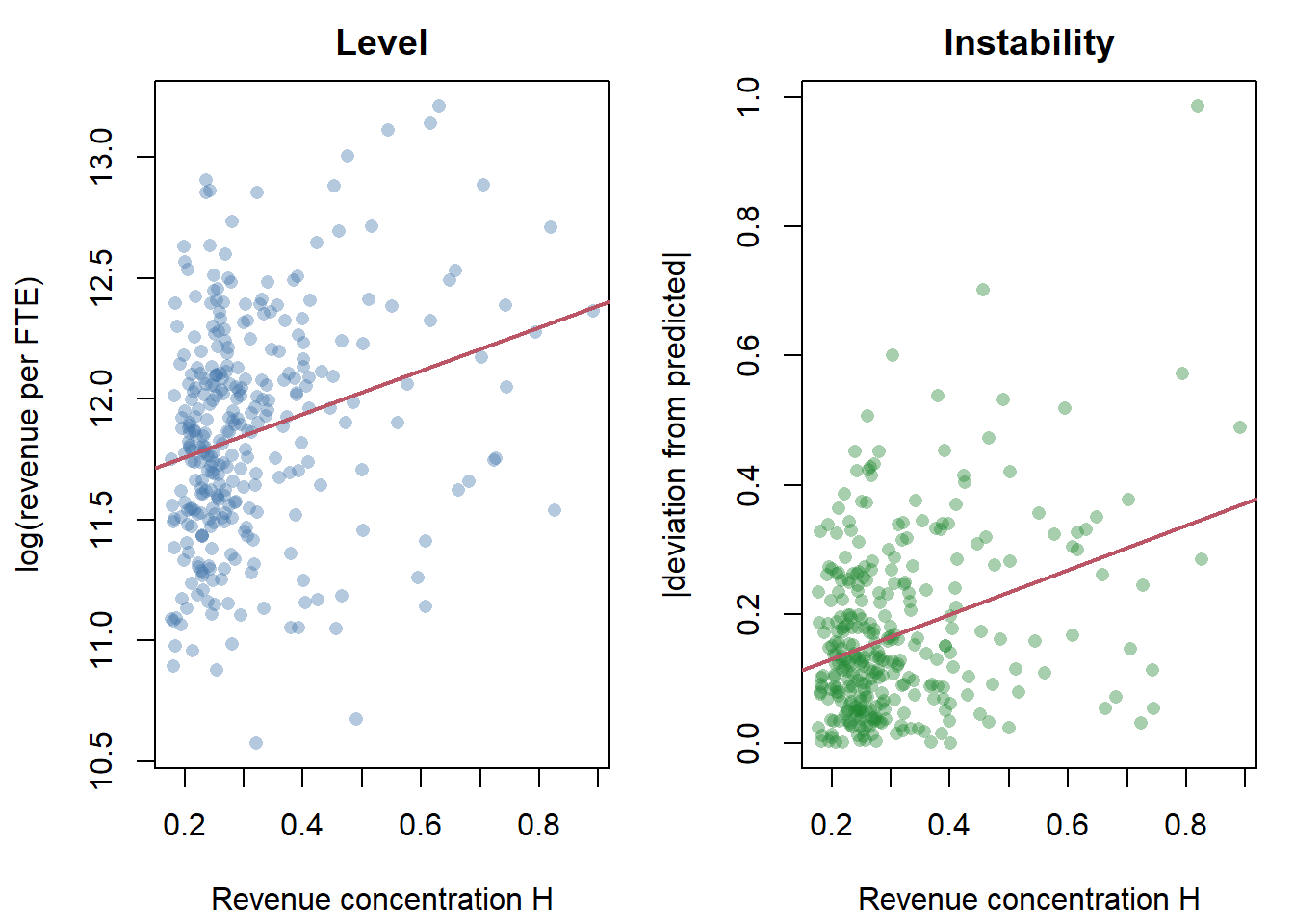
Two cautions belong with any reading of this evidence, simulated or real. The concentration index is chosen, not assigned: an organization that concentrates may be responding to the same donor-market conditions that drive its productivity, so the panel’s fixed effects absorb time-invariant capability but not a time-varying shock that moves strategy and outcome together. And the level and volatility results come from the same panel, so a manager cannot treat them as independent findings to be traded off at will; they are two projections of one strategic posture. The identification discipline of Chapter 43 applies here with no discount for the setting being a nonprofit one.
14.7 Key Takeaways
- Adaptive selling resolves to the speaking turn. Across 783 prospecting calls and 11,566 turns, salesperson speech splits into linguistic acts (legitimizing, piquing, nudging) and paralinguistic acts (intensity, rate, pitch) that work through lead receptivity, a turn-level openness measure whose one-SD increase lifts conversion 13.44% (Balducci, Marinova, and Singh 2026). The acts are positionally effective, not uniformly so: a specific nudge gains 11.82% early and loses 81.40% late. Any call-level aggregate averages those into near-zero and reports that nothing matters (Section 14.2).
- Variable compensation lifts sales but carries a health cost—stress, exhaustion, absenteeism—that is buffered by individual ability and social resources, so the profit-maximizing incentive slope is lower and more differentiated than the standard agency model implies (Habel, Alavi, and Linsenmayer 2021).
- Discretionary bonuses are not a free lever. A natural field experiment finds that surprise bonuses reduced subsequent output—reciprocity ran backward once the bonus was read as a signal of employer contentment rather than a gift to be repaid—so gift-exchange justifications for goodwill pay should not be assumed (Bogliacino, Grimalda, and Pipke 2026).
- Sales rank is ordinal; recovering cardinal demand requires either an experimental demand shock (Chevalier and Goolsbee 2003; He and Hollenbeck 2020), auxiliary demand data (Brynjolfsson, Hu, and Smith 2003), or a parametric demand law identified from multiple ranked lists (Garg and Telang 2013).
- The Pareto rank–demand model (Equation 14.1–Equation 14.7) identifies tail shapes and a scale ratio from rank regressions, but needs one aggregate-download moment to fix scale levels; its identification breaks if revenue is not upfront, if cross-sectional independence fails, or if a single power law does not fit the list.
- Salesperson turnover is contagious: peer turnover predicts individual exit more strongly than own performance, but reading this as causal contagion demands care with the reflection problem and homophily (Sunder et al. 2017).
- A forward-looking, latent-class valuation of the sales force (Equation 14.9) shows that returns to training and incentives are segment- and horizon-specific, so uniform development programs are inefficient (Kumar, Sunder, and Leone 2014).
- Fundraising is selling without a price, and its productivity metric puts labor in the denominator (Equation 14.10). In a three-year panel of 105 food banks, concentrating revenue across fewer solicitation methods raised revenue per FTE—amplified by personalized methods such as grant writing and personal solicitation and by a larger full-time share, and concentrated among the youngest organizations—while reducing financial stability (Han, Sharma, and Pekgün 2026). A strategy can move the level and the volatility of a revenue stream in opposite directions, so “improves performance” is empty until the performance construct is named.
Ahearne, Michael, Eli Jones, Adam Rapp, and John Mathieu. 2008. “High Touch Through High Tech: The Impact of Salesperson Technology Usage on Sales Performance via Mediating Mechanisms.” Management Science 54 (4): 671–85. https://doi.org/10.1287/mnsc.1070.0783.
Balducci, Bitty, Detelina Marinova, and Jagdip Singh. 2026. “Ready to Convert? How to Talk with Sales Leads.” Journal of Marketing Research. https://doi.org/10.1177/00222437261481444.
Bogliacino, Francesco, Gianluca Grimalda, and David Pipke. 2026. “No Gifts Returned: Surprise Bonuses Reduce Productivity in a Natural Field Experiment.” Management Science 72 (7): 5528–43. https://doi.org/10.1287/mnsc.2022.04085.
Brown, Steven P., William L. Cron, and John W. Slocum. 1998. “Effects of Trait Competitiveness and Perceived Intraorganizational Competition on Salesperson Goal Setting and Performance.” Journal of Marketing 62 (4): 88–98. https://doi.org/10.1177/002224299806200407.
Brynjolfsson, Erik, Yu Hu, and Michael D Smith. 2003. “Consumer Surplus in the Digital Economy: Estimating the Value of Increased Product Variety at Online Booksellers.” Management Science 49 (11): 1580–96.
Challagalla, Goutam N., and Tasadduq A. Shervani. 1996. “Dimensions and Types of Supervisory Control: Effects on Salesperson Performance and Satisfaction.” Journal of Marketing 60 (1): 89–105. https://doi.org/10.1177/002224299606000108.
Chevalier, Judith, and Austan Goolsbee. 2003. “Measuring Prices and Price Competition Online: Amazon. Com and BarnesandNoble. Com.” Quantitative Marketing and Economics 1 (2): 203–22.
DeCarlo, Thomas E. 2005. “The Effects of Sales Message and Suspicion of Ulterior Motives on Salesperson Evaluation.” Journal of Consumer Psychology 15 (3): 238–49. https://doi.org/10.1207/s15327663jcp1503_9.
Delecourt, Solene, Laura Doering, and Odyssia Ng. 2026. “Women’s Approachability Premium in Sales: A Field Experiment Among Microentrepreneurs.” Organization Science. https://doi.org/10.1287/orsc.2024.18859.
Garg, Rajiv, and Rahul Telang. 2013. “Inferring App Demand from Publicly Available Data.” MIS Quarterly, 1253–64.
Habel, Johannes, Sascha Alavi, and Kim Linsenmayer. 2021. “Variable Compensation and Salesperson Health.” Journal of Marketing 85 (3): 130–49. https://doi.org/10.1177/0022242921993195.
Han, Yingru, Luv Sharma, and Pelin Pekgün. 2026. “Enhancing Fundraising Productivity Through Strategic Revenue Concentration Decisions: Evidence from Food Banks.” Production and Operations Management. https://doi.org/10.1177/10591478261477172.
He, Sherry, and Brett Hollenbeck. 2020. “Sales and Rank on Amazon. Com.” Available at SSRN 3728281.
Homburg, Christian, Michael Müller, and Martin Klarmann. 2011. “When Should the Customer Really Be King? On the Optimum Level of Salesperson Customer Orientation in Sales Encounters.” Journal of Marketing 75 (2): 55–74. https://doi.org/10.1509/jm.75.2.55.
Jaramillo, Fernando, Douglas B. Grisaffe, Lawrence B. Chonko, and James A. Roberts. 2009. “Examining the Impact of Servant Leadership on Sales Force Performance.” Journal of Personal Selling
& Sales Management 29 (3): 257–75. https://doi.org/10.2753/pss0885-3134290304.
& Sales Management 29 (3): 257–75. https://doi.org/10.2753/pss0885-3134290304.
Kumar, V, Sarang Sunder, and Robert P Leone. 2014. “Measuring and Managing a Salesperson’s Future Value to the Firm.” Journal of Marketing Research 51 (5): 591–608.
Lam, Son K., Florian Kraus, and Michael Ahearne. 2010. “The Diffusion of Market Orientation Throughout the Organization: A Social Learning Theory Perspective.” Journal of Marketing 74 (5): 61–79. https://doi.org/10.1509/jmkg.74.5.061.
MacKenzie, Scott B., Philip M. Podsakoff, and Michael Ahearne. 1998. “Some Possible Antecedents and Consequences of in-Role and Extra-Role Salesperson Performance.” Journal of Marketing 62 (3): 87–98. https://doi.org/10.1177/002224299806200306.
McFarland, Richard G., Goutam N. Challagalla, and Tasadduq A. Shervani. 2006. “Influence Tactics for Effective Adaptive Selling.” Journal of Marketing 70 (4): 103–17. https://doi.org/10.1509/jmkg.70.4.103.
Morgan, Robert M., and Shelby D. Hunt. 1994. “The Commitment-Trust Theory of Relationship Marketing.” Journal of Marketing 58 (3): 20–38. https://doi.org/10.1177/002224299405800302.
Ramsey, Rosemary P., and Ravipreet S. Sohi. 1997. “Listening to Your Customers: The Impact of Perceived Salesperson Listening Behavior on Relationship Outcomes.” Journal of the Academy of Marketing Science 25 (2): 127–37. https://doi.org/10.1007/bf02894348.
Sharma, Luv, Pelin Pekgün, Orgül D. Öztürk, and Sanjay L. Ahire. 2024. “When Do Part-Time Workers Increase Effectiveness? A Study of Food Banks and the SNAP Program Outreach.” Journal of Operations Management 70 (4): 654–73. https://doi.org/10.1002/joom.1304.
Singh, Jagdip, Karen Flaherty, Ravipreet S. Sohi, Dawn Deeter-Schmelz, Johannes Habel, Kenneth Le Meunier-FitzHugh, Avinash Malshe, Ryan Mullins, and Vincent Onyemah. 2019. “Sales Profession and Professionals in the Age of Digitization and Artificial Intelligence Technologies: Concepts, Priorities, and Questions.” Journal of Personal Selling
& Sales Management 39 (1): 2–22. https://doi.org/10.1080/08853134.2018.1557525.
& Sales Management 39 (1): 2–22. https://doi.org/10.1080/08853134.2018.1557525.
Sunder, Sarang, V Kumar, Ashley Goreczny, and Todd Maurer. 2017. “Why Do Salespeople Quit? An Empirical Examination of Own and Peer Effects on Salesperson Turnover Behavior.” Journal of Marketing Research 54 (3): 381–97.
Weitz, B. A., and K. D. Bradford. 1999. “Personal Selling and Sales Management: A Relationship Marketing Perspective.” Journal of the Academy of Marketing Science 27 (2): 241–54. https://doi.org/10.1177/0092070399272008.
Williamson, Oliver E. 1981. “The Economics of Organization: The Transaction Cost Approach.” American Journal of Sociology 87 (3): 548–77. https://doi.org/10.1086/227496.
Zoltners, Andris A., Prabhakant Sinha, and Sally E. Lorimer. 2008. “Sales Force Effectiveness: A Framework for Researchers and Practitioners.” Journal of Personal Selling & Sales Management 28 (2): 115–31. https://doi.org/10.2753/pss0885-3134280201.
The original data were assembled from Apple’s lists and contemporaneous trackers including Appshopper (shut down in 2021) and AppAnnie (now data.ai), with later coverage from providers such as Mobilewalla. The specific vendors are incidental to the method; any source of ranked lists plus a single aggregate-download moment suffices.↩︎