flowchart TD
    A["<b>Randomized experiment / A-B test</b><br/>assignment independent of potential outcomes<br/>[ATE, by design]"]
    B["<b>Regression discontinuity</b><br/>treatment jumps at a known cutoff<br/>[local ATE at the cutoff]"]
    C["<b>Instrumental variables</b><br/>an exogenous shifter of treatment<br/>[LATE: effect on compliers]"]
    D["<b>Difference-in-differences</b><br/>parallel trends absent treatment<br/>[ATT]"]
    E["<b>Synthetic control</b><br/>weighted donors reproduce the counterfactual<br/>[ATT for one treated unit]"]
    A --> B --> C --> D --> E
    style A fill:#1b7837,color:#fff
    style B fill:#5aae61,color:#fff
    style C fill:#a6dba0,color:#000
    style D fill:#d9f0d3,color:#000
    style E fill:#f7f7f7,color:#000
43 Causal Inference and Field Experiments
Marketing decisions are causal claims in disguise. “Spend another dollar on search advertising and we will earn three” is a statement about a counterfactual world that did not happen—the sales the firm would have realized had it not spent the dollar. A correlation between advertising and sales, however precisely estimated, does not license that statement, because the firm chose how much to advertise, and it chose to advertise more precisely where and when it expected to sell more. The gap between what we measure (an association in observational data) and what we want to know (the effect of an intervention we control) is the central problem of this chapter, and of empirical marketing more broadly.
This chapter develops the modern toolkit for closing that gap. It begins with the potential-outcomes framework, the language in which a causal effect is defined before any estimator is chosen, and shows why the naive comparison of treated and untreated units is biased by selection. It then treats randomized experiments and online A/B tests as the benchmark that solves selection by design, and the four leading quasi-experimental designs—difference-in-differences (DiD), instrumental variables (IV), regression discontinuity (RD), and the synthetic control method (SCM)—as strategies for recovering causal effects when randomization is infeasible. Each method is presented the same way: the intuition first, then the estimator, then the identifying assumptions, and—most important—what breaks identification and how a reader can tell. Throughout, the running applications are the two domains where causal inference has reshaped marketing practice: advertising measurement and pricing.
The stakes are not academic. A decade of large-scale field experiments has shown that observational and even quasi-experimental estimates of advertising’s return can be off not by a few percent but by an order of magnitude, and sometimes carry the wrong sign (Lewis and Rao 2015; Gordon et al. 2019b). A marketing scientist who cannot distinguish a credible causal estimate from an incredible one is a liability to the firm. By the end of this chapter the reader will be able to state the estimand, choose a design, defend its assumptions, implement the estimator in R, and diagnose the most common failures.
43.1 Semester arc
This chapter is organized as a fourteen-week doctoral seminar in causal inference and field experiments, tuned to quantitative-marketing applications—advertising measurement, pricing, promotions, and digital/platform experimentation. The arc matches how the topic is taught in the empirical track of top programs (MIT, Chicago Booth, Stanford GSB, Berkeley, Wharton, Columbia, Kellogg, NYU Stern, and the economics and statistics departments marketing students cross-register into). The single organizing question is what makes the treatment as-good-as-randomly assigned, conditional on what we observe and how we designed the study?
The first third establishes the framework (potential outcomes and the assignment mechanism), the gold standard (randomized experiments and large-scale A/B testing), and the realistic case where randomization is absent (selection on observables, and why regression is not magic). The ordering is deliberate: students internalize the experimental ideal before judging how far an observational design falls short of it. The middle third is a tour of quasi-experimental designs, each motivated by a different source of as-good-as-random variation: instrumental variables, difference-in-differences, regression discontinuity, synthetic control, panel/event-study methods, and matching/weighting. A recurring theme is that the past decade re-litigated the workhorses—most dramatically the two-way fixed-effects DiD estimator, long the default, shown to be badly biased under staggered adoption and heterogeneous effects. The seminar treats this episode as the field’s central methodological cautionary tale: a method can be standard, published thousands of times, and still wrong. The final third turns to the machine-learning and marketing-platform frontier: ML for heterogeneous treatment effects; advertising measurement when effects are tiny relative to sales noise; the experimental designs platforms actually use (ghost ads, PSA holdouts, geo experiments); incrementality, pricing, and targeting-policy evaluation; and the interference/spillover problems that break SUTVA in marketplaces and social networks. The course closes on the question every marketing dissertation must answer: given that the effect is real but small and the platform is non-stationary, what is the credible research design, and can it scale?
The standing textbooks for the whole course are Imbens and Rubin’s Causal Inference for Statistics, Social, and Biomedical Sciences (Cambridge, 2015, the potential-outcomes spine), Angrist and Pischke’s Mostly Harmless Econometrics (Princeton, 2009, the applied quasi-experimental workhorse), Cunningham’s Causal Inference: The Mixtape (Yale, 2021, a modern code-forward synthesis), and Wooldridge’s Econometric Analysis of Cross Section and Panel Data, 2nd ed. (MIT, 2010, the panel/fixed-effects reference). Each weekly module below names its topic, subtopics, methods, key readings (with DOI links and a one-line rationale; foundational works are marked [F], frontier works [R]), and central debate. The detailed derivations, R simulations, and worked marketing examples that follow the weekly map—the potential-outcomes algebra, the A/B-power simulation, the DiD/IV/RD/SCM code, and the design-comparison table—are the seminar’s lab sessions; they are kept intact and cross-referenced from the weeks they support.
43.1.1 Week 1 — Potential Outcomes and the Assignment Mechanism
Topic. [F] The Neyman–Rubin potential-outcomes model as the language in which a causal effect is defined before any estimator is chosen.
Subtopics. The fundamental problem of causal inference; SUTVA; the estimands (ATE, ATT, CATE); the assignment mechanism as the central object; “no causation without manipulation”; causal versus predictive questions.
Methods. Writing an estimand precisely; distinguishing estimand / identification / estimation / inference; recognizing when a question is causal versus descriptive. Worked algebra in Section 43.2 below.
Key readings.
- Rubin, D. B. (1974). “Estimating Causal Effects of Treatments in Randomized and Nonrandomized Studies.” Journal of Educational Psychology 66(5), 688–701. doi:10.1037/h0037350 — [F] the founding statement of the potential-outcomes framework.
- Holland, P. W. (1986). “Statistics and Causal Inference.” Journal of the American Statistical Association 81(396), 945–960. doi:10.1080/01621459.1986.10478354 — [F] formalizes the framework and the “no causation without manipulation” doctrine; the field’s conceptual touchstone.
- Imbens, G. W. & Rubin, D. B. (2015). Causal Inference for Statistics, Social, and Biomedical Sciences, Part I. Cambridge University Press (book) — [F] potential outcomes and the assignment mechanism, in book length.
Debate. Is “manipulation” required for causality (what of immutable characteristics)? ATE versus ATT versus policy-relevant estimands; design-based versus model-based inference.
Controversy: the fast-food study that made design-based inference respectable
Marketing’s causal-inference toolkit is borrowed almost entirely from economics, and it was forged in a public argument worth knowing, because the moves both sides made are the moves a referee will make about your identification strategy.
1994 — the natural experiment. Card and Krueger study employment at fast-food restaurants either side of the New Jersey–Pennsylvania border after New Jersey raised its minimum wage, and report no employment loss—against a strong theoretical prior that it should fall.1 The design is the point: a policy boundary supplies the comparison, rather than a functional form.
2000 — the data are attacked, not the logic. Neumark and Wascher (2000) reanalyze the question using payroll records rather than the original telephone survey, and report results pointing the other way. The critique is aimed squarely at measurement: if your outcome is self-reported employment collected by phone, your finding is only as good as that instrument.
2000 — the reply, same issue. Card and Krueger (2000) respond with a further data source and maintain the original conclusion, while conceding what the payroll data do and do not show.
Why it belongs in this chapter. Notice where the argument went. Nobody disputed that a border discontinuity, if the data are sound, identifies something interpretable. The fight moved immediately to measurement—which is where design-based disputes almost always end up once the design itself is credible. That is the standard your own difference-in-differences will be held to (Section 43.1.5): a referee who accepts your design will then ask where your outcome variable came from, and “the platform’s dashboard” is an answer with the same structure as “a telephone survey.”
43.1.2 Week 2 — Randomized Experiments and A/B Testing at Scale
Topic. [F]→[R] Randomization as the assignment mechanism that identifies the ATE, scaled up to industrial web experimentation.
Subtopics. Fisher’s sharp null and randomization inference versus Neyman’s repeated-sampling inference; covariate balance, stratification, and blocking; CUPED-style variance reduction; the engineering of web experimentation, sample-ratio mismatch, peeking/optional stopping, and the experimentation platform as an organizational artifact.
Methods. Running Fisherian permutation tests; computing Neyman variance; designing stratified/clustered assignment; variance reduction; diagnosing sample-ratio mismatch. Lab: the A/B-power simulation in Section 43.3 below (Figure 43.3).
Key readings.
- Kohavi, R., Longbotham, R., Sommerfield, D. & Henne, R. M. (2009). “Controlled Experiments on the Web: Survey and Practical Guide.” Data Mining and Knowledge Discovery 18(1), 140–181. doi:10.1007/s10618-008-0114-1 — [R] the practitioner canon for industrial-scale A/B testing; the pitfalls students will actually hit.
- Bojinov, I. & Shephard, N. (2019). “Time Series Experiments and Causal Estimands: Exact Randomization Tests and Trading.” Journal of the American Statistical Association 114(528), 1665–1682. doi:10.1080/01621459.2018.1527225 — [R] extends design-based randomization inference to single-unit, switchback-style time-series experiments (directly relevant to one-market pricing/ad tests).
- Imbens, G. W. & Rubin, D. B. (2015). Causal Inference…, Part II. Cambridge University Press (book) — [F] classical randomized experiments; Fisher and Neyman inference.
Debate. Fisher versus Neyman inference; fixed-horizon versus sequential/always-valid testing; how much can web A/B testing actually learn given non-stationarity and short windows?
43.1.3 Week 3 — Regression and Selection on Observables
Topic. [F] The conditional-independence (unconfoundedness) assumption and what regression actually estimates under it.
Subtopics. Regression as a weighting/comparison estimator and what it estimates under heterogeneity; “bad controls” and collider bias; the overlap/common-support condition; omitted-variable bias and sensitivity.
Methods. Specifying a credible conditioning set; drawing causal DAGs to spot bad controls and colliders; checking overlap; OVB sensitivity bounds. The selection-bias decomposition is derived in Section 43.2.1 below.
Controversy: can matching recover an experimental answer?
This is the single most relevant economics dispute for anyone doing marketing attribution, because it is the same question in different clothes: when you have observational data and a conditioning set, can you recover what a randomized experiment would have found?
1986 — the benchmark, and the bad news. LaLonde takes a randomized job-training experiment, discards the experimental control group, substitutes non-experimental comparison groups drawn from survey data, and applies the econometric estimators of the day.2 They do not recover the experimental answer. The estimates vary widely with specification and comparison group, and an analyst without the experimental benchmark would have had no way to know which was right.
1999 — the optimistic reassessment. Dehejia and Wahba (1999) revisit the same data with propensity-score methods and report that, with careful matching and attention to overlap, the experimental estimate can be recovered. This result is enormously influential and is a large part of why propensity-score matching spread across the applied social sciences.
2005 — the qualification. Smith and Todd (2005) ask, in their title, Does Matching Overcome LaLonde’s Critique of Nonexperimental Estimators? Their answer is: not robustly. The favorable results are sensitive to the particular sample and specification choices, and the performance degrades when those choices vary.
What survives, and what it means for attribution. The defensible reading is that matching helps when the comparison group is drawn from the same population, faces the same environment, and is compared on rich pre-treatment covariates including the outcome’s own history—and is unreliable otherwise. Notice that this is the same conclusion the advertising literature reached independently (Chapter 13): observational methods benchmarked against experiments diverge, and not with a constant bias one could correct. Two literatures, thirty years apart, arriving at the same place is worth more than either alone.
Key readings.
- Athey, S. & Imbens, G. W. (2017). “The State of Applied Econometrics: Causality and Policy Evaluation.” Journal of Economic Perspectives 31(2), 3–32. doi:10.1257/jep.31.2.3 — [R] the modern map of identification strategies and where selection-on-observables sits among them; assigned as the course’s strategic overview.
- Angrist, J. D. & Pischke, J.-S. (2009). Mostly Harmless Econometrics, ch. 3. Princeton University Press (book) — [F] regression and the conditional-independence assumption; the “bad control” problem.
- Imbens, G. W. & Rubin, D. B. (2015). Causal Inference…, Part III. Cambridge University Press (book) — [F] unconfoundedness and regression.
Debate. When is “control for everything” self-defeating? How much faith can selection-on-observables ever earn without a design?
43.1.4 Week 4 — Instrumental Variables
Topic. [F] Recovering causal effects from an exogenous shifter of an endogenous treatment.
Subtopics. The IV/2SLS estimator; the LATE theorem and the monotonicity/exclusion/relevance assumptions; compliers and what LATE is the effect for; weak instruments; judge/examiner and shift-share designs; IV in marketing (price endogeneity, demand estimation).
Methods. 2SLS and its LATE interpretation; first-stage F / weak-IV diagnostics; reasoning about exclusion and monotonicity in a real application. Lab: the demand-estimation IV simulation in Section 43.5 below.
Key readings.
- Imbens, G. W. & Angrist, J. D. (1994). “Identification and Estimation of Local Average Treatment Effects.” Econometrica 62(2), 467–475. doi:10.2307/2951620 — [F] the LATE theorem; redefines what IV identifies under heterogeneity.
- Angrist, J. D., Imbens, G. W. & Rubin, D. B. (1996). “Identification of Causal Effects Using Instrumental Variables.” Journal of the American Statistical Association 91(434), 444–455. doi:10.1080/01621459.1996.10476902 — [F] embeds IV in potential outcomes; the canonical compliers/defiers exposition.
- Angrist, J. D. & Pischke, J.-S. (2009). Mostly Harmless Econometrics, ch. 4. Princeton University Press (book) — [F] applied IV and weak-instrument diagnostics.
Debate. Is LATE a “policy-relevant” estimand or an artifact of the instrument? Are most instruments’ exclusion restrictions defensible?
43.1.5 Week 5 — Difference-in-Differences I: Foundations and the 2×2
Topic. [F] The canonical 2×2 DiD and the parallel-trends assumption.
Subtopics. Event-study/pre-trend plots; clustered and serially correlated standard errors; placebo and pre-trend tests; DiD for marketing launches, entry, and policy/regulatory shocks.
Methods. Building event-study plots; testing parallel pre-trends; clustering and wild-cluster bootstrap; placebo tests. Lab: the DiD panel simulation in Section 43.4 below.
Key readings.
- Bertrand, M., Duflo, E. & Mullainathan, S. (2004). “How Much Should We Trust Differences-in-Differences Estimates?” The Quarterly Journal of Economics 119(1), 249–275. doi:10.1162/003355304772839588 — [F] exposes serial-correlation underestimation of DiD standard errors; the inference cautionary tale.
- Card, D. & Krueger, A. B. (2000). “Minimum Wages and Employment: A Case Study of the Fast-Food Industry in New Jersey and Pennsylvania: Reply.” American Economic Review 90(5), 1397–1420. doi:10.1257/aer.90.5.1397 — [F] the verified record for the canonical minimum-wage DiD program; the design that made DiD a default tool. (The original Card & Krueger 1994 AER article is (DOI to verify).)
- Angrist, J. D. & Pischke, J.-S. (2009). Mostly Harmless Econometrics, ch. 5. Princeton University Press (book) — [F] DiD and fixed effects, the classical treatment.
Debate. Is parallel trends testable, or only falsifiable on pre-periods? How much should inference (not point estimates) drive DiD credibility?
43.1.6 Week 6 — Difference-in-Differences II: Staggered Adoption and the TWFE Critique
Topic. [R] The field’s central recent methodological episode: why two-way fixed-effects DiD is biased under staggered timing and heterogeneous effects, and the family of robust estimators that replaced it.
Subtopics. “Forbidden comparisons” and negative weights; decomposition diagnostics; the new robust estimators (group-time ATTs, interaction-weighted event studies, imputation); choosing among them; honest pre-trends.
Methods. Running Goodman-Bacon decompositions; estimating the Callaway–Sant’Anna, Sun–Abraham, and Borusyak–Jaravel–Spiess estimators and reconciling them; honest pre-trend (HonestDiD-style) sensitivity. The TWFE failure is introduced in the DiD discussion at Section 43.4.
Key readings.
Goodman-Bacon, A. (2021). “Difference-in-Differences with Variation in Treatment Timing.” Journal of Econometrics 225(2), 254–277. doi:10.1016/j.jeconom.2021.03.014 — [R] the decomposition showing TWFE is a weighted average of all 2×2s, including “forbidden” already-treated comparisons.
de Chaisemartin, C. & d’Haultfœuille, X. (2020). “Two-Way Fixed Effects Estimators with Heterogeneous Treatment Effects.” American Economic Review 110(9), 2964–2996. doi:10.1257/aer.20181169 — [R] proves TWFE can put negative weights on treatment effects; offers a robust alternative.
Callaway, B. & Sant’Anna, P. H. C. (2021). “Difference-in-Differences with Multiple Time Periods.” Journal of Econometrics 225(2), 200–230. doi:10.1016/j.jeconom.2020.12.001 — [R] the group-time ATT estimator that is now a default robust DiD.
Sun, L. & Abraham, S. (2021). “Estimating Dynamic Treatment Effects in Event Studies with Heterogeneous Treatment Effects.” Journal of Econometrics 225(2), 175–199. doi:10.1016/j.jeconom.2020.09.006 — [R] fixes contamination of event-study coefficients; the interaction-weighted estimator.
Borusyak, K., Jaravel, X. & Spiess, J. (2024). “Revisiting Event-Study Designs: Robust and Efficient Estimation.” Review of Economic Studies 92(5), 3253–3285. doi:10.1093/restud/rdae007 — [R] the imputation (efficient) estimator and a unifying view of event-study designs.
Roth, J., Sant’Anna, P. H. C., Bilinski, A. & Poe, J. (2023). “What’s Trending in Difference-in-Differences? A Synthesis of the Recent Econometrics Literature.” Journal of Econometrics 235(2), 2218–2244. doi:10.1016/j.jeconom.2023.03.008 — [R] the synthesis/decision guide assigned as the week’s anchor.
Liu, Q., Jiang, S., Qiu, L. & Huo, B. (2026). “Platform Competition and Adoption Heterogeneity: How Dockless Bike Sharing Shapes Urban Air Quality.” Production and Operations Management. doi:10.1177/10591478261472202 — [F] an applied stacked-DiD design over a staggered two-firm rollout, in which the average effect is entirely driven by one market structure (worked through at Section 69.7.1).
-
Chan, K. W., Wetzel, H. A., Pupovac, L., Dekimpe, M. G. & Loske, D. (2026). “EV Charging Availability and Grocery Store Performance.” Journal of Marketing Research. doi:10.1177/00222437261491290 — [F] Callaway–Sant’Anna estimates for chargers that reached 42 of 332 supermarkets in different months, after a Goodman-Bacon decomposition finds a 10% negative-weighting bias in two-way fixed effects; the robustness ladder (late adopters as controls, stacked synthetic-control DiD, catchment radii for SUTVA) is worked through at
Debate. Which robust estimator, when? Is the efficient imputation estimator’s stronger modeling worth it? How much published DiD work is invalidated? When a staggered rollout involves two competing entrants, is the estimand of interest the effect of entry, or the effect of the market structure that entry produces?
43.1.7 Week 7 — Regression Discontinuity Designs
Topic. [F]→[R] Identifying the local effect at a known assignment threshold, with modern robust inference.
Subtopics. Sharp and fuzzy RDD; continuity-based versus local-randomization views; bandwidth/kernel choice and the bias–variance tradeoff; manipulation/sorting tests (density discontinuity); RDD in marketing (loyalty-tier thresholds, ad-auction reserve prices, eligibility cutoffs).
Methods. Local-polynomial estimation; MSE-optimal and CER-optimal bandwidths; density (McCrary-style) manipulation tests; placebo cutoffs. Lab: the loyalty-tier RD simulation in Section 43.6 below (Figure 43.6).
Key readings.
- Imbens, G. W. & Lemieux, T. (2008). “Regression Discontinuity Designs: A Guide to Practice.” Journal of Econometrics 142(2), 615–635. doi:10.1016/j.jeconom.2007.05.001 — [F] the practitioner’s guide that standardized RDD practice.
- Calonico, S., Cattaneo, M. D. & Titiunik, R. (2014). “Robust Nonparametric Confidence Intervals for Regression-Discontinuity Designs.” Econometrica 82(6), 2295–2326. doi:10.3982/ecta11757 — [R] robust bias-corrected inference and data-driven bandwidths; the modern default.
Debate. Continuity versus local-randomization framing; how local is “local,” and external validity at the cutoff; robustness to bandwidth.
43.1.8 Week 8 — Synthetic Control
Topic. [F]→[R] Constructing a single treated unit’s counterfactual from a weighted average of donors.
Subtopics. The synthetic-control estimator as a data-driven weighted comparison; placebo/permutation inference; pre-treatment fit and donor-pool selection; extensions—generalized synthetic control (interactive fixed effects), synthetic DiD, and Bayesian structural-time-series “CausalImpact” (geo/ad applications).
Methods. Constructing donor pools and weights; permutation/placebo inference; choosing among SC / synthetic DiD / gsynth / CausalImpact for a marketing case. Lab: the single-market SCM simulation in Section 43.7 below (Figure 43.7).
Key readings.
- Abadie, A., Diamond, A. & Hainmueller, J. (2010). “Synthetic Control Methods for Comparative Case Studies: Estimating the Effect of California’s Tobacco Control Program.” Journal of the American Statistical Association 105(490), 493–505. doi:10.1198/jasa.2009.ap08746 — [F] the canonical synthetic-control method and placebo inference.
- Abadie, A. (2021). “Using Synthetic Controls: Feasibility, Data Requirements, and Methodological Aspects.” Journal of Economic Literature 59(2), 391–425. doi:10.1257/jel.20191450 — [F] the authoritative how-to/when-not-to review.
- Arkhangelsky, D., Athey, S., Hirshberg, D. A., Imbens, G. W. & Wager, S. (2021). “Synthetic Difference-in-Differences.” American Economic Review 111(12), 4088–4118. doi:10.1257/aer.20190159 — [R] unifies SC and DiD; the frontier estimator for panel comparisons.
- Xu, Y. (2017). “Generalized Synthetic Control Method: Causal Inference with Interactive Fixed Effects Models.” Political Analysis 25(1), 57–76. doi:10.1017/pan.2016.2 — [R] the SC ⇄ factor-model bridge for multiple treated units.
- Brodersen, K. H., Gallusser, F., Koehler, J., Remy, N. & Scott, S. L. (2015). “Inferring Causal Impact Using Bayesian Structural Time-Series Models.” The Annals of Applied Statistics 9(1), 247–274. doi:10.1214/14-aoas788 — [R] the “CausalImpact” approach used widely for ad/geo impact at platforms.
Debate. Is placebo inference valid with few units? Convex-weight restriction versus regression-based panel methods; overfitting pre-treatment fit.
43.1.9 Week 9 — Panel and Event-Study Methods
Topic. [F]→[R] The causal content of fixed-effects and event-study panel estimators, and the design-based view of panel experiments.
Subtopics. Fixed-effects and first-difference estimators and their causal content; event-study specification and dynamic treatment effects; the finite-population, design-based view of panel/switchback experiments; matrix-completion / factor approaches; serial-correlation-robust inference.
Methods. Specifying dynamic event studies correctly (cf. Week 6); design-based versus model-based panel inference; matrix-completion estimation. Connects to the TWFE specification at Section 43.4.
Key readings.
- Bojinov, I., Rambachan, A. & Shephard, N. (2021). “Panel Experiments and Dynamic Causal Effects: A Finite Population Perspective.” Quantitative Economics 12(4), 1171–1196. doi:10.3982/qe1744 — [R] design-based estimands for panel/switchback experiments; ties experiments to event studies (directly relevant to platform rollouts).
- Athey, S. & Imbens, G. W. (2017). “The State of Applied Econometrics: Causality and Policy Evaluation.” Journal of Economic Perspectives 31(2), 3–32. doi:10.1257/jep.31.2.3 — [R] situates panel/matrix-completion approaches within the broader toolkit (read here for the panel sections; reprised from Week 3).
- Wooldridge, J. M. (2010). Econometric Analysis of Cross Section and Panel Data, 2nd ed., panel chapters. MIT Press (book) — [F] the FE/FD reference treatment.
Debate. When is FE identifying a causal effect versus an artifact? Design-based versus model-based panel inference; overlap with the staggered-DiD literature.
43.1.10 Week 10 — Matching and Weighting
Topic. [F]→[R] Balancing observables via the propensity score, up to high-dimensional balancing.
Subtopics. The propensity score and its balancing property; matching, subclassification, and inverse-propensity weighting; doubly-robust / AIPW estimation; covariate-balancing and entropy/approximate-residual balancing in high dimensions; observational ad-effect estimation and its failure modes.
Methods. Estimating and diagnosing propensity scores; assessing overlap and balance; AIPW/doubly-robust estimation; balancing weights. Motivated by the observational-versus-experimental ad-measurement evidence at Section 43.3.1.
Key readings.
- Rosenbaum, P. R. & Rubin, D. B. (1983). “The Central Role of the Propensity Score in Observational Studies for Causal Effects.” Biometrika 70(1), 41–55. doi:10.1093/biomet/70.1.41 — [F] defines the propensity score and the balancing theorem.
- Hirano, K., Imbens, G. W. & Ridder, G. (2003). “Efficient Estimation of Average Treatment Effects Using the Estimated Propensity Score.” Econometrica 71(4), 1161–1189. doi:10.1111/1468-0262.00442 — [F] efficient IPW; why the estimated score helps.
- Abadie, A. & Imbens, G. W. (2016). “Matching on the Estimated Propensity Score.” Econometrica 84(2), 781–807. doi:10.3982/ecta11293 — [R] correct inference for propensity-score matching (a long-standing error).
- Athey, S., Imbens, G. W. & Wager, S. (2018). “Approximate Residual Balancing: Debiased Inference of Average Treatment Effects in High Dimensions.” Journal of the Royal Statistical Society Series B 80(4), 597–623. doi:10.1111/rssb.12268 — [R] frontier balancing for many covariates; bridges to ML (Week 11).
Debate. Matching versus weighting versus doubly-robust; can balancing ever substitute for a design? The “propensity-score paradox” (over-trimming).
43.1.11 Week 11 — Machine Learning for Heterogeneous Treatment Effects
Topic. [R] Estimating the CATE and learning targeting policies with modern ML.
Subtopics. The CATE and policy learning; causal trees/forests and honest splitting; double/debiased ML (Neyman-orthogonal moments, cross-fitting); generalized random forests; targeting and best-linear-projection summaries of heterogeneity.
Methods. Fitting causal forests / DML with cross-fitting; estimating CATEs and the best-linear-projection of the CATE; constructing and validating targeting policies. The CATE estimand is defined at Section 43.2.
Key readings.
- Athey, S. & Imbens, G. (2016). “Recursive Partitioning for Heterogeneous Causal Effects.” Proceedings of the National Academy of Sciences 113(27), 7353–7360. doi:10.1073/pnas.1510489113 — [F] the “causal tree” with honest estimation; foundation of the HTE-by-ML program.
- Wager, S. & Athey, S. (2018). “Estimation and Inference of Heterogeneous Treatment Effects Using Random Forests.” Journal of the American Statistical Association 113(523), 1228–1242. doi:10.1080/01621459.2017.1319839 — [R] causal forests with valid pointwise confidence intervals.
- Athey, S., Tibshirani, J. & Wager, S. (2019). “Generalized Random Forests.” The Annals of Statistics 47(2), 1148–1178. doi:10.1214/18-aos1709 — [R] the general forest-as-local-estimator framework behind
grf. - Chernozhukov, V., Chetverikov, D., Demirer, M., Duflo, E., Hansen, C., Newey, W. & Robins, J. (2018). “Double/Debiased Machine Learning for Treatment and Structural Parameters.” The Econometrics Journal 21(1), C1–C68. doi:10.1111/ectj.12097 — [R] orthogonalization plus cross-fitting; the dominant ML-for-causal-inference recipe.
- Athey, S. & Imbens, G. W. (2019). “Machine Learning Methods That Economists Should Know About.” Annual Review of Economics 11, 685–725. doi:10.1146/annurev-economics-080217-053433 — [R] the survey assigned as the week’s bridge from prediction to causal ML.
Debate. Inference after model selection; do flexible HTE estimates replicate? Heterogeneity discovery versus confirmatory testing; orthogonality versus plug-in bias.
43.1.12 Week 12 — Platforms and Marketing I: Advertising Measurement
Topic. [R] The marketing-specific core: measuring advertising effects when they are tiny relative to sales variance.
Subtopics. The “unfavorable economics” of ad measurement; intent-to-treat designs, PSA/holdout controls, and ghost ads; selection/endogeneity in ad delivery; experiments versus observational methods for ad ROI; advertising-as-signal measured experimentally.
Methods. Powering ad experiments and MDE calculations; ITT versus exposure effects and the ghost-ad/PSA logic; benchmarking observational estimators against RCTs. Worked motivation in Section 43.3.1 below.
Key readings.
- Lewis, R. A. & Rao, J. M. (2015). “The Unfavorable Economics of Measuring the Returns to Advertising.” The Quarterly Journal of Economics 130(4), 1941–1973. doi:10.1093/qje/qjv023 — [F] shows even huge experiments struggle to detect ad effects; sets the statistical-power agenda for the field (Lewis and Rao 2015).
- Johnson, G. A., Lewis, R. A. & Nubbemeyer, E. I. (2017). “Ghost Ads: Improving the Economics of Measuring Online Ad Effectiveness.” Journal of Marketing Research 54(6), 867–884. doi:10.1509/jmr.15.0297 — [R] the ghost-ads design: a clean, low-cost counterfactual for would-be-exposed users (Johnson, Friend, and Lee 2017).
- Gordon, B. R., Zettelmeyer, F., Bhargava, N. & Chapsky, D. (2019). “A Comparison of Approaches to Advertising Measurement: Evidence from Big Field Experiments at Facebook.” Marketing Science 38(2), 193–225. doi:10.1287/mksc.2018.1135 — [R] observational methods badly mismeasure ad lift versus RCT benchmarks (Gordon et al. 2019b).
- Gordon, B. R., Moakler, R. & Zettelmeyer, F. (2023). “Close Enough? A Large-Scale Exploration of Non-Experimental Approaches to Advertising Measurement.” Marketing Science 42(4), 768–793. doi:10.1287/mksc.2022.1413 — [R] when (rarely) observational ad measurement gets “close enough.”
- Sahni, N. S., Zou, D. & Chintagunta, P. K. (2017). “Do Targeted Discount Offers Serve as Advertising? Evidence from 70 Field Experiments.” Management Science 63(8), 2688–2705. doi:10.1287/mnsc.2016.2450 — [R] promotions carry advertising-like (information) effects beyond redemption; bridges to Week 13.
Debate. Can advertising ROI ever be measured precisely enough to manage? Are platform-run experiments trustworthy and replicable? Lift versus attribution.
43.1.13 Week 13 — Platforms and Marketing II: Incrementality, Geo, and Pricing Experiments
Topic. [R] Measuring incremental lift and evaluating targeting and pricing policies from experiments.
Subtopics. Incrementality versus last-touch attribution; geo experiments and matched-market/synthetic-control designs; pricing field experiments and price-ending effects; coupon/promotion experiments; bandit “learning-and-earning” pricing; targeting-policy evaluation from experiments.
Methods. Designing geo/matched-market experiments and CausalImpact-style readouts (cf. Week 8); incrementality test design; off-policy/targeting-policy evaluation; power for pricing/promo tests.
Key readings.
- Blake, T., Nosko, C. & Tadelis, S. (2015). “Consumer Heterogeneity and Paid Search Effectiveness: A Large-Scale Field Experiment.” Econometrica 83(1), 155–174. doi:10.3982/ecta12423 — [R] eBay’s brand-keyword experiment: paid search was largely non-incremental for known customers; the incrementality cautionary tale (Blake, Nosko, and Tadelis 2015).
- Anderson, E. T. & Simester, D. I. (2003). “Effects of $9 Price Endings on Retail Sales: Evidence from Field Experiments.” Quantitative Marketing and Economics 1(1), 93–110. doi:10.1023/a:1023581927405 — [F] a clean pricing field experiment isolating a behavioral price-ending effect.
- Simester, D., Timoshenko, A. & Zoumpoulis, S. I. (2020). “Efficiently Evaluating Targeting Policies: Improving on Champion vs. Challenger Experiments.” Management Science 66(8), 3412–3424. doi:10.1287/mnsc.2019.3379 — [R] how to evaluate many targeting policies from a single experiment.
- Simester, D., Timoshenko, A. & Zoumpoulis, S. I. (2020). “Targeting Prospective Customers: Robustness of Machine-Learning Methods to Typical Data Challenges.” Management Science 66(6), 2495–2522. doi:10.1287/mnsc.2019.3308 — [R] how ML targeting from experimental data holds up under real data pathologies.
Debate. Geo experiments (few large units, interference) versus user-level randomization; attribution versus incrementality in industry practice; can targeting policies be both learned and validated on the same data?
43.1.14 Week 14 — Interference, Spillovers, and SUTVA Violations
Topic. [R] Synthesis and research craft: causal inference when one unit’s treatment affects another.
Subtopics. SUTVA violations in marketplaces and social networks; partial-interference and exposure-mapping estimands; cluster/graph-cluster randomization to bound bias; the reflection problem and identifying peer/social effects; marketplace equilibrium effects (treatment “cannibalizes” control); research craft—feasible designs under interference, pre-analysis plans, refereeing.
Methods. Specifying exposure mappings; cluster/graph-cluster randomization design; partial-interference estimands; writing a referee report and a pre-analysis plan. SUTVA is introduced at Section 43.2 and revisited in Section 43.10.
Key readings.
- Aronow, P. M. & Samii, C. (2017). “Estimating Average Causal Effects Under General Interference, with Application to a Social Network Experiment.” The Annals of Applied Statistics 11(4), 1912–1947. doi:10.1214/16-aoas1005 — [R] design-based estimation under interference via exposure mappings.
- Sävje, F., Aronow, P. M. & Hudgens, M. G. (2021). “Average Treatment Effects in the Presence of Unknown Interference.” The Annals of Statistics 49(2), 673–701. doi:10.1214/20-aos1973 — [R] what experiments still estimate when interference is present but unmodeled.
- Eckles, D., Karrer, B. & Ugander, J. (2017). “Design and Analysis of Experiments in Networks: Reducing Bias from Interference.” Journal of Causal Inference 5(1),
- doi:10.1515/jci-2015-0021 — [R] graph-cluster randomization to cut interference bias in social/ad experiments.
- Blake, T. & Coey, D. (2014). “Why Marketplace Experimentation Is Harder Than It Seems: The Role of Test-Control Interference.” Proceedings of the Fifteenth ACM Conference on Economics and Computation (EC ’14), 567–582. doi:10.1145/2600057.2602837 — [R] marketplace interference biases naive A/B tests (eBay); the applied motivation.
- Manski, C. F. (1993). “Identification of Endogenous Social Effects: The Reflection Problem.” The Review of Economic Studies 60(3), 531–542. doi:10.2307/2298123 — [F] the foundational impossibility result for separating endogenous from contextual peer effects.
Debate. When does interference bias dominate, and is cluster randomization worth the power loss? Can peer effects ever be point-identified? How should marketing referee non-replicable platform experiments?
43.2 The Potential-Outcomes Framework
The foundational move of modern causal inference is to define the effect of a treatment for each unit before worrying about how to estimate it. Following the Neyman–Rubin potential-outcomes model, let \(D_i \in \{0,1\}\) denote whether unit \(i\) (a consumer, a store, a geographic market, a designated market area) receives a treatment—an ad campaign, a price cut, a new feature. Associate with each unit two potential outcomes: \(Y_i(1)\), the outcome that would occur under treatment, and \(Y_i(0)\), the outcome that would occur under control. The unit-level treatment effect is their difference,
\[ \tau_i = Y_i(1) - Y_i(0). \tag{43.1}\]
The defining difficulty—the fundamental problem of causal inference—is that for any unit we observe only one potential outcome. The realized outcome is
\[ Y_i = D_i\,Y_i(1) + (1 - D_i)\,Y_i(0), \tag{43.2}\]
so the other potential outcome is a counterfactual that is missing by construction. We never see \(\tau_i\) for any single unit. Causal inference is therefore, at root, a missing-data problem, and progress comes from estimating averages of \(\tau_i\) over populations rather than the unit-level effects themselves.
A causal effect is a comparison of two states of the world that differ only in the treatment: the outcome we observe under the treatment a unit received, and the outcome that same unit would have realized under the treatment it did not receive. Because only one of these is ever observed, every causal estimate rests on an assumption that makes the missing outcome recoverable from the data.
The chief estimand is the average treatment effect (ATE), \(\tau_{\text{ATE}} = \mathbb{E}[Y_i(1) - Y_i(0)]\), the expected effect of moving a randomly chosen unit from control to treatment. Two relatives matter in practice. The average treatment effect on the treated (ATT), \(\tau_{\text{ATT}} = \mathbb{E}[Y_i(1) - Y_i(0) \mid D_i = 1]\), is the effect for the units that actually received treatment—the relevant quantity when asking whether a campaign that ran paid off. The conditional average treatment effect (CATE), \(\tau(\mathbf{x}) = \mathbb{E}[Y_i(1) - Y_i(0) \mid \mathbf{X}_i = \mathbf{x}]\), is the effect for a subpopulation with covariates \(\mathbf{x}\), the target of modern heterogeneous-treatment-effect and targeting methods.3
43.2.1 Why the Naive Comparison Fails
The intuitive estimator of a treatment effect is the difference in mean outcomes between treated and untreated units, \(\hat\Delta = \bar Y_{D=1} - \bar Y_{D=0}\). Decomposing its probability limit exposes exactly why it is biased. Adding and subtracting \(\mathbb{E}[Y_i(0) \mid D_i = 1]\) gives
\[ \underbrace{\mathbb{E}[Y_i \mid D_i = 1] - \mathbb{E}[Y_i \mid D_i = 0]}_{\text{naive difference}} = \underbrace{\tau_{\text{ATT}}}_{\text{causal effect}} + \underbrace{\mathbb{E}[Y_i(0) \mid D_i = 1] - \mathbb{E}[Y_i(0) \mid D_i = 0]}_{\text{selection bias}}. \tag{43.3}\]
The second term is selection bias: the difference in the baseline (untreated) outcome between the groups that did and did not get treated. It is zero only if treated and untreated units would have looked the same absent treatment. In marketing they almost never do. A firm targets ads at consumers already inclined to buy; it cuts prices on products whose demand is already softening; loyal customers self-select into a rewards program. In each case \(\mathbb{E}[Y_i(0) \mid D_i = 1] \neq \mathbb{E}[Y_i(0) \mid D_i = 0]\), and the naive difference confounds the effect of the treatment with the reasons the unit was treated. The remainder of this chapter is a catalogue of designs that drive the selection-bias term to zero—by randomization, or by an assumption that makes the untreated a valid stand-in for the treated counterfactual.
Two assumptions are maintained throughout unless stated otherwise. SUTVA (the stable-unit-treatment-value assumption) requires that one unit’s potential outcomes not depend on other units’ treatment assignments (no interference) and that there be a single version of the treatment. SUTVA is violated by spillovers—a price promotion at one store cannibalizing a neighbor, an ad shown to one household influencing another through word of mouth—which is why experimental units in marketing are often geographies rather than individuals. Overlap (positivity) requires \(0 < \Pr(D_i = 1 \mid \mathbf{X}_i) < 1\) for all covariate values, so that comparable treated and control units exist at every \(\mathbf{x}\).
Figure 43.1 situates the designs of this chapter on a spectrum from the strongest identification (randomization, where assumptions hold by construction) to designs that buy identification with progressively stronger, untestable assumptions.
43.3 Randomized Experiments and A/B Tests
Randomization is the gold standard because it eliminates selection bias by construction rather than by assumption. If treatment \(D_i\) is assigned independently of the potential outcomes—\(\{Y_i(0), Y_i(1)\} \perp D_i\)—then the untreated group is, in expectation, a valid counterfactual for the treated group: \(\mathbb{E}[Y_i(0) \mid D_i = 1] = \mathbb{E}[Y_i(0) \mid D_i = 0]\). The selection-bias term in Equation 43.3 vanishes, and the difference in means is unbiased for the ATE,
\[ \hat\tau_{\text{ATE}} = \bar Y_{D=1} - \bar Y_{D=0}. \tag{43.4}\]
The identifying assumption—independence of assignment and potential outcomes—holds because the experimenter, not the units, controls \(D_i\). This is the single most important idea in the chapter: randomization does not make treated and control units identical, it makes them exchangeable in expectation, which is all that Equation 43.4 requires.
In the digital economy this logic is operationalized at enormous scale as the A/B test (online controlled experiment): users arriving at a site are randomly bucketed into a control arm seeing the incumbent experience and one or more treatment arms seeing a variant, and a metric—conversion, revenue per session, retention—is compared across arms. The mechanics are simple; the discipline is in the design. Three issues dominate practice.
Power and the minimum detectable effect. An experiment that cannot detect the effect sizes that matter is worse than no experiment, because it invites the fallacy of accepting the null. For a two-arm test of a mean with equal allocation, the sample size per arm needed to detect a true difference \(\delta\) at significance level \(\alpha\) and power \(1-\beta\) is approximately
\[ n \;\approx\; \frac{2\,(z_{1-\alpha/2} + z_{1-\beta})^2\,\sigma^2}{\delta^2}, \tag{43.5}\]
where \(\sigma^2\) is the outcome variance and \(z_p\) the standard-normal quantile. The quadratic dependence on \(\delta\) is the crux of advertising measurement: sales are so volatile relative to advertising’s effect that the required sample is often larger than even large firms can muster, a point developed below.
The randomization unit and interference. When treating a user can affect other users—social spillovers, marketplace competition for the same inventory, supply constraints—unit-level randomization violates SUTVA and biases the estimate. Cluster-randomizing at the level of the interference (markets, regions, social clusters) restores validity at the cost of effective sample size.
Peeking and the validity of the stopping rule. Repeatedly testing a running experiment and stopping the first time \(p < 0.05\) inflates the false-positive rate far above the nominal level. Either fix the sample size in advance, or adopt a sequential procedure (always-valid \(p\)-values, group-sequential boundaries) whose error guarantee survives continuous monitoring.
The following simulation makes the bias-then-fix logic concrete: it first shows that a confounded observational comparison recovers the wrong effect, then that randomization recovers the truth. Figure 43.2 diagrams the two assignment mechanisms the simulation contrasts.
flowchart LR
  subgraph OB["Observational assignment"]
    PR1["Latent propensity<br/>(buying inclination)"]
    D1["Treatment D"]
    Y1["Outcome Y"]
    PR1 -.-> D1
    PR1 -.-> Y1
    D1 --> Y1
  end
  subgraph RC["Randomized assignment"]
    RA["Random assignment"]
    PR2["Latent propensity<br/>(buying inclination)"]
    D2["Treatment D"]
    Y2["Outcome Y"]
    RA --> D2
    PR2 -.-> Y2
    D2 --> Y2
  end
Code
set.seed(47)

# Data-generating process: a latent 'propensity' drives BOTH self-selection
# into treatment (observationally) AND the baseline outcome -> confounding.
make_population <- function(n, true_tau = 0.20) {
  propensity <- rnorm(n)                       # latent buying inclination
  Y0 <- 0.50 + 0.40 * propensity + rnorm(n)    # untreated potential outcome
  Y1 <- Y0 + true_tau                          # constant treatment effect
  data.frame(propensity, Y0, Y1)
}

# (1) OBSERVATIONAL: high-propensity users self-select into treatment.
n <- 4000
pop <- make_population(n)
D_obs <- as.integer(pop$propensity + rnorm(n) > 0)   # selection on propensity
Y_obs <- ifelse(D_obs == 1, pop$Y1, pop$Y0)
naive <- mean(Y_obs[D_obs == 1]) - mean(Y_obs[D_obs == 0])

# (2) RANDOMIZED: assignment independent of potential outcomes.
rct_estimate <- function(n_per_arm = 1000, true_tau = 0.20) {
  p <- make_population(2 * n_per_arm, true_tau)
  D <- rep(0:1, each = n_per_arm)
  D <- sample(D)                               # random assignment
  Y <- ifelse(D == 1, p$Y1, p$Y0)
  mean(Y[D == 1]) - mean(Y[D == 0])
}
rct_draws <- replicate(2000, rct_estimate())

cat(sprintf("True effect (ATE):              %.3f\n", 0.20))
#> True effect (ATE):              0.200
cat(sprintf("Naive observational estimate:   %.3f  (biased)\n", naive))
#> Naive observational estimate:   0.737  (biased)
cat(sprintf("Mean of randomized estimates:   %.3f  (unbiased)\n", mean(rct_draws)))
#> Mean of randomized estimates:   0.201  (unbiased)

hist(rct_draws, breaks = 40, col = "grey80", border = "white",
     main = "", xlab = "Estimated treatment effect")
abline(v = 0.20, lwd = 2, lty = 2)
abline(v = naive, lwd = 2, col = "firebrick")
legend("topright", bty = "n",
       legend = c("true effect (0.20)", "naive observational"),
       lwd = 2, lty = c(2, 1), col = c("black", "firebrick"))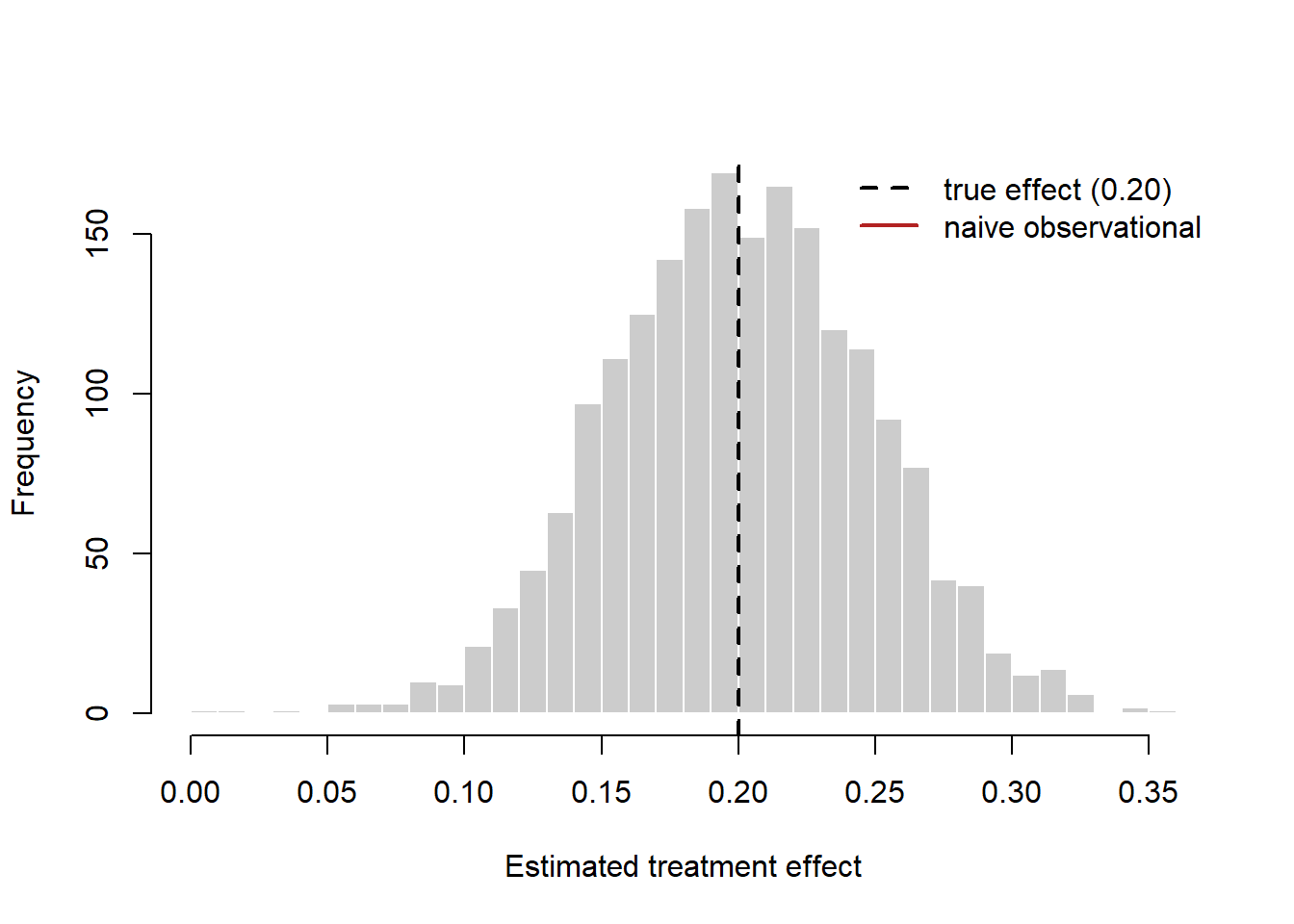
43.3.1 Advertising Measurement: The Hard Case for Experiments
Advertising is the canonical setting where experiments are both essential and difficult. The difficulty is statistical, and Equation 43.5 explains it. The effect of a typical online display campaign on purchase probability is small in absolute terms, while individual purchasing is enormously variable; substituting realistic magnitudes into Equation 43.5 implies that detecting advertising’s true return on investment with confidence can require millions of randomized users—more than many campaigns ever reach (Lewis and Rao 2015). Lewis and Rao show that even well-powered experiments deliver confidence intervals on ROI so wide that firms cannot distinguish a profitable campaign from a money-losing one, and that the observational regressions firms typically run fare far worse.
How much worse is documented by large-scale comparisons. Across digital advertising experiments at scale, observational methods—matching, regression adjustment, propensity scores—routinely yield estimates that diverge sharply from the experimental benchmark, frequently overstating effects by large multiples and occasionally reversing their sign, because no set of observed covariates fully captures why a platform showed a given user a given ad (Gordon et al. 2019b). The lesson is not that observational methods are useless but that, in advertising, the selection-bias term in Equation 43.3 is large relative to the effect itself, so even small failures of the conditional-independence assumption swamp the signal. A recurrent culprit is activity bias: users who are online and active are both more likely to be served (and to “see”) an ad and more likely to convert for reasons unrelated to the ad, manufacturing a spurious correlation that intention-to-treat experimental designs avoid (Lewis, Rao, and Reiley 2011).
These findings reframe the practitioner’s task. The question is rarely “what is the point estimate of ROI?” but “is my experiment powered to answer the decision I face?”—and often the honest answer is to redesign the test (larger, geo-based, or focused on an intermediate outcome) rather than to trust an underpowered or observational number.
43.3.2 Policy Lotteries and the Estimand You Actually Want
Not every randomization is run by a researcher. Governments allocate scarce rights by lottery—visas, permits, school seats, subsidy slots—and those lotteries are experiments whose treatment is a policy, which is often the treatment a decision-maker cares about and rarely the one a study estimates. Clemens and Lewis (2026) make the distinction sharply. The dominant identification strategy in their literature instruments for immigrant presence with historical settlement patterns, which identifies a local average treatment effect of varying immigrant supply regardless of current demand. The policy question is different: what happens when a quota binds on firms that want to hire now? That is a policy-relevant treatment effect, and it is recovered by the quota’s own randomization—the H-2B visa lottery—rather than by an instrument built from history.
Three features of the design are worth importing into marketing work whenever an allocation rule contains randomness. The randomization is at the level of the decision-making unit (the firm), not the individual, so the estimates speak to firm-level adjustment rather than to worker-level exposure. Hypotheses, subsample tests, and predicted signs were committed to a pre-analysis plan before data collection, which converts the heterogeneity analysis from exploration into a test. And the outcome data come from a purpose-built survey of winners and losers rather than from whatever administrative file happened to exist, with prespecified checks on item and global nonresponse. Marketing has more of these opportunities than it uses: oversubscribed beta programs, capacity-rationed loyalty perks, lotteried event invitations, and regulator-run license allocations all embed randomization that a firm can exploit without running an experiment of its own. Section 75.5 treats the same paper as a template for writing up a mechanism rather than an average.
The same logic applies when the randomized policy is an enforcement action rather than an allocation. Fan, Guo, and Ke (2026) use China’s randomized pre-IPO on-site inspection program, under which the securities regulator draws a random subset of IPO applicants for intensive inspection of their books, to estimate the causal effect of proactive public enforcement on the financial reporting quality of applicants in a setting with weak institutional oversight. Selected applicants end up with better reporting, largely because inspection screens out firms with questionable disclosures. The larger effect is deterrence: later applicants, who were never drawn, submit higher-quality reports because they might be. The cost is that some firms that would have merited approval are rejected. Two features carry over to marketing settings. Randomizing the point of enforcement identifies the policy-relevant effect of scrutiny itself, free of the targeting that makes ordinary audits uninformative about deterrence, and the deterrence result is a spillover onto untreated units of exactly the kind Chapter 70 warns will contaminate a naive comparison of inspected firms with their uninspected peers. (Only the published abstract was accessible when this section was written; the magnitudes are in the paper.)
Firms run policy experiments too, and the same point about estimands applies. Fang et al. (2026) randomized nearly one million customers of a global e-commerce platform between an AI-decided, returnless partial refund and the standard process of shipping the item back for a full refund. The treatment arm changes three things at once: who decides, whether the item comes back, and how much is refunded. The experiment therefore identifies the effect of the policy as it would be deployed, not the effect of any single component, and the deployment effect is the quantity the platform’s decision turns on. The outcomes are chosen the same way. Refund payouts, processing costs, later purchasing, and strategic claiming each enter the platform’s payoff, and the paper reports all of them rather than a single headline metric (Section 75.5).
43.4 Difference-in-Differences
When randomization is impossible—a competitor enters a market, a regulator changes a privacy rule, a firm rolls a price change out to some regions before others—the analyst exploits timing. Difference-in-differences compares the change in outcomes for a treated group, before versus after the intervention, against the contemporaneous change for an untreated control group. Differencing over time removes any fixed differences between the groups; differencing across groups removes any common time trend. What remains, under one key assumption, is the treatment effect. Figure 43.4 traces the two subtractions.
flowchart LR
  subgraph TG["Treated group"]
    TP["Mean outcome,<br/>pre-period"] --> TQ["Mean outcome,<br/>post-period"]
  end
  subgraph CG["Control group"]
    CP["Mean outcome,<br/>pre-period"] --> CQ["Mean outcome,<br/>post-period"]
  end
  TP --> DT["First difference, treated:<br/>fixed group differences drop out"]
  TQ --> DT
  CP --> DC["First difference, control:<br/>fixed group differences drop out"]
  CQ --> DC
  DT --> DD["Difference of differences:<br/>common time trend drops out;<br/>equals the ATT under parallel trends"]
  DC --> DD
Formally, with two periods (pre, post) and two groups (treated \(T\), control \(C\)), the DiD estimator is the difference of differences in group means,
\[ \hat\tau_{\text{DiD}} = \big(\bar Y_{T,\text{post}} - \bar Y_{T,\text{pre}}\big) - \big(\bar Y_{C,\text{post}} - \bar Y_{C,\text{pre}}\big). \tag{43.6}\]
In panel-regression form, with unit fixed effects \(\alpha_i\), time fixed effects \(\gamma_t\), and a treatment indicator \(D_{it}\) equal to one for treated units in post-treatment periods,
\[ Y_{it} = \alpha_i + \gamma_t + \tau\,D_{it} + \varepsilon_{it}, \tag{43.7}\]
and \(\hat\tau\) is the DiD (two-way fixed-effects) estimator of the ATT.
Identifying assumption: parallel trends. DiD is unbiased for the ATT if, absent treatment, the treated and control groups would have followed the same trajectory:
\[ \mathbb{E}[Y_{i,\text{post}}(0) - Y_{i,\text{pre}}(0) \mid T] = \mathbb{E}[Y_{i,\text{post}}(0) - Y_{i,\text{pre}}(0) \mid C]. \tag{43.8}\]
The groups may differ in levels—that is differenced away—but their untreated trends must coincide. This assumption is fundamentally untestable, because the treated group’s untreated post-period trend is the missing counterfactual. What is testable is its observable implication: if trends are parallel after treatment, they were typically parallel before. A pre-trends (event-study) check estimates leads and lags of the treatment and asks whether the pre-treatment leads are jointly zero.
What breaks identification. Parallel trends fails whenever something other than the treatment moves the groups differently over the window—a localized demand shock, mean reversion when treatment is assigned to units with unusually low recent outcomes (Ashenfelter’s dip), or anticipation effects. A subtler hazard has emerged in staggered adoption, where units are treated at different times: the standard two-way fixed-effects estimator in Equation 43.7 implicitly uses already-treated units as controls for later-treated ones, and when effects vary over time this “forbidden comparison” can produce a weighted average with negative weights and a biased—even wrong-signed—estimate. Modern heterogeneity-robust estimators address this, and a careful analyst reports both the two-way fixed-effects number and a robust alternative.
Code
set.seed(47)

# Panel: 60 markets x 12 months. Treatment (a price cut) hits half the markets
# in month 7. The control group is constructed to satisfy parallel trends.
n_markets <- 60; n_months <- 12; treat_month <- 7; true_att <- 1.5
markets <- 1:n_markets
treated <- markets %in% sample(markets, n_markets / 2)

panel <- expand.grid(market = markets, month = 1:n_months)
panel$treated <- treated[panel$market]
market_fe <- rnorm(n_markets, 10, 2)[panel$market]   # level differences (ok)
time_fe   <- 0.20 * panel$month                       # common trend (ok)
post      <- panel$month >= treat_month
panel$D   <- as.integer(panel$treated & post)
panel$sales <- market_fe + time_fe + true_att * panel$D +
               rnorm(nrow(panel), 0, 0.8)

# DiD via two-way fixed effects (unit + time dummies).
fit <- lm(sales ~ factor(market) + factor(month) + D, data = panel)
att_hat <- coef(fit)["D"]
ci <- confint(fit)["D", ]
cat(sprintf("True ATT:        %.3f\n", true_att))
#> True ATT:        1.500
cat(sprintf("DiD estimate:    %.3f  [%.3f, %.3f]\n", att_hat, ci[1], ci[2]))
#> DiD estimate:    1.662  [1.437, 1.886]
DiD is the workhorse of advertising-spillover and pricing studies in marketing, precisely because firms so often roll changes out geographically and at staggered times—exactly the structure DiD exploits, and exactly the structure that demands the heterogeneity-robust care just described.
43.5 Instrumental Variables
Sometimes treatment is endogenous and no untreated group plausibly satisfies parallel trends, yet there exists a third variable that shifts the treatment for reasons unrelated to the outcome. Instrumental variables exploit that variable to isolate the slice of treatment variation that is “as good as randomly assigned.” The motivating problem in marketing is the price endogeneity that defeats naive demand estimation: observed prices and quantities are jointly determined by demand and supply, so a regression of quantity on price recovers neither the demand curve nor a causal price elasticity. An instrument that shifts supply (and hence price) without shifting demand traces out the demand curve.
Let the structural (“second-stage”) equation of interest be
\[ Y_i = \beta_0 + \beta_1 D_i + \mathbf{x}_i^{\top}\boldsymbol{\gamma} + u_i, \tag{43.9}\]
where \(D_i\) (e.g., price) is correlated with the error \(u_i\) (\(\mathbb{E}[D_i u_i] \neq 0\)), so OLS is biased. An instrument \(Z_i\) identifies \(\beta_1\) if it satisfies three conditions:
- Relevance: \(Z_i\) shifts the treatment, \(\operatorname{Cov}(Z_i, D_i) \neq 0\). This is testable—it is the first-stage regression.
- Exclusion: \(Z_i\) affects \(Y_i\) only through \(D_i\), not directly, \(\operatorname{Cov}(Z_i, u_i) = 0\). This is untestable and must be argued from institutional knowledge.
- Exogeneity (independence): \(Z_i\) is as good as randomly assigned with respect to the unobservables driving \(Y_i\).
Figure 43.5 depicts the structure in the demand-estimation setting that motivates it.
flowchart LR
  Z["Instrument Z<br/>(supply-side cost shifter)"] -->|"relevance:<br/>the first stage"| D["Endogenous treatment D<br/>(price)"]
  D -->|"causal effect β₁"| Y["Outcome Y<br/>(quantity demanded)"]
  U["Unobserved u<br/>(demand shock)"] -.-> D
  U -.-> Y
The estimator is two-stage least squares (2SLS): regress \(D_i\) on \(Z_i\) and covariates to obtain fitted \(\hat D_i\) (the exogenous part of treatment variation), then regress \(Y_i\) on \(\hat D_i\). With a single instrument and no covariates this reduces to the Wald ratio,
\[ \hat\beta_1^{\text{IV}} = \frac{\operatorname{Cov}(Y_i, Z_i)}{\operatorname{Cov}(D_i, Z_i)} = \frac{\widehat{\text{reduced form}}}{\widehat{\text{first stage}}}. \tag{43.10}\]
What IV identifies. With heterogeneous effects and a binary instrument, 2SLS does not estimate the ATE but the local average treatment effect (LATE): the average effect among compliers—units whose treatment status responds to the instrument—under a monotonicity condition (the instrument moves no unit in the opposite direction). The effect on always-takers and never-takers is not identified. This is a feature to interpret, not a bug to hide: the LATE answers “what is the effect for the units a policy operating through this instrument would actually move?”
What breaks identification. Two failures dominate. A weak instrument (low first-stage correlation) inflates variance and, worse, biases 2SLS toward the OLS estimate it was meant to fix; the conventional diagnostic is a first-stage \(F\)-statistic well above the rule-of-thumb of 10, though that threshold is now known to be optimistic. An exclusion-restriction violation—the instrument affecting the outcome through any channel other than the treatment—biases the estimate by an amount that cannot be detected from the data and must be defended by argument. In demand estimation the classic instruments are cost shifters and, following the differentiated-products tradition, functions of rival products’ characteristics that shift a product’s markup without entering its demand directly (Berry, Levinsohn, and Pakes 1995). The credibility of any IV study lives or dies on the narrative for the exclusion restriction.
Code
set.seed(47)

# Demand estimation with price endogeneity. A demand shock 'xi' raises BOTH
# quantity and (through the firm's pricing) price -> OLS elasticity is biased
# toward zero. A cost shifter 'Z' instruments for price.
n <- 5000
xi   <- rnorm(n)                              # unobserved demand shock
Z    <- rnorm(n)                              # cost shifter (instrument)
price <- 2.0 - 0.8 * Z + 1.0 * xi + rnorm(n) # price rises with demand shock
true_elasticity <- -1.2
logq <- 5 + true_elasticity * price + 1.5 * xi + rnorm(n)  # xi enters demand

ols <- coef(lm(logq ~ price))["price"]

# 2SLS by hand: first stage, then second stage on fitted price.
first  <- lm(price ~ Z)
phat   <- fitted(first)
iv     <- coef(lm(logq ~ phat))["phat"]
F_stat <- summary(first)$fstatistic["value"]

cat(sprintf("True price elasticity:   %.3f\n", true_elasticity))
#> True price elasticity:   -1.200
cat(sprintf("OLS (biased):            %.3f\n", ols))
#> OLS (biased):            -0.628
cat(sprintf("2SLS (IV):               %.3f\n", iv))
#> 2SLS (IV):               -1.195
cat(sprintf("First-stage F:           %.1f\n", F_stat))
#> First-stage F:           1795.5
43.6 Regression Discontinuity
A regression discontinuity design exploits rules that assign treatment based on whether a continuous running variable crosses a known cutoff. A customer becomes a “gold-tier” member at 1,000 loyalty points; a buyer earns free shipping at a $50 basket; an ad campaign targets ZIP codes above a median-income threshold. Units just below and just above the cutoff are, in every respect other than treatment, nearly identical—their assignment is determined by a sliver of the running variable that is plausibly as good as random. Comparing outcomes just above versus just below the threshold therefore identifies the treatment effect at the cutoff.
Let \(X_i\) be the running variable, \(c\) the cutoff, and treatment \(D_i = \mathbf{1}\{X_i \geq c\}\) in the sharp design. The estimand is the jump in the conditional expectation of the outcome at the cutoff,
\[ \tau_{\text{RD}} = \lim_{x \downarrow c} \mathbb{E}[Y_i \mid X_i = x] - \lim_{x \uparrow c} \mathbb{E}[Y_i \mid X_i = x]. \tag{43.11}\]
In practice \(\tau_{\text{RD}}\) is estimated by fitting flexible regressions—usually local linear regressions within a bandwidth \(h\) around \(c\)—separately on each side and reading off the gap at \(c\). In the fuzzy design, crossing the cutoff changes the probability of treatment rather than treatment itself; the jump in outcomes is then scaled by the jump in treatment probability, making fuzzy RD a local IV with cutoff-crossing as the instrument.
Identifying assumption: continuity. RD identifies the effect at the cutoff if the potential outcomes \(\mathbb{E}[Y_i(0) \mid X_i = x]\) and \(\mathbb{E}[Y_i(1) \mid X_i = x]\) are continuous in \(x\) at \(c\)—that is, nothing other than treatment jumps at the threshold. Then any discontinuity in the observed outcome must be caused by the treatment.
What breaks identification. The fatal threat is manipulation of the running variable: if units can precisely control which side of the cutoff they land on—a customer nudging a basket to exactly $50, a salesperson booking revenue to clear a quota—then those who sort just above the cutoff differ systematically from those just below, and continuity fails. The standard diagnostic is the McCrary density test: a discontinuity in the density of \(X\) at \(c\) signals sorting. Two further practices guard validity: confirm that pre-determined covariates do not jump at the cutoff (a placebo RD on baseline characteristics), and show the estimate is robust to bandwidth choice, since RD trades bias (wide bandwidth, more extrapolation) against variance (narrow bandwidth, fewer observations). The estimand is also intrinsically local: RD recovers the effect only at \(c\) and need not generalize to units far from the threshold.
Code
set.seed(47)

# Running variable: loyalty points. Treatment at >= 1000. Smooth baseline
# relationship between points and spending PLUS a true jump of 8 at the cutoff.
n <- 4000; cutoff <- 1000; true_jump <- 8
points  <- runif(n, 600, 1400)
D       <- as.integer(points >= cutoff)
spend   <- 20 + 0.03 * (points - cutoff) + true_jump * D + rnorm(n, 0, 4)

# Local linear RD within a bandwidth, separate slopes each side.
h <- 150
inb <- abs(points - cutoff) <= h
rd_fit <- lm(spend ~ D + I(points - cutoff) + D:I(points - cutoff),
             data = data.frame(spend, D, points), subset = inb)
jump_hat <- coef(rd_fit)["D"]
cat(sprintf("True jump at cutoff: %.3f\n", true_jump))
#> True jump at cutoff: 8.000
cat(sprintf("RD estimate:         %.3f\n", jump_hat))
#> RD estimate:         8.899

s <- sample(n, 400)
plot(points[s], spend[s], pch = 16, col = "grey70", cex = 0.6,
     xlab = "Loyalty points (running variable)", ylab = "Spending")
abline(v = cutoff, lty = 3)
gl <- seq(cutoff - h, cutoff, length.out = 50)
gr <- seq(cutoff, cutoff + h, length.out = 50)
predl <- predict(rd_fit, data.frame(D = 0, points = gl))
predr <- predict(rd_fit, data.frame(D = 1, points = gr))
lines(gl, predl, lwd = 3); lines(gr, predr, lwd = 3)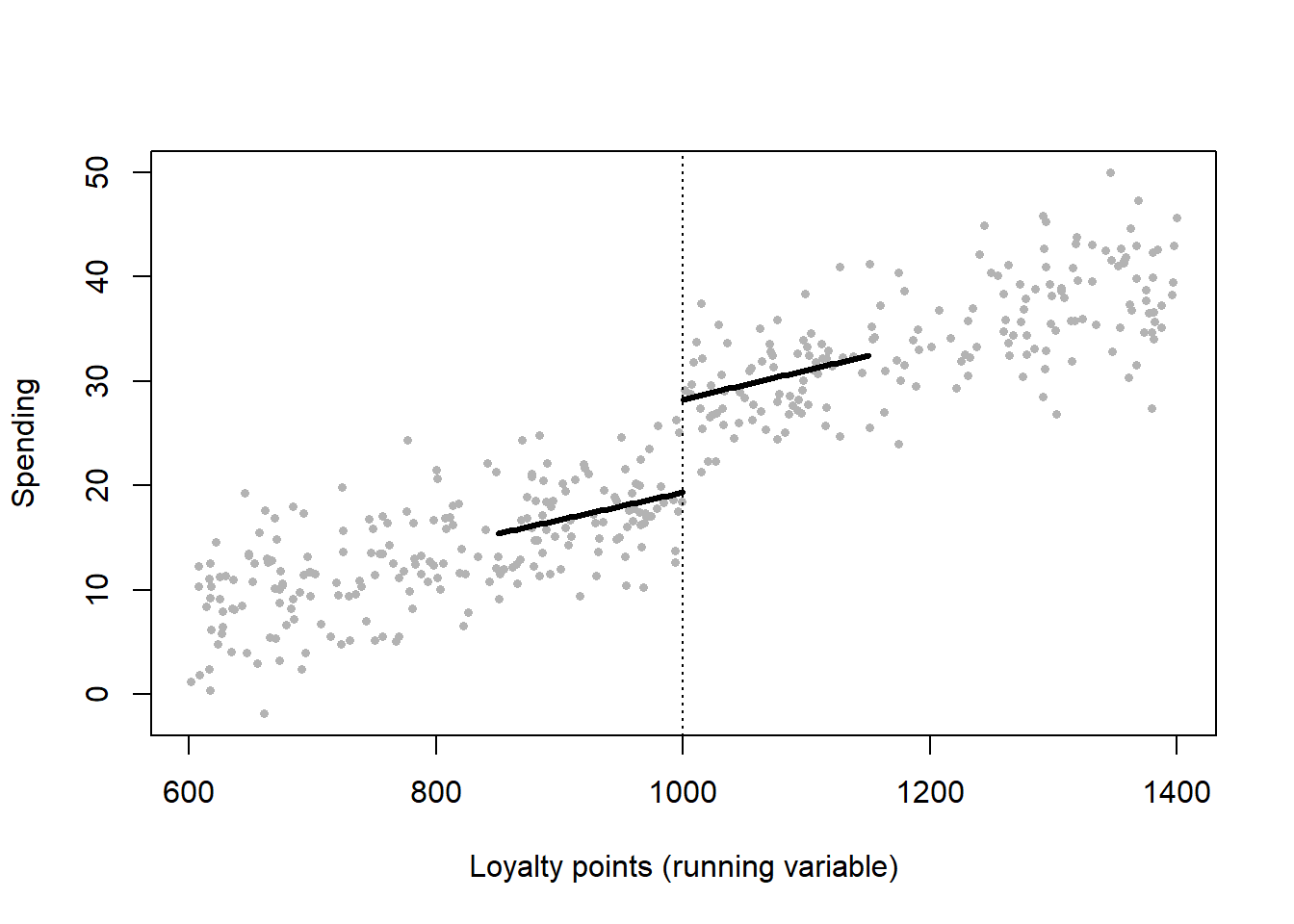
The simulation is sharp; eligibility rules in the field rarely are. Hotchkiss, Iverson, and Zheng (2026) supply a fuzzy design with every diagnostic on display. Subchapter V, a streamlined bankruptcy procedure for small businesses, is open only to debtors whose noncontingent liabilities do not exceed $7.5 million. But eligible firms may still choose traditional Chapter 11, and a dozen cases above the line were admitted after courts classified some of their debts as contingent, so crossing the cutoff shifts the probability of treatment. Firms just below it are 41.9 percentage points more likely to use the procedure (first-stage \(F = 71.23\)). Scaling the jump in plan confirmations by that first stage gives a 32.0-point increase within $4 to $11 million of liabilities and 49.5 points within $6 to $9 million, where identification is most credible but the first-stage \(F\) falls to 19.71.
Three features are worth copying. The running variable was not in the administrative data: reported total liabilities include contingent and unliquidated claims that do not count toward eligibility, so the authors hand-collected each debtor’s schedules of claims to measure it. The validity checks are the full set described above: a McCrary test (\(p = 0.25\)), six covariates smooth individually and jointly, a donut that drops cases between $7 and $7.5 million, second-order polynomials, and a placebo cutoff at $4 million. And the threat specific to this setting is not manipulation but entry, since a more generous procedure could change which firms file at all; the authors bound that possibility rather than assume it away (Section 29.6.3). The same reform also supports a difference-in-differences comparison with pre-2020 filings. Its 12.5-point intent-to-treat estimate, divided by the 0.42 first stage, implies roughly 30 points, so two designs resting on different assumptions arrive at nearly the same local effect.
43.6.1 Boundary Discontinuities: When the Running Variable Is a Place
The loyalty-points example has a running variable that each unit carries as a number. A large and growing class of designs replaces it with geography: the treatment changes at an administrative line—a state border, a school-district boundary, a media-market edge, a judicial-circuit line—and units are compared according to which side of the line they fall on. These are boundary (or spatial, or geographic) discontinuity designs, and they follow the same identification logic as Equation 43.11 with the running variable replaced by signed distance to the boundary.
The appeal is that economic geography is continuous and administrative geography is not. Two adjacent counties share a labor market, weather, commuting patterns, input prices, and regional demand shocks. If a policy, a tax, a regulation, or a legal regime switches on at the line between them, the pair supplies a comparison in which nearly everything except the treatment is held fixed by proximity. In practice the estimator is usually not a single local linear fit but a contiguous-pair regression: each treated unit is matched to the unit it physically borders, and pair fixed effects absorb the shared local conditions.
Canayaz and Gustafson (2026) is a clean instance. Federal appellate circuits partition the United States, and their boundaries cut through continuous economic geography. Comparing a county’s small business count to that of the county it borders, when the two sit in different circuits, the authors find that a one-standard-deviation shift toward less probusiness judicial ideology predicts a 1% reduction in firm count—an effect that operates through the exit of young firms rather than through relocation. The substantive reading is developed in Section 29.6.
The setting also illustrates why a static cross-border comparison would not have sufficed. Federal circuits are built from whole states, so every circuit boundary is also a state boundary and carries the entire apparatus of state tax, licensing, and incorporation law with it. What makes the design work is that the treatment moves along a fixed boundary over time: circuit ideology turns over as judges are appointed and replaced for reasons unconnected to any one county’s economy, so a county-pair effect absorbs the permanent differences between the two states and identification comes from within-pair change. The residual threat is not static state policy but state policy that changes in a way correlated with the timing of judicial turnover—a much narrower claim to have to rule out, and the general lesson for any boundary design whose treatment has a time dimension.
What breaks identification here is different from what breaks a score-based RD. Manipulation of the running variable, the fatal threat in Section 43.6, is mostly irrelevant: a firm cannot nudge its county across a circuit line, and the paper’s finding that the effect runs through exit rather than relocation is itself evidence that sorting is not driving it. Three other threats take its place, and they are the ones to interrogate.
- Coincident boundaries. The identifying assumption is that only the treatment changes at the line. Administrative boundaries are notoriously nested: judicial circuits largely follow state lines, and state lines also carry tax rates, licensing rules, minimum wages, incorporation law, and Medicaid eligibility. A discontinuity estimated at such a line recovers the effect of the bundle, not of the component the researcher has in mind. Boundaries that cut within states, or variation in the treatment’s intensity over time along a fixed boundary, are the standard escapes.
- Spillovers across the line. RD assumes the untreated side reveals the treated side’s counterfactual. Adjacency makes that assumption harder, not easier: workers commute, customers cross, and firms on the control side may be affected by the treatment through exactly the proximity that makes them a good comparison. A treatment effect that leaks across the boundary biases the estimate toward zero.
- Boundary endogeneity and sample size. Some boundaries were drawn because of a pre-existing economic difference, which violates continuity at the moment of drawing. And because only units near the line are usable, effective sample size falls sharply with the bandwidth; standard errors must also be clustered in a way that respects spatial correlation, since neighboring units’ disturbances are not independent.
For marketing, the natural applications sit where a firm’s decision environment switches at a line the customer does not perceive: designated market areas for advertising exposure, state-level privacy and advertising-disclosure regimes (Chapter 26), sales-tax nexus rules for e-commerce, and franchise or distribution territories. In each case the design’s credibility rests on the same question—what else changes at that boundary—rather than on any statistical diagnostic.
43.7 Synthetic Control
Difference-in-differences needs a control group whose untreated trend matches the treated group’s. When the treated unit is a single large entity—one country where a brand launched, one state that changed a privacy law, one market where a flagship store opened—no single control unit is a credible match. The synthetic control method constructs the counterfactual as a weighted average of untreated “donor” units, choosing the weights so that the synthetic unit reproduces the treated unit’s pre-treatment outcome path (and predictors). The treatment effect is then the gap between the treated unit and its synthetic twin after the intervention.
Let unit \(1\) be treated at time \(T_0\) and units \(2,\dots,J+1\) be the donor pool. Choose nonnegative weights \(\mathbf{w} = (w_2,\dots,w_{J+1})\), with \(\sum_j w_j = 1\), to minimize pre-treatment discrepancy,
\[ \mathbf{w}^{\star} = \arg\min_{\mathbf{w}} \sum_{t < T_0}\Big(Y_{1t} - \sum_{j=2}^{J+1} w_j\,Y_{jt}\Big)^2, \quad w_j \geq 0,\ \textstyle\sum_j w_j = 1. \tag{43.12}\]
The estimated effect at each post-period is the gap between the treated unit and the weighted donors,
\[ \hat\tau_{1t} = Y_{1t} - \sum_{j=2}^{J+1} w_j^{\star}\,Y_{jt}, \qquad t \geq T_0. \tag{43.13}\]
Identifying assumptions. SCM identifies the treated unit’s ATT if (i) the weighted donors reproduce the treated unit’s pre-treatment outcomes closely (good pre-fit), (ii) the donors are themselves untreated and free of spillovers from the treatment, and (iii) the relationship that made the synthetic control track the treated unit before treatment continues to hold absent treatment—the synthetic-control analogue of parallel trends, but enforced on the full pre-period path rather than a single trend. The convexity constraints (\(w_j \geq 0\), summing to one) prevent extrapolation outside the donor support and make the weights interpretable.
What breaks identification. Poor pre-treatment fit is disqualifying: if the synthetic unit cannot track the treated unit before the intervention, the post-period gap is not credibly causal. Interpolation bias arises when donors are too dissimilar from the treated unit; overfitting to noise inflates apparent effects when the pre-period is short. Because there is only one treated unit, inference rests not on large-sample theory but on placebo (permutation) tests: reassign the treatment to each donor in turn, compute the placebo gap, and ask whether the true treated unit’s post/pre gap ratio is extreme relative to the placebo distribution.
Code
set.seed(47)

# One treated market + 20 donors over 30 periods; a brand campaign starts at t=21
# and lifts the treated market's sales by a growing amount.
Tn <- 30; T0 <- 20; J <- 20; true_post_effect <- 6
common <- cumsum(rnorm(Tn, 0.2, 0.4))                 # shared latent trend
donors <- sapply(1:J, function(j)
  3 + runif(1, 0.5, 1.5) * common + rnorm(Tn, 0, 0.6))
# Treated market is a convex blend of three donors, pre-treatment.
truew <- numeric(J); truew[c(2, 5, 11)] <- c(0.5, 0.3, 0.2)
treated <- as.numeric(donors %*% truew) + rnorm(Tn, 0, 0.4)
treated[(T0 + 1):Tn] <- treated[(T0 + 1):Tn] +
  true_post_effect * seq_len(Tn - T0) / (Tn - T0)

# Solve for nonnegative weights summing to 1 on the PRE period via a simple
# projected optimization (quadratic loss, simplex constraint).
pre <- 1:T0
loss <- function(w) sum((treated[pre] - donors[pre, ] %*% w)^2)
ui <- rbind(diag(J), rep(-1, J)); ci <- c(rep(0, J), -1)  # w>=0, sum(w)<=1
w0 <- rep(0.9 / J, J)   # interior start: sum < 1, so constrOptim's strict-feasibility check passes
opt <- constrOptim(w0, loss, grad = NULL, ui = ui, ci = ci)
w <- opt$par / sum(opt$par)

synth <- as.numeric(donors %*% w)
gap_post <- mean(treated[(T0 + 1):Tn] - synth[(T0 + 1):Tn])
cat(sprintf("Mean post-period effect (truth ~%.2f): %.3f\n",
            true_post_effect / 2, gap_post))
#> Mean post-period effect (truth ~3.00): 3.313

plot(1:Tn, treated, type = "l", lwd = 2, xlab = "Period", ylab = "Sales",
     ylim = range(c(treated, synth)))
lines(1:Tn, synth, lwd = 2, lty = 2, col = "firebrick")
abline(v = T0 + 0.5, lty = 3)
legend("topleft", bty = "n", lwd = 2, lty = c(1, 2),
       col = c("black", "firebrick"),
       legend = c("treated market", "synthetic control"))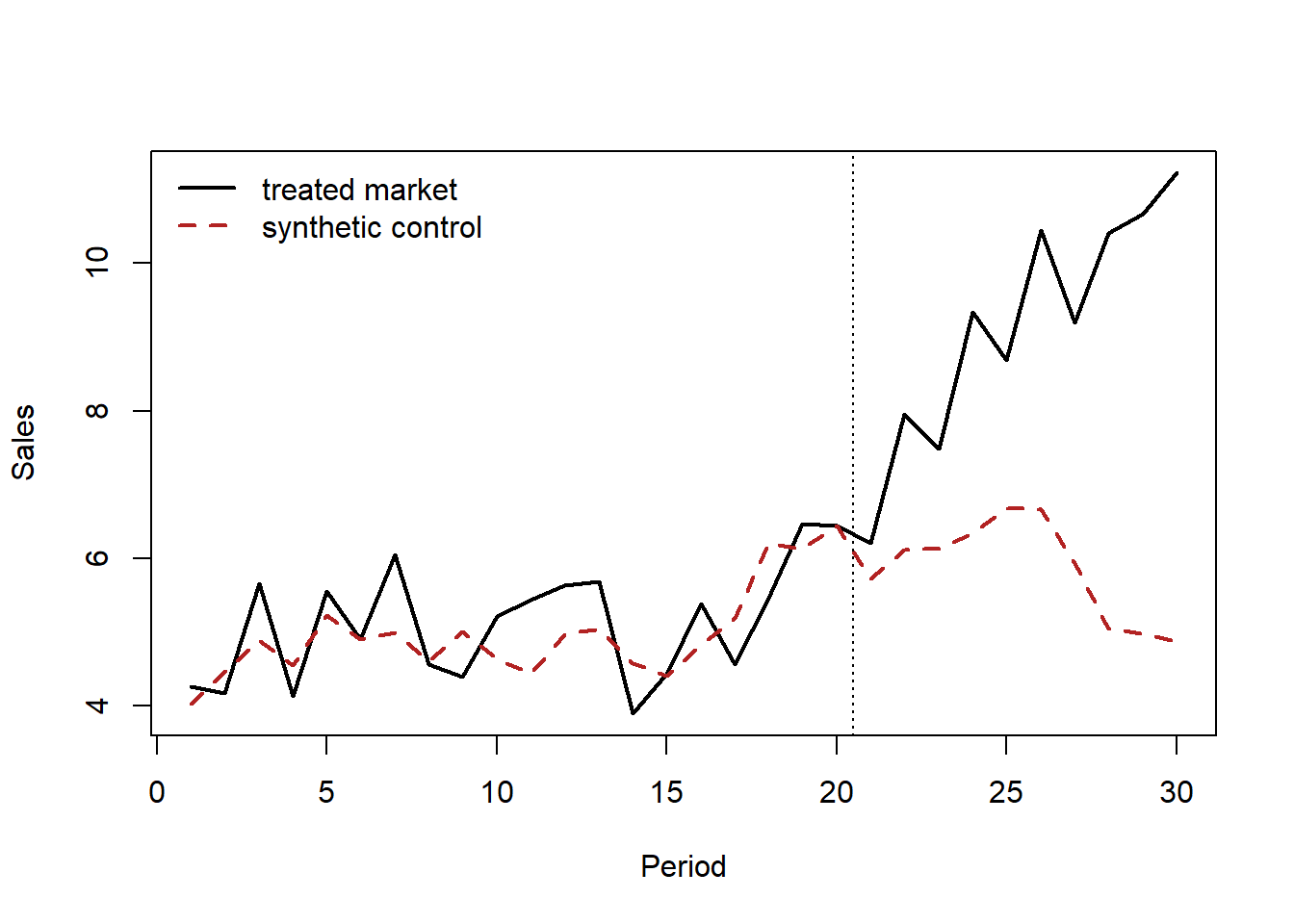
43.8 Mechanism: Causal Mediation and Moderated Mediation
Every design above answers the same question: what did \(D\) do to \(Y\). None of them answers the question a referee asks next, which is through what. Mechanism is not a refinement of the total effect; it is a separate identification problem with its own estimand and its own assumption, and the assumption is not one that randomizing \(D\) can supply. This section states the estimand, states the assumption, and then works through what a credible pathway argument looks like in practice—because the interesting craft question is not how to compute a mediation model but how to defend one.
Controversy: is observational mediation identified at all?
Mediation analysis is among the most-run procedures in consumer research and among the least defensible as usually practised. The critique is old, well known, and routinely ignored, which makes the sequence worth stating plainly.
2010 — the identification objection. Bullock, Green, and Ha (2010) publish Yes, But What’s the Mechanism? (Don’t Expect an Easy Answer). The argument is not that mediation estimates are noisy. It is that randomizing the treatment \(D\) does nothing to randomize the mediator \(M\). Subjects arrive at their mediator values through their own characteristics, so the mediator is observational even inside a perfectly executed experiment, and the sequential-ignorability assumption the estimator requires (Section 43.8.2) is untestable and usually implausible. A bootstrapped indirect effect with a confidence interval excluding zero is not evidence against that objection; it presupposes the objection away.
2017 — the constructive reform position. Pieters (2017) responds not by defending standard practice but by specifying what better practice would be: manipulate the mediator directly where possible, use moderation-of-process designs, report sensitivity analyses that state how strong an unmeasured confounder would have to be to overturn the conclusion, and communicate the causal claim at the strength the design supports rather than at the strength the software output implies.
What this means at the desk. These two positions are not really opposed. The first says the standard estimator does not identify what its users believe it identifies; the second says there are designs that do better and researchers should use them. Neither supports the ubiquitous practice of running a bootstrap on observational mediator data and reporting the indirect effect as a mechanism.
The reviewer’s question is therefore not “did they use the right macro” but “what would have to be true for this indirect effect to be causal, and did the authors argue for it?” Section 76.8.7 places this among the field’s standing methodological disagreements.
43.8.1 The Estimand: Effects That Route Through a Mediator
Let \(M_i\) be a post-treatment variable on the hypothesized pathway and write the outcome as a function of both the treatment and the mediator, \(Y_i(d, m)\). The mediator itself responds to treatment, \(M_i(d)\), so the observed outcome is \(Y_i(D_i, M_i(D_i))\). Two effects follow. The average causal mediation effect (ACME, or indirect effect) holds treatment fixed and moves the mediator to the value it would have taken under each arm,
\[ \delta_i(d) \;=\; Y_i\!\left(d, M_i(1)\right) - Y_i\!\left(d, M_i(0)\right), \tag{43.14}\]
while the average direct effect holds the mediator fixed and moves the treatment,
\[ \zeta_i(d) \;=\; Y_i\!\left(1, M_i(d)\right) - Y_i\!\left(0, M_i(d)\right). \tag{43.15}\]
The two decompose the total effect exactly, \(\tau_i = \delta_i(d) + \zeta_i(1-d)\) for either \(d\), which is the sense in which mediation “accounts for” a share of the effect.
The critical feature of Equation 43.14 is easy to miss. The quantity \(Y_i(d, M_i(1-d))\) is a cross-world counterfactual: it asks what would have happened had the unit received one treatment while its mediator took the value it would have taken under the other. No experiment, however well run, realizes that state for anybody. This is why mediation is harder than it looks in a path diagram, and why its identifying assumption cannot be reduced to a design feature.
43.8.2 Sequential Ignorability, and Why Randomizing \(D\) Is Not Enough
Identification of Equation 43.14 and Equation 43.15 from observed data rests on sequential ignorability (Imai, Keele, and Yamamoto 2010; Imai, Keele, and Tingley 2010), a pair of conditions given pre-treatment covariates \(X_i\):
\[ \{Y_i(d', m),\, M_i(d)\} \perp\!\!\!\perp D_i \mid X_i = x, \tag{43.16}\]
\[ Y_i(d', m) \perp\!\!\!\perp M_i(d) \mid D_i = d,\, X_i = x . \tag{43.17}\]
Equation 43.16 is the familiar unconfoundedness of the treatment, and a randomized trial delivers it for free. Equation 43.17 is not. It says that conditional on treatment and pre-treatment covariates, the mediator is as good as randomly assigned with respect to the outcome—no unmeasured common cause of \(M\) and \(Y\), and no post-treatment confounder of the mediator–outcome link. Randomizing \(D\) does nothing for it, because the mediator is chosen, produced, or realized after assignment. A field experiment with a beautifully clean total effect can have a completely unidentified mechanism, and this is the single most common overclaim in applied mediation work (Bullock, Green, and Ha 2010).
The classical three-regression procedure (Baron and Kenny 1986)—regress \(M\) on \(D\), regress \(Y\) on \(D\), regress \(Y\) on \(D\) and \(M\), and multiply or difference coefficients—is a statistical decomposition. It acquires causal meaning only under Equation 43.16–Equation 43.17, and the product-of-coefficients form additionally assumes no treatment–mediator interaction. When that interaction exists, \(\delta(1) \neq \delta(0)\) and there is no single “indirect effect” to report. The potential-outcomes formulation makes both the assumption and the interaction explicit, which is the reason to prefer it even when the arithmetic ends up similar.
Moderated mediation adds a variable \(W\) that changes the size of the pathway itself, so the estimand becomes \(\delta(d; w)\) and the object of interest is the contrast \(\delta(d; w_1) - \delta(d; w_0)\) (Preacher, Rucker, and Hayes 2007). Used carelessly this is a fishing device: with two moderators and two mediators there are many contrasts and one of them will be significant. Used well, it is the strongest observational evidence a pathway argument can have, because a moderator that is predicted by the mechanism to shut the pathway off converts a correlational story into a falsifiable one.
43.8.3 How a Pathway Argument Is Actually Built
A paper that claims a mechanism is making three claims, not one, and the credible papers defend each separately rather than letting a single structural equation carry all of them.
- The \(D \to M\) link. Treatment moves the mediator. This link inherits whatever design identifies the total effect, so it is usually the easiest to defend.
- The \(M \to Y\) link. The mediator moves the outcome. This is where Equation 43.17 bites, and it almost never comes free: the mediator is typically a decision, and decisions respond to the same unobservables that drive the outcome. Confounding by indication—the treatment is given to those who most need it—is the canonical form in operational and clinical settings.
- The exclusion of the residual direct path. Whatever is left over is attributed to “everything else,” so the interpretation of \(\delta\) depends on having enumerated the alternatives.
Four devices do the real work of defending these claims, and they are worth naming because they generalize far beyond any one paper.
Manipulate the mediator, not just the treatment. The cleanest fix is a design that randomizes \(M\) directly, or a parallel or crossover encouragement design that varies the mediator independently of treatment (Imai, Tingley, and Yamamoto 2013). This buys identification of a mechanism at the price of a stronger consistency assumption: the manipulated mediator must be the same object as the naturally occurring one.
Find a condition that switches the mechanism off. If the proposed pathway is real, there should exist a subpopulation, period, or regime in which it cannot operate—and the effect should vanish there. A predicted null under a mechanism-off condition is far more informative than another significant coefficient, because rival explanations do not generally predict it. This is moderated mediation used as a falsification test rather than as a search.
Argue the direction of the bias. When Equation 43.17 fails, ask which way. If the plausible confounding pushes against the estimate—if the sickest patients are the most likely to receive the treatment whose protective effect you are estimating—then the observed estimate is a conservative bound, and saying so converts an admitted weakness into an argument.
Report where the result breaks, not that it is robust. A sensitivity analysis for mediation parameterizes the violation of Equation 43.17 by the correlation \(\rho\) between the mediator and outcome errors and reports the \(\rho^\*\) at which the ACME crosses zero (Imai, Keele, and Yamamoto 2010). The number is interpretable: a result that survives only up to \(\rho = 0.05\) is fragile, one that survives to \(\rho = 0.4\) is not, and the comparison to the explanatory power of observed covariates gives the reader a yardstick.
43.8.4 A Worked Reading: Diagnostic Bias as an Upstream Process Defect
Zhang and Jetley (2026) is a compact example of all four devices, and it is worth reading as a design rather than as a healthcare result. Pulse oximetry estimates blood oxygen saturation from light absorption, and it systematically overestimates saturation in patients with darker skin pigmentation—a measurement bias documented clinically by Sjoding et al. (2020). The paper’s move is to treat that bias not as a device-calibration problem but as an upstream process defect whose consequences propagate through the clinical decision it feeds, and to trace the resulting chain with a moderated mediation framework on patient-level ICU data from MIMIC-IV.
The chain runs: race \(\to\) a biased saturation reading under peripheral-oximetry (\(\mathrm{SpO}_2\)) monitoring \(\to\) undertreatment with supplemental oxygen \(\to\) unplanned within-hospitalization ICU readmission \(\to\) downstream capacity consumption. The reported magnitudes are, in the authors’ estimates: under \(\mathrm{SpO}_2\)-only monitoring, Black patients are 5.2 percentage points less likely than White patients to receive supplemental oxygen; oxygen delivery reduces the probability of unplanned ICU readmission by 4.8 percentage points, a 37% relative reduction; and, in a separate operational-load analysis by OLS, ICU bounce-backs are associated with an 86% increase in remaining hospital length of stay.
The design’s load-bearing element is none of those numbers. It is the use of arterial oxygen saturation (\(\mathrm{SaO}_2\)) measurement—the accurate, invasive reading—as a quasi-intervention that switches the mechanism off. If the disparity in oxygen therapy is produced by the device’s measurement error, then supplying the clinician with an accurate reading should eliminate it; if it is produced by something else—clinician bias operating directly on race, differential comorbidity, differential unit assignment—an accurate saturation reading has no particular reason to remove it. The authors report that with \(\mathrm{SaO}_2\) available, the racial disparity in oxygen therapy attenuates to statistically indistinguishable from zero. That is the predicted null under the mechanism-off condition, and it is the sentence the causal claim actually rests on.
Notice what the moderator is doing structurally. \(W = 1\{\mathrm{SaO}_2\text{ available}\}\) is not a garden-variety interaction hunting for heterogeneity. It is a theoretical moderator: the mechanism names it in advance, predicts the sign, and predicts the magnitude (zero). Equation 43.14 evaluated at \(W=1\) versus \(W=0\) is therefore a test rather than a description, and the contrast \(\delta(d; 1) - \delta(d; 0)\) is the paper’s real estimate.
43.8.5 Where the Argument Is Still Vulnerable
Reading a design this way is only useful if it also exposes what would break it. Six issues apply to the ICU case and, with the nouns changed, to most observational mediation work in marketing and operations.
The first link has no manipulable cause. Race is not assignable, so \(\delta\) evaluated on it is a disparity decomposition, not the average causal effect of a treatment. The honest statement is that conditional on observed clinical state, patients differ in the probability of receiving oxygen, and that the gap closes when the measurement improves. The causal weight sits on the \(M \to Y\) link and on the moderator contrast, not on the first arrow. Papers that blur this invite an objection they cannot answer.
The moderator is chosen by the same clinicians whose behavior is the outcome. An arterial blood gas is ordered, not assigned. It is ordered for patients who are sicker, less stable, or already a source of concern, so the \(\mathrm{SaO}_2\) subsample is selected on precisely the dimensions that drive treatment. The attenuation could therefore reflect who gets an arterial reading rather than what the reading tells the clinician. Strengthening this would mean comparing within severity strata with explicit balance diagnostics, instrumenting the ordering decision with something that shifts it for non-clinical reasons (unit protocol differences, lab turnaround, shift staffing, time of day), or exploiting within-patient timing: the same patient’s treatment decisions before and after the first arterial reading, with patient fixed effects absorbing the selection that determined who was drawn at all.
Confounding by indication runs through the second link. Supplemental oxygen is given to patients who look hypoxemic, and looking hypoxemic predicts readmission. That biases the protective estimate toward zero, which is the direction that helps: an estimate that survives a bias pushing against it is a lower bound, and the argument is stronger stated that way than as a robustness claim.
The mediator is a bundle. “Received supplemental oxygen” collapses device, flow rate, timing, and duration into a binary. Under multiple versions of the mediator, the ACME is a composite over whatever mix of versions the population happens to realize, and the consistency half of the potential-outcomes setup is doing quiet work. A dose or timing measure would sharpen the estimand.
The sharpest test is not the binary race indicator. The physics of the bias predicts where it should be worst: at low true saturation, where occult hypoxemia, a normal-looking \(\mathrm{SpO}_2\) over a genuinely low \(\mathrm{SaO}_2\), is concentrated. A design that predicts and finds a steeper disparity in exactly that region, and none where readings are unambiguous, is harder to explain away than an average gap, because rival explanations do not predict the gradient.
A placebo pathway is available and cheap. An outcome that clinical oxygenation should not affect, or a treatment decision that does not read the oximeter, should show no disparity under \(\mathrm{SpO}_2\)-only monitoring. Reporting that null costs one table and forecloses a large class of alternatives.
None of this is a complaint about the paper; it is the standard by which the design should be graded, and the design meets a good part of it. The transferable lesson for marketing research is the structure: when the antecedent of interest is an attribute rather than a lever, move the causal burden downstream to links you can defend, and find the condition under which your mechanism is supposed to disappear.
43.8.6 A Second Reading: Moderated Mediation on Firm Panel Data
The oximetry study runs the machinery on patients. Singh et al. (2026) run it on firms, and the contrast is instructive because the identification problem changes shape when the unit is an organization observed annually rather than a patient observed once. The substantive result—open-source product development raises gross margin about 4–5%—is discussed in Chapter 27. What concerns us here is the second stage of their design, which is a textbook-clean instance of a first-stage moderated mediation and repays reading as a template.
The chain is open-source development intensity (\(OSDI\)) \(\to\) labor productivity \(\to\) gross margin, with the volunteer contribution ratio (\(VCR\), the external share of observed contributions to a firm’s repositories) moderating the first link. Estimation is by generalized structural equation modeling, so every path is fit simultaneously, with 5,000 bootstrap replications for the indirect effects. The paths come back as follows: the interaction \(OSDI \times VCR\) on labor productivity is 0.069 (0.025); labor productivity on gross margin is 0.196 (0.013); and the direct \(OSDI \to\) gross margin path survives at 0.011 (0.003), which is what makes the mediation partial.
Which path the moderator sits on is the theoretical claim. This is the first lesson and the most frequently botched. Their theory says external contributors are what convert a GitHub presence into genuine knowledge integration, so the moderator belongs on the \(D \to M\) path—Model 7 in the taxonomy of Hayes (2017) —and nowhere else. Putting \(VCR\) on the \(M \to Y\) path instead (Model 14) would assert something different and, here, implausible: that the rate at which productivity converts into margin depends on who wrote the code. The numbered Hayes models are not a menu to be searched; each one is a distinct hypothesis, and the paper should say in words which link the moderator is claimed to govern before any model is fit.
Report the index, not the ±1 SD table. Their conditional indirect effects are \(-0.001\) (n.s.) at one SD below the mean \(VCR\), \(0.002\) at the mean, and \(0.005\) (\(p<0.01\)) at one SD above. It is tempting to stop there and say the mechanism “works at high external engagement but not at low.” That inference is invalid on its own terms, because a difference in significance is not a significant difference. The quantity that tests the actual claim is the index of moderated mediation—the slope of the indirect effect with respect to the moderator—which they report as \(\omega = 0.014\) (\(p<0.01\)). Without the index, a ±1 SD table is a display, not a test.
Constituent terms in an interaction model are conditional effects, not main effects. Their base model (no interaction) has \(VCR \to\) labor productivity at 0.103 (\(p<0.05\)); in the full model the same coefficient is \(-0.003\) and insignificant. Nothing disappeared. In the full model that coefficient is the effect of \(VCR\) at \(OSDI = 0\), a firm with no open-source development at all, which is both a different quantity and one estimated off the edge of the data. Papers lose referees on this point, and the fix is to say which quantity is being reported and, where the variables are not centered, to say that too.
A threshold recovered from a continuous interaction is an estimate. Plotting the conditional indirect effect across the full range of \(VCR\) shows it crossing zero at roughly 35% external contribution, which is a genuinely useful number—it separates firms using GitHub as a development tool from firms running a community. The authors label it “a sample-specific point at which the labor-productivity pathway becomes positive and statistically discernible, not as a universal managerial cutoff,” and that sentence is the model to copy. A crossover point is a function of estimated coefficients and carries their sampling error; reporting it as a managerial rule launders an interval into a decision boundary.
Partial mediation is a claim about what you did not model. The surviving direct path is not a residual to be waved at. Singh et al. (2026) enumerate the specific alternatives it might carry—community governance, licensing-driven value capture, signaling to investors—and concede the direct effect may run through them. That is the honest form of the third claim in Section 43.8.3: name the candidates for “everything else,” because the interpretation of \(\delta\) is only as good as that enumeration.
Finally, notice where the identification actually stops. Stage 1 of their design is causally serious: staggered difference-in-differences (Callaway and Sant’Anna 2021), the de Chaisemartin–D’Haultfœuille estimator, generalized synthetic control, an instrument built from industry peer adoption, and Arellano–Bond and Blundell–Bond dynamic panels, all converging on 4–5%. None of that machinery carries over to the mediation stage, which is estimated on adopters with year fixed effects and controls. The \(D \to M\) link inherits some of the design’s credibility; the \(M \to Y\) link—labor productivity to gross margin—is an association between two outcomes a firm produces jointly, and Equation 43.17 is doing uncompensated work there. This is not a criticism peculiar to this paper; it is the normal state of mediation analysis in firm panels, and the reason the chapter insists that randomizing \(D\) does not identify a mechanism. A paper in this shape should say plainly that its identification strength declines from stage to stage rather than presenting all three stages in one confident register.
43.8.7 Sensitivity and the Mechanism-Off Contrast in Practice
The simulation below makes both points concrete. It generates a chain \(D \to M \to Y\) with an unobserved confounder \(U\) of the mediator-outcome link, so Equation 43.17 fails by construction and the naive product-of-coefficients estimate of the ACME is biased. It then does two things a careful paper does: sweeps the assumed confounding strength to find where the conclusion flips, and computes the mechanism-off contrast in a regime where the \(D \to M\) path is shut down by design.
Code
set.seed(47)

n <- 8000

# --- Structural parameters ---------------------------------------------------
a_true <- 0.40   # D -> M
b_true <- 0.50   # M -> Y
c_true <- 0.15   # D -> Y (direct)
gam_M  <- 0.60   # U -> M   (unobserved mediator-outcome confounder)
gam_Y  <- 0.70   # U -> Y

D <- rbinom(n, 1, 0.5)
U <- rnorm(n)                                  # never observed by the analyst
M <- a_true * D + gam_M * U + rnorm(n)
Y <- c_true * D + b_true * M + gam_Y * U + rnorm(n)

# --- Naive mediation: the Baron-Kenny product, ignoring U --------------------
a_hat <- unname(coef(lm(M ~ D))["D"])
b_hat <- unname(coef(lm(Y ~ D + M))["M"])

c(truth = a_true * b_true, naive = round(a_hat * b_hat, 3))
#> truth naive
#>  0.20  0.34
The naive estimate is inflated because the mediator coefficient absorbs the effect of \(U\) on \(Y\). The analyst cannot see \(U\), but can ask how much mediator-outcome confounding would be needed to overturn the conclusion. Parameterize the violation by the residual correlation \(\rho\) and re-solve for the mediator slope under each assumed value.
Code
m_fit <- lm(M ~ D)
y_fit <- lm(Y ~ D + M)
s_m   <- summary(m_fit)$sigma
s_y   <- summary(y_fit)$sigma

# Under an assumed error correlation rho, the mediator slope loses the part of
# the M-Y association that rho already explains.
rho_grid <- seq(0, 1, by = 0.02)
acme_rho <- vapply(rho_grid, function(r) {
  b_adj <- unname(coef(y_fit)["M"]) - r * s_y / s_m
  a_hat * b_adj
}, numeric(1))

k        <- which.min(abs(acme_rho))
rho_star <- rho_grid[k]
c(rho_star = rho_star, acme_at_rho_star = round(acme_rho[k], 4))
#>         rho_star acme_at_rho_star
#>            0.800           -0.001
Code
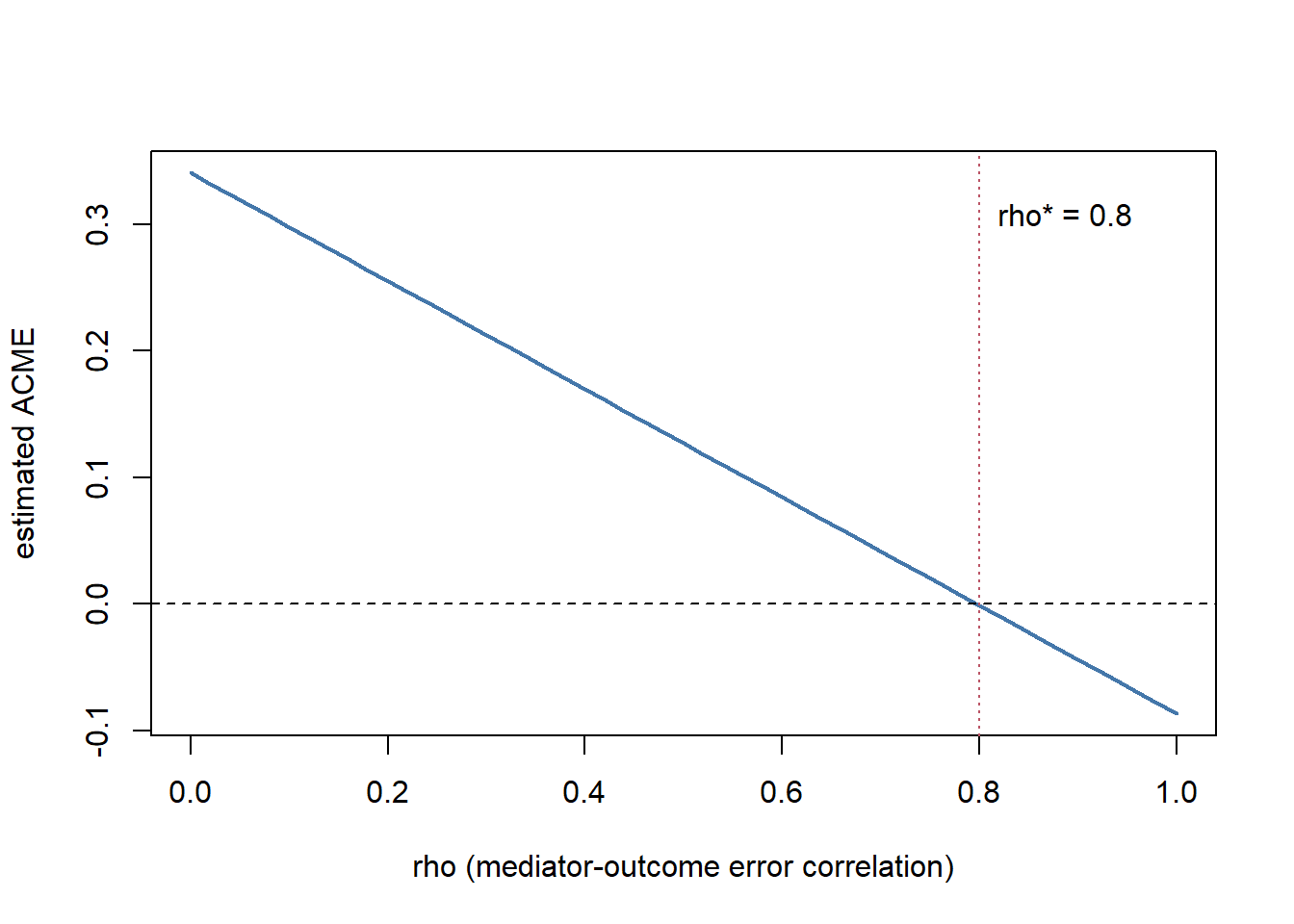
In this configuration the indirect effect survives until \(\rho\) is large, on the order of 0.8, so the conclusion is not fragile to modest mediator-outcome confounding. That is a claim a reader can check against the explanatory power of the observed covariates: if no measured covariate comes close to a residual correlation of 0.8, an unmeasured one probably does not either. “The results are robust” carries none of this information.
The mechanism-off contrast is a different kind of evidence. Suppose a regime \(W=1\) in which the treatment can no longer move the mediator, because accurate information replaces the biased signal, while everything else about the population is held fixed. The indirect effect should vanish there, and the contrast across regimes is the quantity the argument turns on.
Code
W  <- rbinom(n, 1, 0.5)                    # 1 = accurate reading available
# The D -> M path operates only when the biased signal is the clinician's input.
M2 <- a_true * D * (1 - W) + gam_M * U + rnorm(n)
Y2 <- c_true * D + b_true * M2 + gam_Y * U + rnorm(n)

indirect_by_regime <- vapply(c(0, 1), function(w) {
  idx <- W == w
  a_w <- coef(lm(M2[idx] ~ D[idx]))[2]
  b_w <- coef(lm(Y2[idx] ~ D[idx] + M2[idx]))[3]
  unname(a_w * b_w)
}, numeric(1))

names(indirect_by_regime) <- c("mechanism on (W=0)", "mechanism off (W=1)")
round(indirect_by_regime, 3)
#>  mechanism on (W=0) mechanism off (W=1)
#>               0.343              -0.034
The estimate under \(W=1\) is near zero while the estimate under \(W=0\) is not, and the gap between them is what a rival explanation must also reproduce. Both halves matter: the sensitivity sweep tells the reader how much unmeasured confounding the level result can absorb, and the mechanism-off contrast tells the reader whether the proposed channel, rather than some other channel correlated with it, is the one carrying the effect.
43.9 Choosing a Design
No design dominates; each buys identification with a different assumption, and the right choice depends on what variation the world (or the firm) supplies. The comparison below summarizes the trade-offs.
| Design | Estimand | Key assumption | Diagnostic | What breaks it |
|---|---|---|---|---|
| Randomized / A-B test | ATE | Random assignment | Balance / power checks | Interference; peeking |
| Difference-in-differences | ATT | Parallel trends | Pre-trend (event study) | Differential shocks; staggering |
| Instrumental variables | LATE (compliers) | Exclusion + relevance | First-stage F; over-ID | Weak / invalid instrument |
| Regression discontinuity | Local effect at cutoff | Continuity at cutoff | McCrary density; covariate jumps | Manipulation of running var. |
| Boundary discontinuity | Local effect at boundary | Only treatment changes at line | Coincident-boundary audit | Bundled policies; cross-line spillovers |
| Synthetic control | ATT (one unit) | Donors match pre-trend | Pre-fit; placebo permutation | Poor pre-fit; spillovers |
Three principles guide the choice in marketing practice. First, prefer experimentation where the cost of running it is bearable; in advertising and pricing, firms increasingly hold out geographies or randomize at the user level precisely because the observational alternatives are so unreliable (Gordon et al. 2019b). Second, when an experiment is infeasible, match the design to the source of exogenous variation: a sharp eligibility rule invites RD, a staggered rollout invites DiD, a jurisdictional boundary cutting through common economic geography invites a boundary discontinuity (Section 43.6.1), a single large treated entity invites SCM, and a credible supply-side shifter invites IV. Third, triangulate: where two designs with different assumptions point to the same answer, the causal claim is far more credible than any single estimate, because the assumptions fail for different reasons. Figure 43.9 condenses these principles into the decision sequence an analyst walks.
flowchart TD
  Q1{"Can the firm run an experiment<br/>at bearable cost?"}
  Q1 -->|"yes"| EX["Run the experiment:<br/>user-level A-B test or geo holdout<br/>(ATE by design)"]
  Q1 -->|"no"| Q2{"What as-good-as-random<br/>variation does the world supply?"}
  Q2 -->|"sharp eligibility rule"| RD["Regression discontinuity<br/>(local effect at the cutoff)"]
  Q2 -->|"staggered rollout"| DD["Difference-in-differences<br/>(ATT under parallel trends)"]
  Q2 -->|"single large treated entity"| SC["Synthetic control<br/>(ATT for a single treated unit)"]
  Q2 -->|"credible supply-side shifter"| IV["Instrumental variables<br/>(LATE for compliers)"]
  RD --> TRI["Triangulate: agreement across designs<br/>whose assumptions fail for different<br/>reasons strengthens the causal claim"]
  DD --> TRI
  SC --> TRI
  IV --> TRI
43.10 Threats Common to All Designs
Beyond design-specific failures, several threats recur and deserve a standing checklist. Spillovers and general equilibrium: a treatment that changes one unit’s behavior may change untreated units’ behavior (SUTVA failure), and a price experiment that would be profitable at small scale may not survive a firm-wide rollout once competitors and supply respond. Attrition and survivorship: differential dropout between arms reintroduces selection even into a randomized design. Outcome windows and dynamics: advertising and brand effects accumulate and decay, so an effect measured over too short a window understates the true return; carryover (the Koyck/adstock structure of Chapter 13) must be modeled, not assumed away. Multiple comparisons: testing many metrics, segments, or variants inflates false positives, demanding pre-registration of primary outcomes or explicit correction. External validity: every estimand here is local to a population, a period, and a level of treatment intensity; a LATE for compliers, an RD effect at a cutoff, or an SCM effect for one market need not transfer to the firm’s broader decision. Naming the estimand—the discipline this chapter opened with—is the antidote, because it forces the analyst to state precisely whose effect, under what intervention, has been estimated.
43.11 Foundational vs. frontier at a glance
The seminar marks every method as foundational (qualifying-exam material the left column) or frontier (where dissertations are written, the right column). The marketing-specific value-add over a generic econometrics course is concentrated in Weeks 12–14—advertising measurement, incrementality/geo/pricing experiments, and marketplace interference—and in framing every method around small effects, non-stationary platforms, and targeting decisions.
| Block | Foundational core [F] | Frontier extensions [R] |
|---|---|---|
| Framework (Wk 1) | Rubin 1974; Holland 1986; Imbens–Rubin | design- vs. model-based inference |
| Experiments / A/B (Wk 2) | Fisher/Neyman inference; Kohavi | time-series/switchback; always-valid inference |
| Selection on observables (Wk 3) | CIA, bad controls, overlap (Angrist–Pischke) | sensitivity analysis; Athey–Imbens overview |
| IV (Wk 4) | Imbens–Angrist LATE; Angrist–Imbens–Rubin | weak-IV; judge/shift-share designs |
| DiD I (Wk 5) | Card–Krueger; Bertrand–Duflo–Mullainathan | wild-cluster inference |
| DiD II — staggered (Wk 6) | the critique itself is now foundational | Goodman-Bacon; CS; dCDH; Sun–Abraham; BJS; Roth et al. |
| RDD (Wk 7) | Imbens–Lemieux guide | Calonico–Cattaneo–Titiunik robust inference |
| Synthetic control (Wk 8) | Abadie–Diamond–Hainmueller; Abadie JEL | synthetic DiD; gsynth; CausalImpact |
| Panel/event-study (Wk 9) | FE/FD (Wooldridge) | design-based panel experiments; matrix completion |
| Matching/weighting (Wk 10) | Rosenbaum–Rubin; Hirano–Imbens–Ridder | approximate residual balancing; PS-matching inference |
| ML for HTE (Wk 11) | Athey–Imbens causal trees | causal forests; GRF; double/debiased ML |
| Ad measurement (Wk 12) | Lewis–Rao unfavorable economics | ghost ads; experiments-vs-observational (Gordon et al.) |
| Incrementality/geo/pricing (Wk 13) | Blake–Nosko–Tadelis; Anderson–Simester | targeting-policy evaluation; bandit pricing |
| Interference (Wk 14) | Manski reflection problem | Aronow–Samii; Sävje et al.; graph-cluster designs |
Week 6 is the rare case where a critique has itself become foundational: no student can use DiD today without knowing the staggered-adoption failure of the two-way fixed-effects estimator. A paper is promoted from frontier to foundational only once it is standard qualifying-exam material—the staggered-DiD critique is the current example mid-transition.
43.12 How this chapter expands
This chapter is a living syllabus. Future revisions should (1) reconcile this canonical ordering against actual week-by-week reading lists pulled from live PhD syllabi (MIT applied econometrics, Chicago Booth’s causal-inference and quantitative-marketing sequences, Stanford GSB/Econ causal-ML courses, Berkeley digital-experiments, and the Wharton/Columbia/Kellogg marketing-methods seminars), citing program and URL; (2) track Week 6, which moves fastest, as the robust-DiD literature consolidates (continuous treatment, non-absorbing treatment, triple-difference, design-based DiD); (3) deepen the marketing-platform core of Weeks 12–14 with incrementality and geo-experiment methodology as version-of-record DOIs appear (much of it currently lives in working papers and platform tech reports), plus the growing experimentation-under-interference literature for marketplaces and recommender systems; (4) add a power/design appendix on MDE/power for small-lift ad experiments, variance reduction (CUPED), cluster-randomization power loss, and sequential testing; (5) add a software/replication appendix mapping methods to canonical packages (grf, DoubleML/econml, did, fixest/sunab, rdrobust, Synth/synthdid/gsynth, CausalImpact); and (6) maintain the foundational/frontier marking as the load-bearing pedagogical device.
43.13 Key Takeaways
- A causal effect is a comparison of potential outcomes (Equation 43.1); because only one is observed per unit (Equation 43.2), every estimate rests on an assumption that recovers the missing counterfactual.
- The naive treated-minus-untreated difference is biased by selection (Equation 43.3); randomization removes the bias by construction, which is why field experiments and A/B tests are the benchmark.
- In advertising, the effect is small relative to sales volatility, so experiments must be very large to be conclusive and observational substitutes can err by multiples or in sign (Lewis and Rao 2015; Gordon et al. 2019b).
- Each quasi-experimental design targets a specific estimand under a specific assumption—DiD/ATT under parallel trends, IV/LATE under exclusion, RD under continuity, SCM/ATT under donor pre-fit—and each has a named diagnostic and a named failure mode (Table 43.1).
- Boundary discontinuities replace the running variable with a location: units on either side of an administrative line share economic geography but not the treatment (Section 43.6.1). Manipulation is rarely the threat; coincident boundaries are, because administrative lines arrive bundled with tax, licensing, and regulatory changes, and adjacency invites spillovers across the line (Canayaz and Gustafson 2026).
- Name the estimand before choosing a method, probe the identifying assumption with its diagnostic, and triangulate across designs whose assumptions fail for different reasons.
- Mechanism is a separate identification problem. The indirect effect (Equation 43.14) is defined by a cross-world counterfactual, so it requires sequential ignorability (Equation 43.16–Equation 43.17), and randomizing the treatment supplies only the first half (Imai, Keele, and Yamamoto 2010; Bullock, Green, and Ha 2010). A clean total effect does not buy a clean mechanism.
- A pathway argument is defended by manipulating the mediator, finding a condition that switches the mechanism off, signing the direction of the residual bias, and reporting the confounding strength at which the conclusion flips—not by adding a third regression. Zhang and Jetley (2026) is a compact example: pulse-oximetry measurement bias is traced from race to undertreatment to unplanned ICU readmission, with the availability of an accurate arterial reading serving as the moderator under which the disparity is predicted—and found—to vanish (Section 43.8.4).
- In a moderated mediation, the path the moderator sits on is the hypothesis: Model 7 (moderating \(D \to M\)) and Model 14 (moderating \(M \to Y\)) assert different theories and are not interchangeable (Hayes 2017). Test the claim with the index of moderated mediation, not with a table of conditional effects at ±1 SD, because a difference in significance is not a significant difference; read constituent terms in the interaction model as conditional effects at moderator zero; and treat any crossover threshold as an estimate with sampling error rather than a managerial cutoff (Section 43.8.6).
43.14 Further Reading
The potential-outcomes framework and the estimators in this chapter are developed at length in the standard graduate econometrics references (Cameron and Trivedi 2005; Greene 2003) and in the econometric treatments of program evaluation (Heckman and Vytlacil 2007; Abbring and Heckman 2007). For demand estimation with endogenous prices and instruments built from rival product characteristics, the differentiated-products literature is the entry point (Berry, Levinsohn, and Pakes 1995). The advertising-measurement evidence that motivates experimentation over observational inference is most directly accessible through the large-scale experimental comparisons cited above (Lewis, Rao, and Reiley 2011; Lewis and Rao 2015; Gordon et al. 2019b), and the dynamics of advertising response that complicate any single-window estimate are treated in Chapter 13. On boundary discontinuities, Canayaz and Gustafson (2026) is a compact worked example—contiguous-county comparisons across federal judicial circuits, with the exit-versus-relocation decomposition that shows what the design can separate; its substantive reading is in Section 29.6.
On mechanism, the classical procedure and its vocabulary come from Baron and Kenny (1986), and the potential-outcomes reconstruction that gives the indirect effect a causal definition, an identifying assumption, and a sensitivity analysis is developed in Imai, Keele, and Yamamoto (2010) and Imai, Keele, and Tingley (2010); Imai, Tingley, and Yamamoto (2013) sets out the experimental designs—parallel, crossover, encouragement—that identify a mechanism rather than assume one. Bullock, Green, and Ha (2010) is the sharpest short statement of why a randomized treatment does not buy a randomized mediator. For the moderated-mediation estimand and the conditional indirect effect, see Preacher, Rucker, and Hayes (2007). Zhang and Jetley (2026) is the worked design read in Section 43.8.4, and the underlying clinical measurement bias is documented in Sjoding et al. (2020).
The primary sources behind each design are worth reading in the order the chapter develops them. The potential-outcomes framework itself is Rubin (1974), which is where the notation of this chapter originates and where the stability assumption that everything else leans on is first made explicit. For instrumental variables, Imbens and Angrist (1994) and Angrist, Imbens, and Rubin (1996) establish that an instrument identifies a local average treatment effect defined on compliers rather than the population average — the single most misread result in applied work — and the weak-instrument diagnostics that decide whether that identification is worth anything come from Staiger and Stock (1997).
Difference-in-differences has two separate literatures a reader must not conflate. The inference problem — serially correlated outcomes making conventional standard errors far too small — is Bertrand, Duflo, and Mullainathan (2004), and the design’s canonical application is Card and Krueger (1994). The identification problem under staggered adoption is newer and more damaging: with treatment timing varying across units and effects varying over time, the two-way fixed-effects estimator averages some comparisons with negative weights and can return an estimate of the wrong sign (Goodman-Bacon 2021), which is why the group-time estimators of Callaway and Sant’Anna (2021) should now be the default rather than the robustness check.
For regression discontinuity, Imbens and Lemieux (2008) and Lee and Lemieux (2010) are the practical guides — bandwidth choice, polynomial order, covariate balance — and McCrary (2008) supplies the density test that decides whether units sorted across the threshold, which is the assumption the whole design rests on. When no discontinuity and no natural comparison group exist, the synthetic-control construction of Abadie, Diamond, and Hainmueller (2010) builds a weighted comparison unit from a donor pool, with the pre-treatment fit serving as its own diagnostic.
On the experimental side, the marketing field’s cleanest demonstrations that observational advertising estimates diverge sharply from experimental ones are Gordon et al. (2019a) and its follow-on Gordon et al. (2021), while Shapiro, Hitsch, and Tuchman (2021) shows how little survives when the same design is replicated across hundreds of brands rather than one. For pricing specifically, Anderson and Simester (2003) remains the model of a field experiment that isolates a single design parameter. Finally, anyone running continuously monitored online experiments should understand why repeatedly checking a fixed-horizon test inflates the false-positive rate well beyond its nominal level, and adopt a sequential or always-valid procedure instead — the peeking problem is not a rare edge case but the default behavior of most experimentation dashboards.
Abadie, Alberto, Alexis Diamond, and Jens Hainmueller. 2010. “Synthetic Control Methods for Comparative Case Studies: Estimating the Effect of California’s Tobacco Control Program.” Journal of the American Statistical Association 105 (490): 493–505. https://doi.org/10.1198/jasa.2009.ap08746.
Abbring, Jaap H, and James J Heckman. 2007. “Econometric Evaluation of Social Programs, Part III: Distributional Treatment Effects, Dynamic Treatment Effects, Dynamic Discrete Choice, and General Equilibrium Policy Evaluation.” Handbook of Econometrics 6: 5145–5303.
Anderson, Eric T., and Duncan I. Simester. 2003. Quantitative Marketing and Economics 1 (1): 93–110. https://doi.org/10.1023/a:1023581927405.
Angrist, Joshua D., Guido W. Imbens, and Donald B. Rubin. 1996. “Identification of Causal Effects Using Instrumental Variables.” Journal of the American Statistical Association 91 (434): 444–55. https://doi.org/10.1080/01621459.1996.10476902.
Baron, Reuben M., and David A. Kenny. 1986. “The Moderator–Mediator Variable Distinction in Social Psychological Research: Conceptual, Strategic, and Statistical Considerations.” Journal of Personality and Social Psychology 51 (6): 1173–82. https://doi.org/10.1037/0022-3514.51.6.1173.
Berry, Steven, James Levinsohn, and Ariel Pakes. 1995. “Automobile Prices in Market Equilibrium.” Econometrica 63 (4): 841. https://doi.org/10.2307/2171802.
Bertrand, M., E. Duflo, and S. Mullainathan. 2004. “How Much Should We Trust Differences-in-Differences Estimates?” The Quarterly Journal of Economics 119 (1): 249–75. https://doi.org/10.1162/003355304772839588.
Blake, Thomas, Chris Nosko, and Steven Tadelis. 2015. “Consumer Heterogeneity and Paid Search Effectiveness: A Large-Scale Field Experiment.” Econometrica 83 (1): 155–74. https://doi.org/10.3982/ecta12423.
Bullock, John G., Donald P. Green, and Shang E. Ha. 2010. “Yes, but What’s the Mechanism? (Don’t Expect an Easy Answer).” Journal of Personality and Social Psychology 98 (4): 550–58. https://doi.org/10.1037/a0018933.
Callaway, Brantly, and Pedro H. C. Sant’Anna. 2021. “Difference-in-Differences with Multiple Time Periods.” Journal of Econometrics 225 (2): 200–230. https://doi.org/10.1016/j.jeconom.2020.12.001.
Cameron, A Colin, and Pravin K Trivedi. 2005. Microeconometrics: Methods and Applications. Cambridge university press.
Canayaz, Mehmet I., and Matthew T. Gustafson. 2026. “Small Business Judging Judges.” Management Science. https://doi.org/10.1287/mnsc.2024.08333.
Card, David, and Alan B. Krueger. 1994. “Minimum Wages and Employment: A Case Study of the Fast-Food Industry in New Jersey and Pennsylvania.” American Economic Review 84 (4): 772–93.
———. 2000. “Minimum Wages and Employment: A Case Study of the Fast-Food Industry in New Jersey and Pennsylvania: Reply.” American Economic Review 90 (5): 1397–1420. https://doi.org/10.1257/aer.90.5.1397.
Clemens, Michael A., and Ethan G. Lewis. 2026. “The Effect of Low-Skill Immigration Restrictions on US Firms and Workers: Evidence from a Randomized Lottery.” American Economic Journal: Applied Economics 18 (3): 43–82. https://doi.org/10.1257/app.20250049.
Dehejia, Rajeev H., and Sadek Wahba. 1999. “Causal Effects in Nonexperimental Studies: Reevaluating the Evaluation of Training Programs.” Journal of the American Statistical Association 94 (448): 1053–62. https://doi.org/10.1080/01621459.1999.10473858.
Fan, Manyi, Kai Guo, and Bin Ke. 2026. “Public Enforcement and Initial Public Offering Reporting Quality in Weak Institutional Environments: Evidence from a Random Experiment in China.” Management Science. https://doi.org/10.1287/mnsc.2024.05042.
Fang, Lu, Chunhua Wu, Zhe Yuan, and Kaifu Zhang. 2026. “Returnless Partial Refunds: A Large-Scale Field Experiment in E-Commerce.” Marketing Science. https://doi.org/10.1287/mksc.2025.0618.
Goodman-Bacon, Andrew. 2021. “Difference-in-Differences with Variation in Treatment Timing.” Journal of Econometrics 225 (2): 254–77. https://doi.org/10.1016/j.jeconom.2021.03.014.
Gordon, Brett R., Kinshuk Jerath, Zsolt Katona, Sridhar Narayanan, Jiwoong Shin, and Kenneth C. Wilbur. 2021. “Inefficiencies in Digital Advertising Markets.” Journal of Marketing 85 (1): 7–25. https://doi.org/10.1177/0022242920913236.
Gordon, Brett R., Florian Zettelmeyer, Neha Bhargava, and Dan Chapsky. 2019a. “A Comparison of Approaches to Advertising Measurement: Evidence from Big Field Experiments at Facebook.” Marketing Science 38 (2): 193–225. https://doi.org/10.1287/mksc.2018.1135.
———. 2019b. “A Comparison of Approaches to Advertising Measurement: Evidence from Big Field Experiments at Facebook.” Marketing Science 38 (2): 193–225. https://doi.org/10.1287/mksc.2018.1135.
Greene, William H. 2003. Econometric Analysis. Pearson Education India.
Hayes, Andrew F. 2017. Introduction to Mediation, Moderation, and Conditional Process Analysis: A Regression-Based Approach. 2nd ed. New York: Guilford Press.
Heckman, James J, and Edward J Vytlacil. 2007. “Econometric Evaluation of Social Programs, Part II: Using the Marginal Treatment Effect to Organize Alternative Econometric Estimators to Evaluate Social Programs, and to Forecast Their Effects in New Environments.” Handbook of Econometrics 6: 4875–5143.
Hotchkiss, Edith, Benjamin Iverson, and Xiang Zheng. 2026. “Can Small Businesses Survive Chapter 11?” The Journal of Finance 81 (5): 2493–2542. https://doi.org/10.1111/jofi.70076.
Imai, Kosuke, Luke Keele, and Dustin Tingley. 2010. “A General Approach to Causal Mediation Analysis.” Psychological Methods 15 (4): 309–34. https://doi.org/10.1037/a0020761.
Imai, Kosuke, Luke Keele, and Teppei Yamamoto. 2010. “Identification, Inference and Sensitivity Analysis for Causal Mediation Effects.” Statistical Science 25 (1). https://doi.org/10.1214/10-STS321.
Imai, Kosuke, Dustin Tingley, and Teppei Yamamoto. 2013. “Experimental Designs for Identifying Causal Mechanisms.” Journal of the Royal Statistical Society Series A: Statistics in Society 176 (1): 5–51. https://doi.org/10.1111/j.1467-985X.2012.01032.x.
Imbens, Guido W., and Joshua D. Angrist. 1994. “Identification and Estimation of Local Average Treatment Effects.” Econometrica 62 (2): 467. https://doi.org/10.2307/2951620.
Imbens, Guido W., and Thomas Lemieux. 2008. “Regression Discontinuity Designs: A Guide to Practice.” Journal of Econometrics 142 (2): 615–35. https://doi.org/10.1016/j.jeconom.2007.05.001.
Johnson, Jeff S., Scott B. Friend, and Hannah S. Lee. 2017. “Big Data Facilitation, Utilization, and Monetization: Exploring the 3Vs in a New Product Development Process.” Journal of Product Innovation Management 34 (5): 640–58. https://doi.org/10.1111/jpim.12397.
Lee, David S, and Thomas Lemieux. 2010. “Regression Discontinuity Designs in Economics.” Journal of Economic Literature 48 (2): 281–355. https://doi.org/10.1257/jel.48.2.281.
Lewis, Randall A., and Justin M. Rao. 2015. “The Unfavorable Economics of Measuring the Returns to Advertising .” The Quarterly Journal of Economics 130 (4): 1941–73. https://doi.org/10.1093/qje/qjv023.
Lewis, Randall A., Justin M. Rao, and David H. Reiley. 2011. “The 20th International Conference.” In Proceedings of the 20th International Conference on World Wide Web. ACM Press. https://doi.org/10.1145/1963405.1963431.
McCrary, Justin. 2008. “Manipulation of the Running Variable in the Regression Discontinuity Design: A Density Test.” Journal of Econometrics 142 (2): 698–714. https://doi.org/10.1016/j.jeconom.2007.05.005.
Neumark, David, and William Wascher. 2000. “Minimum Wages and Employment: A Case Study of the Fast-Food Industry in New Jersey and Pennsylvania: Comment.” American Economic Review 90 (5): 1362–96. https://doi.org/10.1257/aer.90.5.1362.
Pieters, Rik. 2017. “Meaningful Mediation Analysis: Plausible Causal Inference and Informative Communication.” Journal of Consumer Research 44 (3): 692–716. https://doi.org/10.1093/jcr/ucx081.
Preacher, Kristopher J., Derek D. Rucker, and Andrew F. Hayes. 2007. “Addressing Moderated Mediation Hypotheses: Theory, Methods, and Prescriptions.” Multivariate Behavioral Research 42 (1): 185–227. https://doi.org/10.1080/00273170701341316.
Rubin, Donald B. 1974. “Estimating Causal Effects of Treatments in Randomized and Nonrandomized Studies.” Journal of Educational Psychology 66 (5): 688–701. https://doi.org/10.1037/h0037350.
Shapiro, Bradley T., Günter J. Hitsch, and Anna E. Tuchman. 2021. “TV Advertising Effectiveness and Profitability: Generalizable Results from 288 Brands.” Econometrica 89 (4): 1855–79. https://doi.org/10.3982/ECTA17674.
Singh, Shivendu Pratap, Narayan Ramasubbu, Chris F. Kemerer, and Muhammad Zia Hydari. 2026. “Profitability of Open-Source Software Product Development.” Information Systems Research. https://doi.org/10.1287/isre.2025.1821.
Sjoding, Michael W., Robert P. Dickson, Theodore J. Iwashyna, Steven E. Gay, and Thomas S. Valley. 2020. “Racial Bias in Pulse Oximetry Measurement.” New England Journal of Medicine 383 (25): 2477–78. https://doi.org/10.1056/NEJMc2029240.
Smith, Jeffrey A., and Petra E. Todd. 2005. “Does Matching Overcome LaLonde’s Critique of Nonexperimental Estimators?” Journal of Econometrics 125 (1–2): 305–53. https://doi.org/10.1016/j.jeconom.2004.04.011.
Staiger, Douglas, and James H. Stock. 1997. “Instrumental Variables Regression with Weak Instruments.” Econometrica 65 (3): 557. https://doi.org/10.2307/2171753.
Zhang, He, and Gaurav Jetley. 2026. “Beyond the Pulse: Racial Disparities in Pulse Oximetry Readings and the Influence on Intensive Care Unit Readmission Rates.” Production and Operations Management. https://doi.org/10.1177/10591478261474395.
David Card and Alan B. Krueger (1994), “Minimum Wages and Employment: A Case Study of the Fast-Food Industry in New Jersey and Pennsylvania,” American Economic Review 84(4), 772–793. The 1994 article predates DOI assignment; the 2000 exchange it provoked is cited above by DOI.↩︎
Robert J. LaLonde (1986), “Evaluating the Econometric Evaluations of Training Programs with Experimental Data,” American Economic Review 76(4), 604–620. The article predates DOI assignment; the reassessments it provoked are cited above by DOI.↩︎
A discipline this chapter enforces: name the estimand before choosing a method. Much confusion in applied marketing arises from estimating one quantity (say, an ATT among self-selected adopters) and interpreting it as another (the ATE the firm would obtain by treating everyone). The two coincide only under constant effects.↩︎