flowchart LR
  SV["Shared values"] --> T["Trust"]
  COMM["Communication"] --> T
  OPP["Opportunistic<br/>behavior"] -->|–| T
  BEN["Relationship<br/>benefits"] --> C["Commitment"]
  TC["Termination<br/>costs"] --> C
  SV --> C
  T --> C
  C --> ACQ["Acquiescence"]
  C --> LEAVE["Propensity<br/>to leave (–)"]
  T --> COOP["Cooperation"]
  T --> UNC["Decision<br/>uncertainty (–)"]
5 Trust, Commitment, and Loyalty
If satisfaction (Chapter 4) is the evaluative residue of a single consumption episode, the relational constructs are what accumulate across many. Marketing’s “relational turn” of the late 1980s reframed exchange not as a sequence of independent transactions but as an ongoing relationship with a past and an expected future, and it imported a family of constructs to describe the glue that holds such relationships together: trust, the willingness to rely on a partner one is confident in; commitment, the enduring desire to maintain a valued relationship; and loyalty, the resulting disposition to keep choosing the same partner despite situational pulls to defect. These three are the most theorized intangibles in relationship marketing, and they form a short causal chain—trust and commitment are the psychological mediators, loyalty the behavioral-attitudinal outcome—whose links have been estimated and re-estimated for three decades.
This chapter treats them as a system rather than three isolated scales. We open with the relational turn that made the constructs necessary, then define and formalize each in turn: trust as a two-dimensional belief, commitment as a multi-component bond, and loyalty as a two-by-two of attitude and behavior layered over a four-phase developmental sequence. We then assemble them into the commitment–trust theory of relationship marketing—the field’s canonical mediation model—and show, with reproducible code, how it is identified and estimated as a structural model of latent constructs. The chapter closes with the meta-analytic evidence on what drives and what follows from these constructs, and with the disciplining findings that puncture the naive view that more relationship is always better. Throughout, the measurement apparatus of Chapter 3 is doing silent work: trust, commitment, and loyalty are latent constructs measured by reflective indicators, and every estimate below inherits the reliability and validity problems developed there.
5.1 The Relational Turn
The intellectual pivot is Dwyer, Schurr, and Oh (1987), who argued that marketing had over-invested in the discrete transaction—a clean, anonymous, price-mediated exchange with no past and no future—and under-theorized relational exchange, in which the parties’ history and anticipated future govern present behavior. They mapped a developmental sequence (awareness, exploration, expansion, commitment, dissolution) through which a buyer–seller dyad passes, and in doing so they relocated the object of study from the act of purchase to the relationship that produces a stream of purchases. The move had a measurement consequence that this chapter inherits: once the relationship is the unit of theory, the constructs worth measuring are the ones that characterize relationships—how much the parties trust each other, how committed they are, how loyal the buyer is—rather than the attributes of any single transaction.
The relational turn drew its theoretical spine from social exchange theory: relationships persist when each party’s outcomes exceed both their internal comparison level (what they feel they deserve) and the comparison level of alternatives (what they could get elsewhere). Trust and commitment are, in this reading, the psychological residues of a history of exchanges whose outcomes have repeatedly cleared those bars. The constructs are therefore not free-floating attitudes but relationship-specific states, which is why they are typically measured with reference to a named partner (“this supplier,” “this brand”) rather than in the abstract.
5.2 Trust
Trust is the willingness of a party to rely on an exchange partner in whom it has confidence. The most durable conceptualization, from Moorman, Zaltman, and Deshpandé (1992) and Moorman, Deshpandé, and Zaltman (1993), decomposes it into two beliefs that are routinely distinguished both theoretically and empirically:
- Credibility (reliability): the belief that the partner has the expertise and dependability to perform effectively and as promised—a competence judgment.
- Benevolence: the belief that the partner is genuinely interested in the truster’s welfare and will not act opportunistically when new conditions arise for which no commitment was made—a motive judgment.
The distinction matters because the two beliefs have different antecedents and different failure modes. A supplier can be highly credible (it always delivers) yet low in benevolence (it will exploit any contractual gap), and a partner that is benevolent but unreliable inspires affection without dependence. Moorman, Deshpandé, and Zaltman (1993) define trust operationally as a willingness to rely on a partner—deliberately separating the belief (confidence in the partner) from the behavioral intention (willingness to act on that confidence), because a party may trust and yet decline to rely when the stakes are too high. This separation foreshadows the identification problem in the commitment–trust model: trust is a latent belief, and the behaviors we observe (continued reliance, information sharing) are its consequences, not the construct itself.
5.2.1 Formalizing reliance under uncertainty
Trust does its work precisely when outcomes are uncertain and the partner could defect. A minimal decision-theoretic statement makes the role of the two beliefs explicit. Let a truster choose whether to rely (\(r = 1\)) or not (\(r = 0\)) on a partner who may honor the relationship (probability \(p\)) or exploit it (probability \(1 - p\)). Reliance yields gain \(G\) if honored and loss \(L\) if exploited; non-reliance yields a safe outcome normalized to \(0\). The truster relies when expected value is positive,
\[ p\,G - (1 - p)\,L > 0 \quad\Longleftrightarrow\quad p > \frac{L}{G + L}. \tag{5.1}\]
The two belief dimensions enter through different terms. Credibility governs \(p\), the perceived probability the partner is able to honor the relationship; benevolence governs the truster’s assessment that the partner is willing to forgo the exploitation payoff even when \(1 - p\) situations arise. Equation Equation 5.1 also exposes why trust substitutes for contracts: raising perceived \(p\) (through reputation, history, or relational norms) lowers the threshold performance a formal safeguard would otherwise have to guarantee, which is the economic content of the claim that trust reduces transaction costs. It also shows trust is stake-dependent: as the loss \(L\) from betrayal grows relative to the gain \(G\), the required confidence rises, so the same belief supports reliance on small matters but not large ones—exactly the belief-versus-behavior gap Moorman, Deshpandé, and Zaltman (1993) insist on.
5.3 Commitment
Commitment is an enduring desire to maintain a valued relationship—a pledge of relational continuity that, unlike a single satisfied transaction, persists across episodes and resists short-term temptation. Gundlach, Achrol, and Mentzer (1995) give the construct its standard internal structure, distinguishing three components that are now treated as conceptually (if not always empirically) separable:
- Affective (attitudinal) commitment: an emotional attachment and identification with the partner—staying because one wants to.
- Calculative (instrumental) commitment: a cost-based bond reflecting switching costs and the scarcity of alternatives—staying because leaving is expensive.
- Temporal/behavioral commitment: consistency of the bond over time, evidenced by durable inputs and pledges rather than momentary intentions.
Gundlach, Achrol, and Mentzer (1995) emphasize that genuine commitment requires inputs—credible, often irreversible investments that signal intent and would be costly to abandon—so commitment is revealed by what a party stakes, not merely by what it says. This is the logic of Anderson and Weitz (1992) on pledges: idiosyncratic investments and other self-binding actions build and sustain commitment in distribution channels precisely because they are hard to reverse, making the pledging party’s continuation credible to the other side. The asymmetry between the two motives is consequential downstream: affective commitment predicts advocacy and willingness to sacrifice, whereas purely calculative commitment can coexist with resentment and evaporates the moment a cheaper alternative appears—a distinction that reappears in Section 5.5 as the difference between true and spurious loyalty.
5.4 The Commitment–Trust Theory
The synthesis that organizes the field is the commitment–trust theory of Morgan and Hunt (1994), universally abbreviated KMV (for the “key mediating variables” model). Its central claim is a mediation hypothesis: relationship marketing succeeds not because relational inputs act directly on outcomes, but because they operate through commitment and trust, which are the key mediating variables standing between a set of relational antecedents and a set of relational outcomes. Trust additionally is a cause of commitment—one commits to a partner one trusts— so the two mediators are themselves ordered.
Morgan and Hunt (1994) specify five antecedents (relationship termination costs, relationship benefits, shared values, communication, and opportunistic behavior) and five outcomes (acquiescence, propensity to leave, cooperation, functional conflict, and decision-making uncertainty), with commitment and trust mediating between them. Figure 5.1 renders the core mediation skeleton. The model’s enduring influence comes from this architecture rather than from any single coefficient: it established that relational constructs are mediators, which means that a study which regresses an outcome directly on relationship investments—omitting trust and commitment—is mis-specified, and its direct effect is a reduced-form blend of the true structural paths.
5.4.1 Estimating the mediation model
The KMV model is a structural-equation model in the sense of Section 3.3: each construct is latent, measured by reflective indicators, and the structural paths connect the latent variables. The chunk below simulates a compact version—two antecedents (shared values, communication) feeding trust, trust plus relationship benefits feeding commitment, and commitment driving acquiescence—each construct measured by three reflective items, then fits it in lavaan (Rosseel 2012) and recovers the structural paths. The point is the one Morgan and Hunt (1994) make conceptually: the antecedents’ effect on the outcome is indirect, routed through the mediators, and a structural model recovers that routing while a naive regression of the outcome on the antecedents would not.
Code
set.seed(914)

have_lavaan <- requireNamespace("lavaan", quietly = TRUE)

n <- 800
# --- latent constructs (structural model) ---
shared <- rnorm(n)                              # shared values
comm   <- rnorm(n)                              # communication
trust  <- 0.45 * shared + 0.35 * comm + rnorm(n, sd = 0.7)
benef  <- rnorm(n)                              # relationship benefits
commit <- 0.50 * trust + 0.30 * benef + rnorm(n, sd = 0.7)
acquie <- 0.55 * commit + rnorm(n, sd = 0.8)    # acquiescence (outcome)

# --- reflective measurement: 3 indicators per construct ---
ind <- function(eta, lambdas) {
  sapply(lambdas, function(l) l * eta + rnorm(length(eta), sd = sqrt(1 - l^2)))
}
mk <- function(eta) ind(scale(eta), c(0.85, 0.78, 0.72))
dat <- data.frame(
  setNames(as.data.frame(mk(shared)), paste0("sv", 1:3)),
  setNames(as.data.frame(mk(comm)),   paste0("cm", 1:3)),
  setNames(as.data.frame(mk(trust)),  paste0("tr", 1:3)),
  setNames(as.data.frame(mk(benef)),  paste0("bn", 1:3)),
  setNames(as.data.frame(mk(commit)), paste0("co", 1:3)),
  setNames(as.data.frame(mk(acquie)), paste0("aq", 1:3))
)

if (have_lavaan) {
  kmv <- "
    SV =~ sv1 + sv2 + sv3
    CM =~ cm1 + cm2 + cm3
    TR =~ tr1 + tr2 + tr3
    BN =~ bn1 + bn2 + bn3
    CO =~ co1 + co2 + co3
    AQ =~ aq1 + aq2 + aq3
    TR ~ SV + CM
    CO ~ TR + BN
    AQ ~ CO
  "
  fit <- lavaan::sem(kmv, data = dat, std.lv = TRUE)
  pe  <- lavaan::parameterEstimates(fit, standardized = TRUE)
  print(pe[pe$op == "~", c("lhs", "rhs", "std.all", "pvalue")], row.names = FALSE)
  # Indirect effect of shared values on acquiescence (SV -> TR -> CO -> AQ)
  b <- function(l, r) pe$std.all[pe$op == "~" & pe$lhs == l & pe$rhs == r]
  cat(sprintf("\nIndirect SV -> AQ via TR, CO: %.3f\n",
              b("TR","SV") * b("CO","TR") * b("AQ","CO")))
} else {
  cat("lavaan unavailable; skipping KMV SEM demo.\n")
}
#>  lhs rhs std.all pvalue
#>   TR  SV   0.534      0
#>   TR  CM   0.309      0
#>   CO  TR   0.566      0
#>   CO  BN   0.272      0
#>   AQ  CO   0.529      0
#>
#> Indirect SV -> AQ via TR, CO: 0.160
The recovered structural coefficients track the population paths, and the indirect-effect calculation makes the mediation explicit: shared values reach acquiescence only by first raising trust, which raises commitment, which raises acquiescence. Omitting the mediators would collapse this chain into a single attenuated direct effect and discard the mechanism the theory is about.
5.5 Loyalty
Loyalty is the downstream construct the relationship is built to produce, and it is the one most often mismeasured—because the behavior (repeat buying) and the attitude (commitment to the brand) can come apart. Dick and Basu (1994) give the field its organizing scheme by crossing relative attitude (how strongly, and how differentiated from alternatives, the consumer evaluates the brand) with repeat patronage (observed behavioral frequency), yielding four cells (Table 5.1):
| High repeat patronage | Low repeat patronage | |
|---|---|---|
| High relative attitude | Loyalty (true) | Latent loyalty |
| Low relative attitude | Spurious loyalty | No loyalty |
The typology’s payoff is diagnostic. Spurious loyalty—repeat buying without favorable attitude—looks identical to true loyalty in transaction data but is fragile, sustained by inertia, switching costs, or lack of alternatives rather than preference, and it collapses when a competitor removes the friction. Latent loyalty—favorable attitude without repeat buying—signals that situational or market barriers (stockouts, distribution gaps, budget constraints) suppress behavior the attitude would otherwise produce. The managerial prescriptions differ sharply across cells, which is the whole point: a firm reading only behavioral loyalty cannot tell a defensible franchise from a captive one, and will mis-allocate retention spending accordingly. This is the construct-to-measure gap of Figure 3.1 in operational dress—behavioral repeat purchase is a deficient and contaminated measure of the loyalty construct.
5.5.1 Loyalty as a developmental sequence
Oliver (1999) deepens the static typology into a temporal one, arguing that loyalty develops through four phases, each vulnerable to a different competitive threat:
- Cognitive loyalty: preference grounded in beliefs about the brand’s attributes (information-based, hence vulnerable to better competitor information).
- Affective loyalty: a liking or attitude toward the brand built from cumulative satisfaction (vulnerable to competitor-induced dissatisfaction and to the affect’s own decay).
- Conative loyalty: a behavioral intention, a commitment to rebuy (vulnerable to counter-persuasion).
- Action loyalty: intention converted into action accompanied by a willingness to overcome obstacles—the only phase that is behaviorally inertial and hard for competitors to disrupt.
The sequence matters because it locates where a loyalty program or recovery effort must intervene: defending a merely cognitively loyal customer requires different levers than defending an action-loyal one, and the deepest loyalty is reached only when satisfaction has been converted, stage by stage, into a self-sustaining behavioral disposition. Oliver’s account also clarifies why satisfaction is necessary but not sufficient for loyalty—satisfaction feeds affective loyalty but must still be carried through the conative and action phases—anticipating the asymmetric, nonlinear satisfaction–loyalty link discussed below.
5.5.2 Visualizing the typology
The chunk below simulates consumers on the two Dick–Basu axes and classifies them into the four cells, illustrating how attitude and behavior dissociate and why a behavior-only measure conflates true with spurious loyalty.
Code
set.seed(2718)
n <- 600

# Attitude and behavior are correlated but far from identical (rho ~ 0.45):
# the gap between them is where spurious and latent loyalty live.
rel_att  <- rnorm(n)
repeat_b <- 0.45 * rel_att + rnorm(n, sd = sqrt(1 - 0.45^2))

cell <- ifelse(rel_att > 0 & repeat_b > 0, "True loyalty",
        ifelse(rel_att > 0 & repeat_b <= 0, "Latent loyalty",
        ifelse(rel_att <= 0 & repeat_b > 0, "Spurious loyalty", "No loyalty")))

cat("Cell counts:\n"); print(table(cell))
#> Cell counts:
#> cell
#>   Latent loyalty       No loyalty Spurious loyalty     True loyalty
#>              102              183              112              203
cat(sprintf("\nShare of repeat buyers (behavior > 0) that are SPURIOUS: %.1f%%\n",
            100 * mean(cell[repeat_b > 0] == "Spurious loyalty")))
#>
#> Share of repeat buyers (behavior > 0) that are SPURIOUS: 35.6%

plot(repeat_b, rel_att, col = factor(cell), pch = 19, cex = 0.5,
     xlab = "Repeat patronage (behavior)", ylab = "Relative attitude",
     main = "Dick & Basu loyalty space")
abline(h = 0, v = 0, lty = 2)
legend("topleft", legend = levels(factor(cell)),
       col = 1:4, pch = 19, cex = 0.7, bty = "n")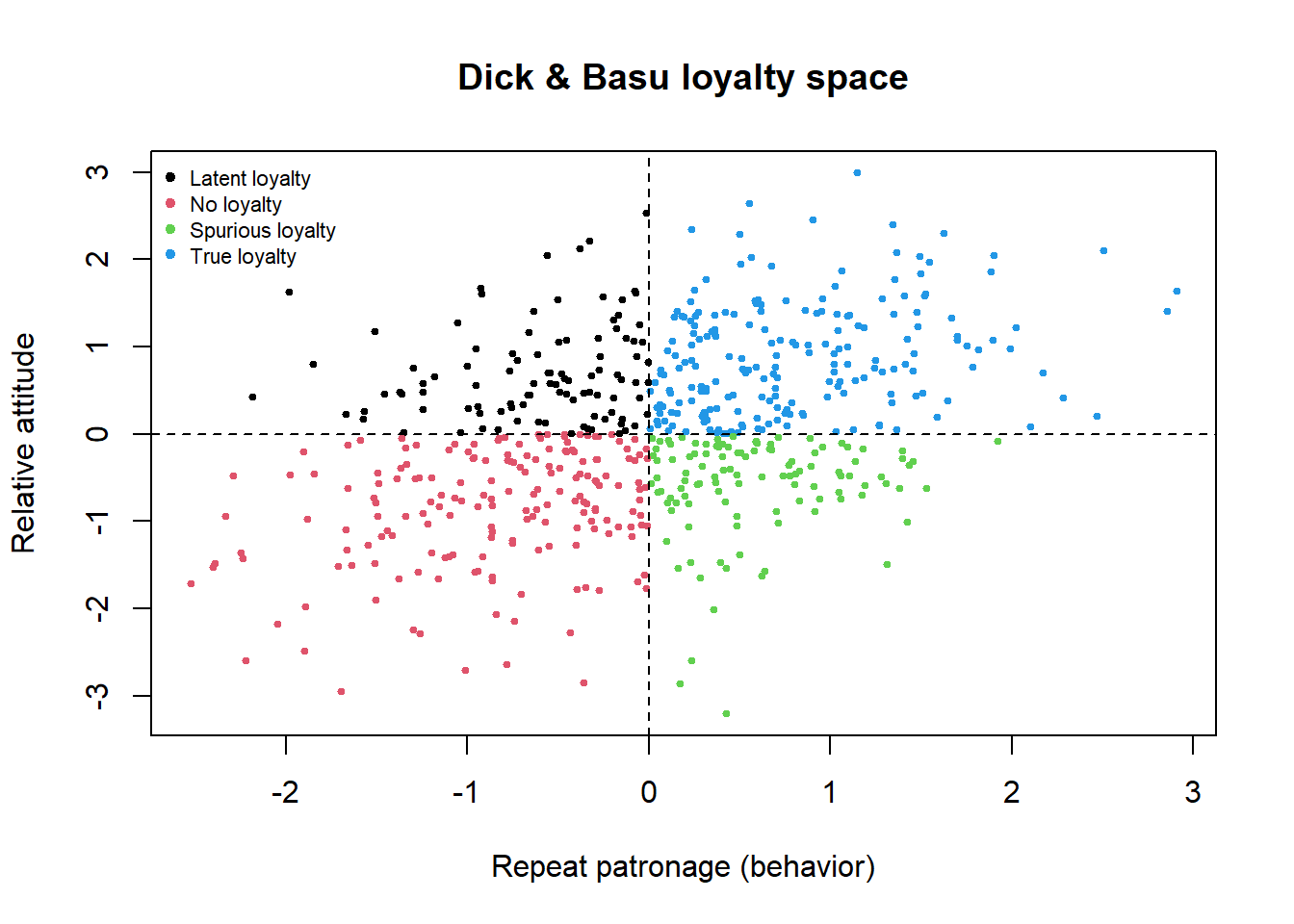
A sizeable share of the repeat buyers turn out to be spurious loyals—high behavior, low attitude—who would be invisible to a churn model trained on transactions alone. That is the empirical cost of treating a convenient behavioral metric as if it were the construct.
5.6 Relationship Quality: A Higher-Order Construct
Trust, commitment, and satisfaction co-vary so strongly in relational settings that a literature treats them as facets of a single higher-order construct, relationship quality—the overall strength of a relationship, of which the three are reflective sub-dimensions (Hennig-Thurau, Gwinner, and Gremler 2002; Garbarino and Johnson 1999). Garbarino and Johnson (1999) show the facets are not interchangeable across customer types: for low-relational customers, overall satisfaction drives future intentions, whereas for high-relational customers, trust and commitment carry the predictive load. This is a moderation result with a measurement moral—the same battery of items maps onto behavior differently depending on relationship stage, so a model that imposes one structure on a mixed customer base will fit neither segment well.
The second-order structure is itself a testable measurement model. The chunk fits a second-order CFA in which a single relationship-quality factor explains the covariation among first-order trust, commitment, and satisfaction factors, each with its own reflective indicators—the construct-validity machinery of Chapter 3 applied to a relational battery.
Code
set.seed(4040)
n <- 700

# One second-order factor RQ drives three first-order factors,
# each measured by three reflective items.
RQ   <- rnorm(n)
trust  <- 0.80 * RQ + rnorm(n, sd = 0.6)
commit <- 0.75 * RQ + rnorm(n, sd = 0.6)
satis  <- 0.70 * RQ + rnorm(n, sd = 0.6)

mk <- function(eta, lam = c(0.85, 0.80, 0.74))
  sapply(lam, function(l) l * scale(eta) + rnorm(length(eta), sd = sqrt(1 - l^2)))
rq_dat <- data.frame(
  setNames(as.data.frame(mk(trust)),  paste0("tr", 1:3)),
  setNames(as.data.frame(mk(commit)), paste0("co", 1:3)),
  setNames(as.data.frame(mk(satis)),  paste0("sa", 1:3))
)

if (have_lavaan) {
  rq_mod <- "
    TR =~ tr1 + tr2 + tr3
    CO =~ co1 + co2 + co3
    SA =~ sa1 + sa2 + sa3
    RQ =~ TR + CO + SA          # second-order relationship-quality factor
  "
  fit <- lavaan::cfa(rq_mod, data = rq_dat, std.lv = TRUE)
  pe  <- lavaan::parameterEstimates(fit, standardized = TRUE)
  cat("Second-order loadings (RQ -> facets):\n")
  print(pe[pe$op == "=~" & pe$lhs == "RQ", c("rhs", "std.all")], row.names = FALSE)
  fm <- lavaan::fitMeasures(fit, c("cfi", "rmsea", "srmr"))
  cat(sprintf("\nFit: CFI=%.3f  RMSEA=%.3f  SRMR=%.3f\n", fm[1], fm[2], fm[3]))
} else {
  cat("lavaan unavailable; skipping relationship-quality CFA.\n")
}
#> Second-order loadings (RQ -> facets):
#>  rhs std.all
#>   TR   0.794
#>   CO   0.786
#>   SA   0.765
#>
#> Fit: CFI=0.999  RMSEA=0.013  SRMR=0.018
When the second-order loadings are high and the model fits, relationship quality is defensible as a single construct; when a facet loads weakly, the data are saying that facet carries relationship-specific information the umbrella construct discards—the same reflective/formative judgment call of Table 3.1, now at the level of whether three constructs are one.
5.7 Consequences and Antecedents: The Meta-Analytic Evidence
Because the relational constructs have been measured in hundreds of studies, the most authoritative statements about them are meta-analytic. Palmatier et al. (2006) synthesize the relationship-marketing literature and deliver several findings that discipline the individual-study noise:
- Commitment and trust are the central mediators, but they do not mediate equally: relational antecedents that build trust and commitment translate into performance, and objective relationship outcomes (e.g., exchange performance) are predicted better by some constructs than the seller’s financial performance is.
- Relationship investments and relationship benefits are among the strongest antecedents, consistent with the social-exchange logic of Section 5.1.
- The constructs’ effects are stronger in service than in product contexts and in channel/B2B than in consumer settings, because relational governance matters most where exchange is ongoing, customized, and hard to contract on completely.
Palmatier, Dant, and Grewal (2007) push further by pitting theoretical perspectives against one another longitudinally, and Palmatier et al. (2013) add a dynamic construct—relationship velocity, the rate and direction of change in relationship quality—showing that the trajectory of a relationship predicts performance beyond its current level, so two relationships of equal present quality diverge in value depending on whether they are improving or decaying. On the outcome side, Verhoef, Franses, and Hoekstra (2002) link relational constructs to customer referrals and cross-buying, and Watson et al. (2015) review how loyalty is built, measured, and—crucially—monetized, integrating the attitudinal/behavioral distinction with the customer-lifetime-value machinery of Chapter 15. Chaudhuri and Holbrook (2001) close the loop to brand outcomes: brand trust and brand affect drive both purchase and attitudinal loyalty, and through them market-share and relative-price outcomes, tying the relational constructs of this chapter to the brand constructs of Chapter 11.
5.8 Disciplining Findings
As with satisfaction (Chapter 4), the relational constructs invite a naive maximization that the evidence does not support. Three findings discipline it.
First, loyalty is not automatically profitable. The presumption that loyal customers cost less to serve, pay more, and spread favorable word of mouth holds only conditionally; Watson et al. (2015) and the broader loyalty literature document that behavioral loyalty unaccompanied by attitudinal loyalty (the spurious cell of Table 5.1) often reflects captivity rather than preference and carries little of loyalty’s promised margin. Managing the behavioral metric without the attitude can buy retention that does not pay.
Second, the satisfaction–loyalty link is asymmetric and nonlinear. Oliver’s phase model (Section 5.5.1) and the delight research of Oliver, Rust, and Varki (1997) imply that satisfaction must be carried through successive phases to yield action loyalty, and that merely meeting expectations secures far less loyalty than exceeding them into delight—while dissatisfaction destroys loyalty faster than satisfaction builds it, echoing the loss-aversion asymmetry priced by markets in Chapter 4.
Third, relationships have a dark side. The same idiosyncratic investments and pledges that build commitment (Anderson and Weitz 1992; Gundlach, Achrol, and Mentzer 1995) also create lock-in, complacency, and vulnerability to opportunism; Aaker, Fournier, and Brasel (2004) show that strong consumer–brand relationships make transgressions more damaging, not less, because a trusted partner’s betrayal violates a stronger expectation. Commitment, in other words, raises the stakes of Equation 5.1: the deeper the relationship, the larger the loss \(L\) a betrayal inflicts, and the more a single failure can cost. Relationship strength is an asset that is also a hostage.
5.8.1 Whose Loyalty? Political Extremism After the Purchase
The three findings above discipline the relationship. A further one disciplines the customer, by asking which customers supply loyalty in the first place and on what terms. Marketing research on political identity has mostly asked how consumers on the left differ from consumers on the right, the ideological asymmetry behind results such as the congruent-appeal effect of Kidwell, Farmer, and Hardesty (2013). Morgeson et al. (2026) argue that this captures only one dimension of polarization. The other is political extremism: how far a consumer sits from the center of the ideological spectrum, in either direction. Their question is how consumers near either end differ in post-purchase decisions from consumers whose political identities are weaker or moderate.
The answer has two faces. Politically extreme consumers show a stronger likelihood of repurchasing from the brand they chose, which may let them derive the benefits associated with committing to a brand. They are also less sensitive to that brand’s price increases, even when viable alternatives exist, which raises the risk that they overpay and undermines their financial well-being. Both effects are driven by a belief that one’s own consumption choices are superior, and both depend on where a threat to the relationship comes from (Figure 5.2). Threats from the consumption domain, such as a product or service failure by the focal brand or a new product launch by a competitor, make the effects more pronounced. Threats from the political domain, such as a political misalignment between the customer and the focal brand or a political alignment between the customer and a competitor, weaken them. (Only the published abstract was accessible when this section was written; the design details below come from the dissertation version, so the published measures may differ.)
flowchart LR
  EXT["Political extremism:<br/>distance from the center,<br/>left or right"] --> BS["Belief that one's own<br/>consumption choices<br/>are superior"]
  BS --> OUT["Higher repurchase likelihood<br/>and lower sensitivity to the<br/>brand's price increases"]
  CT["Consumption-domain threats:<br/>focal-brand failure,<br/>competitor product launch"] -.->|"amplify"| OUT
  PT["Political-domain threats:<br/>misalignment with the brand,<br/>alignment with a competitor"] -.->|"weaken"| OUT
Three lessons follow for relationship marketing. First, loyalty that is attitudinal is not thereby good for the customer. A conviction that one’s choice is superior is an attitude rather than inertia, so this loyalty does not belong in the spurious cell of Table 5.1. Yet its price-insensitive side can work against the customer, because the margin a firm earns from tolerant repurchasers can come out of their financial well-being. The firm-side caution that loyalty is profitable only conditionally has a customer-side counterpart: loyalty serves the customer only conditionally. Second, resilience depends on the domain of the threat. Aaker, Fournier, and Brasel (2004) find that a transgression hurts a strong relationship more. For politically extreme customers, a consumption-domain failure instead widens the gap between them and moderates, while a political signal narrows it. A segment that cushions the brand against failures and competitive entry is therefore exposed to the one threat a brand can create for itself, a public political stance of the kind traced in Chapter 12. Third, the driver sits with the customer rather than the relationship. Political extremism is not a relationship benefit, a termination cost, or a shared value in the sense of Morgan and Hunt (1994), so a loyalty model that conditions only on relationship-level antecedents leaves this driver in the error term.
The measurement lesson concerns the variable rather than the construct. Political identity usually enters marketing data as a single left–right item, such as a seven-point party-identification or ideology scale, and that item carries two constructs: direction and distance from the center. Entered as a linear score, it recovers direction only. If extreme customers on both sides repurchase more, the two tails largely cancel in the slope, and a coefficient near zero would be read as politics not mattering for loyalty when the operative variable was never constructed. Separating the two requires an explicit transformation, such as the absolute distance of a response from the scale midpoint, entered alongside the centered direction score. This is the construct-to-variable step of Chapter 3, applied to an attribute that customer files often treat as already measured. It also sets a floor on what must be collected: a file that holds only an inferred party label or an area-level vote share cannot recover an individual customer’s extremity.
The article grew out of a dissertation (Sharma 2024) that framed the same construct as political intensity and studied repurchase likelihood and likelihood to recommend, not price sensitivity. Its field study shows what such a measure looks like in a real customer file. It linked American Customer Satisfaction Index respondents who had answered both a brand survey and a federal-government survey that records party identification, yielding 22,489 customer observations of 131 brands in airlines, retail, internet service, and insurance between 2016 and 2021. Intensity was the absolute distance of the seven-point party-identification response (strong Democrat to strong Republican) from its midpoint, with the centered direction score kept as a control. Competitor threat came from a text-based measure of how much competitors’ products change relative to the focal brand’s, drawn from 10-K filings, and failure was proxied by whether the customer had recently complained. Eight experiments then manipulated intensity, competitor price promotions, service failure, and brand political activism.
5.9 Delegated Exchange: Relational Constructs When Both Sides Send Agents
Every construct above assumes that the two parties to the relationship are also the two parties to the exchange. Once a customer delegates search, comparison, negotiation, and purchase to an AI agent, and the firm answers with an agent of its own, the assumption fails. Pattabhiramaiah et al. (2026) name the resulting structure B2A2C—business to agent to customer—a triadic exchange in which firms and their agents transact directly with customers and theirs. Three features separate it from the dyad this chapter has described: delegation, so the principal is no longer the actor; multiplicity, since both sides run many agents and many delegations at once; and infrastructural mediation, since the exchange runs over protocols and platforms neither party controls.
The paper is conceptual—a framework and eight propositions, not an estimated model—and its contribution is a claim about which existing theory the structure breaks. Relationship marketing in the Morgan and Hunt (1994) line (Section 5.4) theorizes exchange as direct firm–customer interaction; principal–agent theory, the salesforce-control lens of Section 14.1, theorizes a single agent to be aligned by a contract. B2A2C is neither, because both sides delegate to learning agents that have to be governed jointly. To fill the gap the authors propose CARMA—customer-agent relationship marketing—built on five interdependent mechanisms (calibration, accountability, reciprocity, mediation, adaptivity), and close with six KPIs and a readiness assessment for firms judging whether their stack can support agentic exchange at all.
Two of the propositions bear directly on the constructs developed here.
First, trust becomes an ex-ante condition rather than an accumulated residue. The relational turn (Section 5.1) makes trust the psychological deposit left by a history of exchanges whose outcomes repeatedly cleared the comparison level. A delegating customer must instead extend trust before the exchange, and to a different object: not the firm but the agent, and derivatively the protocol the agent transacts over. The stake-dependent threshold of Equation 5.1 still organizes the decision, but the confidence weighed against it is confidence in a delegate’s competence and alignment, and the loss \(L\) now includes actions the principal never authorized.
Second, loyalty may be produced by protocol design rather than by attitude. If a customer’s agent re-purchases because a firm’s interface is machine-readable, exposes terms and inventory cleanly, and answers queries reliably, the resulting repeat patronage is behavioral loyalty with no attitudinal correlate at all—the spurious cell of Table 5.1, reached through infrastructure rather than through inertia or captivity. That is a measurement problem before it is a strategy problem: an instrument that asks a human about attitude toward the brand will not detect it, and a behavioral metric will score it as strength.
The honest caveat is that this is an agenda rather than evidence. The propositions are untested and the constructs—calibration, machine-readable reciprocity, agentic alignment—have no validated measures yet, which is exactly the condition Chapter 3 warns against: a vocabulary running ahead of its instruments. What the framework does supply is a specification of whose trust and whose commitment a study must measure once neither party is transacting for itself, which is the question every dyadic instrument in this chapter silently assumes away.
5.10 Connections
The relational constructs sit at the center of the book’s construct map. Their measurement is the reflective-construct theory of Chapter 3; their upstream driver is the satisfaction of Chapter 4; their monetization is the customer-lifetime-value and loyalty-program material of Chapter 15; and their brand-level expression—brand trust, brand attachment, brand love—is developed among the brand-and-self constructs and in Chapter 11. The KMV mediation logic also recurs whenever a marketing input is theorized to work through a psychological state rather than on behavior directly, which is most of the time.
5.11 Key Takeaways
- The relational turn (Dwyer, Schurr, and Oh 1987) relocated marketing’s object of study from the discrete transaction to the ongoing relationship, making trust, commitment, and loyalty the central intangibles—latent constructs measured reflectively, inheriting every reliability and validity concern of Chapter 3.
- Trust is a two-dimensional belief—credibility (competence) and benevolence (motive)—and a willingness to rely distinct from the belief itself (Moorman, Zaltman, and Deshpandé 1992; Moorman, Deshpandé, and Zaltman 1993); it supports reliance only when confidence clears a stake-dependent threshold (Equation 5.1).
- Commitment is multi-component—affective, calculative, temporal (Gundlach, Achrol, and Mentzer 1995)—and is revealed by credible, costly pledges rather than stated intent (Anderson and Weitz 1992); affective and calculative commitment have sharply different downstream behavior.
- The commitment–trust (KMV) theory (Morgan and Hunt 1994) establishes trust and commitment as the key mediating variables between relational antecedents and outcomes; the model is a latent-variable SEM (Section 5.4.1), and omitting the mediators mis-specifies the mechanism.
- Loyalty is the conjunction of favorable relative attitude and repeat patronage (Dick and Basu 1994), developing through cognitive → affective → conative → action phases (Oliver 1999); behavior-only measures cannot separate true from spurious loyalty (Table 5.1).
- Meta-analytic evidence makes commitment and trust the central mediators, strongest in service and B2B settings (Palmatier et al. 2006), with relationship velocity adding a dynamic dimension (Palmatier et al. 2013) and loyalty monetized through CLV (Watson et al. 2015; Verhoef, Franses, and Hoekstra 2002; Chaudhuri and Holbrook 2001).
- Disciplining findings: loyalty is profitable only conditionally, the satisfaction–loyalty link is asymmetric and nonlinear (Oliver, Rust, and Varki 1997), and strong relationships amplify the damage of betrayal (Aaker, Fournier, and Brasel 2004)—commitment raises the stakes of trust, not just its rewards.
- Who is loyal matters alongside how loyalty is built. Politically extreme customers on both the left and the right repurchase more and resist their brand’s price increases more than moderates, through a belief that their choices are superior; consumption-domain threats amplify this and political-domain threats weaken it (Morgeson et al. 2026) (Section 5.8.1). Political identity therefore enters marketing data as two variables, direction and extremity, and a linear left–right score recovers only the first.
- When both sides delegate to AI agents, the dyad these constructs describe becomes a triad. Pattabhiramaiah et al. (2026)’s B2A2C framework and its CARMA mechanisms (calibration, accountability, reciprocity, mediation, adaptivity) imply that trust shifts from accumulated residue to an ex-ante condition extended to a delegate and a protocol, and that loyalty can be manufactured by machine-readable infrastructure with no attitudinal correlate—behaviorally indistinguishable from the spurious cell of Table 5.1 (Section 5.9). The propositions are untested and the constructs unmeasured, which is the warning of Chapter 3, not a finding.
5.12 Further Reading
The foundational relational-turn statement is Dwyer, Schurr, and Oh (1987); the trust conceptualization is Moorman, Zaltman, and Deshpandé (1992) and Moorman, Deshpandé, and Zaltman (1993), and the commitment structure is Gundlach, Achrol, and Mentzer (1995) with Anderson and Weitz (1992) on pledges. The canonical synthesis is the commitment–trust theory of Morgan and Hunt (1994), extended longitudinally by Palmatier, Dant, and Grewal (2007) and dynamically by Palmatier et al. (2013). On loyalty, read Dick and Basu (1994) for the typology and Oliver (1999) for the phase model, with Watson et al. (2015) for the modern measurement-and-monetization integration. The meta-analytic anchor is Palmatier et al. (2006); the customer-type moderation is Garbarino and Johnson (1999); the relational-benefits and relationship-quality integration is Hennig-Thurau, Gwinner, and Gremler (2002); and the consumer–brand-relationship and dark-side strands run through Fournier (1998) and Aaker, Fournier, and Brasel (2004) into Chapter 11.
Aaker, Jennifer, Susan Fournier, and S. Adam Brasel. 2004. “When Good Brands Do Bad.” Journal of Consumer Research 31 (1): 1–16. https://doi.org/10.1086/383419.
Anderson, Erin, and Barton Weitz. 1992. “The Use of Pledges to Build and Sustain Commitment in Distribution Channels.” Journal of Marketing Research 29 (1): 18–34. https://doi.org/10.1177/002224379202900103.
Chaudhuri, Arjun, and Morris B. Holbrook. 2001. “The Chain of Effects from Brand Trust and Brand Affect to Brand Performance: The Role of Brand Loyalty.” Journal of Marketing 65 (2): 81–93. https://doi.org/10.1509/jmkg.65.2.81.18255.
Dick, Alan S., and Kunal Basu. 1994. “Customer Loyalty: Toward an Integrated Conceptual Framework.” Journal of the Academy of Marketing Science 22 (2): 99–113. https://doi.org/10.1177/0092070394222001.
Dwyer, F. Robert, Paul H. Schurr, and Sejo Oh. 1987. “Developing Buyer-Seller Relationships.” Journal of Marketing 51 (2): 11–27. https://doi.org/10.1177/002224298705100202.
Fournier, Susan. 1998. “Consumers and Their Brands: Developing Relationship Theory in Consumer Research.” Journal of Consumer Research 24 (4): 343–53. https://doi.org/10.1086/209515.
Garbarino, Ellen, and Mark S. Johnson. 1999. “The Different Roles of Satisfaction, Trust, and Commitment in Customer Relationships.” Journal of Marketing 63 (2): 70–87. https://doi.org/10.1177/002224299906300205.
Gundlach, Gregory T., Ravi S. Achrol, and John T. Mentzer. 1995. “The Structure of Commitment in Exchange.” Journal of Marketing 59 (1): 78–92. https://doi.org/10.1177/002224299505900107.
Hennig-Thurau, Thorsten, Kevin P. Gwinner, and Dwayne D. Gremler. 2002. “Understanding Relationship Marketing Outcomes: An Integration of Relational Benefits and Relationship Quality.” Journal of Service Research 4 (3): 230–47. https://doi.org/10.1177/1094670502004003006.
Kidwell, Blair, Adam Farmer, and David M. Hardesty. 2013. “Getting Liberals and Conservatives to Go Green: Political Ideology and Congruent Appeals.” Journal of Consumer Research 40 (2): 350–67. https://doi.org/10.1086/670610.
Moorman, Christine, Rohit Deshpandé, and Gerald Zaltman. 1993. “Factors Affecting Trust in Market Research Relationships.” Journal of Marketing 57 (1): 81–101. https://doi.org/10.1177/002224299305700106.
Moorman, Christine, Gerald Zaltman, and Rohit Deshpandé. 1992. “Relationships Between Providers and Users of Market Research: The Dynamics of Trust Within and Between Organizations.” Journal of Marketing Research 29 (3): 314–28. https://doi.org/10.1177/002224379202900303.
Morgan, Robert M., and Shelby D. Hunt. 1994. “The Commitment-Trust Theory of Relationship Marketing.” Journal of Marketing 58 (3): 20–38. https://doi.org/10.1177/002224299405800302.
Morgeson, Forrest V., Udit Sharma, Yuyuan (Hana) Pan, G. Tomas M. Hult, Ayalla A. Ruvio, and Shana L. Redd. 2026. “Political Extremism and Post-Purchase Customer–Brand Relationships.” Journal of Marketing. https://doi.org/10.1177/00222429261492328.
Oliver, Richard L. 1999. “Whence Consumer Loyalty?” Journal of Marketing 63 (4_suppl1): 33–44. https://doi.org/10.1177/00222429990634s105.
Oliver, Richard L., Roland T. Rust, and Sajeev Varki. 1997. “Customer Delight: Foundations, Findings, and Managerial Insight.” Journal of Retailing 73 (3): 311–36. https://doi.org/10.1016/S0022-4359(97)90021-X.
Palmatier, Robert W., Rajiv P. Dant, and Dhruv Grewal. 2007. “A Comparative Longitudinal Analysis of Theoretical Perspectives of Interorganizational Relationship Performance.” Journal of Marketing 71 (4): 172–94. https://doi.org/10.1509/jmkg.71.4.172.
Palmatier, Robert W., Rajiv P. Dant, Dhruv Grewal, and Kenneth R. Evans. 2006. “Factors Influencing the Effectiveness of Relationship Marketing: A Meta-Analysis.” Journal of Marketing 70 (4): 136–53. https://doi.org/10.1509/jmkg.70.4.136.
Palmatier, Robert W., Mark B. Houston, Rajiv P. Dant, and Dhruv Grewal. 2013. “Relationship Velocity: Toward a Theory of Relationship Dynamics.” Journal of Marketing 77 (1): 13–30. https://doi.org/10.1509/jm.11.0219.
Pattabhiramaiah, Adithya, Martin Mende, Huachao Gao, and Shrihari Sridhar. 2026. “Agentic AI and the New Architecture of Marketing Relationships.” Journal of Marketing. https://doi.org/10.1177/00222429261481116.
Rosseel, Yves. 2012. “Lavaan: An R Package for Structural Equation Modeling.” Journal of Statistical Software 48 (2): 1–36. https://doi.org/10.18637/jss.v048.i02.
Sharma, Udit. 2024. “Political Intensity, Customer Loyalty, and Brand Advocacy: A Novel Perspective on Political Polarization with Strategic Implications.” PhD thesis, Michigan State University. https://doi.org/10.25335/5850-wj34.
Verhoef, Peter C., Philip Hans Franses, and Janny C. Hoekstra. 2002. “The Effect of Relational Constructs on Customer Referrals and Number of Services Purchased from a Multiservice Provider: Does Age of Relationship Matter?” Journal of the Academy of Marketing Science 30 (3): 202–16. https://doi.org/10.1177/0092070302303002.
Watson, George F., Joshua T. Beck, Conor M. Henderson, and Robert W. Palmatier. 2015. “Building, Measuring, and Profiting from Customer Loyalty.” Journal of the Academy of Marketing Science 43 (6): 790–825. https://doi.org/10.1007/s11747-015-0439-4.